- 556 pages
- English
- ePUB (mobile friendly)
- Available on iOS & Android
eBook - ePub
About this book
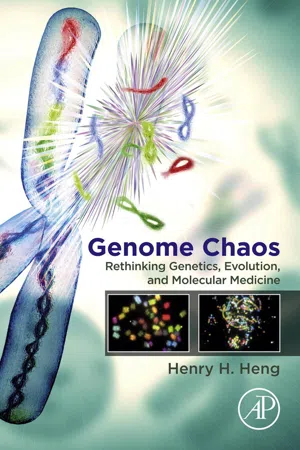
Genome Chaos: Rethinking Genetics, Evolution, and Molecular Medicine transports readers from Mendelian Genetics to 4D-genomics, building a case for genes and genomes as distinct biological entities, and positing that the genome, rather than individual genes, defines system inheritance and represents a clear unit of selection for macro-evolution. In authoring this thought-provoking text, Dr. Heng invigorates fresh discussions in genome theory and helps readers reevaluate their current understanding of human genetics, evolution, and new pathways for advancing molecular and precision medicine.
- Bridges basic research and clinical application and provides a foundation for re-examining the results of large-scale omics studies and advancing molecular medicine
- Gathers the most pressing questions in genomic and cytogenomic research
- Offers alternative explanations to timely puzzles in the field
- Contains eight evidence-based chapters that discuss 4d-genomics, genes and genomes as distinct biological entities, genome chaos and macro-cellular evolution, evolutionary cytogenetics and cancer, chromosomal coding and fuzzy inheritance, and more
Information
Topic
MedicineSubtopic
Genetics in MedicineChapter 1
From Mendelian Genetics to 4D Genomics
Abstract
The gene frames much of modern genetics by acting as an independent unit of genetic information. The gene-defined genotype–phenotype relationship has been demonstrated by classical studies linking genes to specific genetic traits and Mendelian diseases. However, it is now apparent that most genetic traits cannot be explained by single genes or even a combination of many. Genomics was positioned to solve this challenge by searching for more genetic variants and quantitatively illustrating their combinatorial mechanisms. Although this approach appears promising to many, genomics has failed to identify common mechanisms of most complex traits. Where then do genetics and genomics fall short? A review of the field reveals that most genes do not, in reality, have independent functions, leading to a great deal of confusion about the role of genes in determining the phenotype. One could say that Mendel’s original pea experiments, which formed the foundation of modern genetics, should have already generated such confusion upon close analysis. In this chapter, the transition from genetics to genomics is briefly reviewed, as reflected by how the concept of the gene has changed during the genomics era. The initial enthusiasm and subsequent disappointment of the Human Genome Project is addressed, as well as the lack of fundamental progress despite overwhelming data accumulation, which slows down bio-industry and medicine. This journey has now brought us to an urgent need for a new biological paradigm, which focuses on genome and evolution-based genomics and incorporates both emergent properties and cytogenetic organization.
Keywords
4-D Genomics; Genetic determinism; Human Genome Project; Limitations of gene; Reevaluating Mendelian genetics
1.1. Summary
The gene frames much of modern genetics by acting as an independent unit of genetic information. The gene-defined genotype–phenotype relationship has been demonstrated by classical studies linking genes to specific genetic traits and Mendelian diseases. However, it is now apparent that most genetic traits cannot be explained by single genes or even a combination of many. Genomics was positioned to solve this challenge by searching for more genetic variants and quantitatively illustrating their combinatorial mechanisms. Although this approach appears promising to many, genomics has failed to identify common mechanisms of most complex traits. Where then do genetics and genomics fall short? A review of the field reveals that most genes do not, in reality, have independent functions, leading to a great deal of confusion about the role of genes in determining the phenotype. One could say that Mendel’s original pea experiments, which formed the foundation of modern genetics, should have already generated such confusion upon close analysis. In this chapter, the transition from genetics to genomics is briefly reviewed, as reflected by how the concept of the gene has changed during the genomics era. The initial enthusiasm and subsequent disappointment of the Human Genome Project is addressed, as well as the lack of fundamental progress despite overwhelming data accumulation, which slows down bio-industry and medicine. This journey has now brought us to an urgent need for a new biological paradigm, which focuses on genome and evolution-based genomics and incorporates both emergent properties and cytogenetic organization.
1.2. The Emergence of Genomics
“Genetics” had already come a long way when British botanist William Bateson coined the term at the first International Congress on Genetics in 1906 to describe a new science that explored heredity and variation as initiated by Mendel's (1866) publication of heredity in peas (Mendel, 1866). In the past 150 years, to understand the mechanism of Mendelian inheritance, researchers have zoomed in from the nucleus to chromosomes, from chromosomes to genes, and then from genes to DNA motifs. Such reductionist analyses have triumphed, leading to our understanding of the physical and chemical properties and structure of the gene, the mechanism of gene coding RNAs and proteins, the various models of gene regulation, protein modifications/degradation, macromolecule assembly, and the link between gene mutations and phenotypic variants, including many human diseases. We also understand how to identify and manipulate specific genes and apply this knowledge to produce genetically modified foods and improve human health through molecular medicine.
The introduction of the double-helix model of DNA in 1953 and recombinant DNA technology in 1972 changed genetics forever (Watson and Crick, 1953a; Jackson et al., 1972). Molecular genetics has become the go-to field for new generations of biologists. Many bio-disciplines that were not gene-based withered. Moreover, the power of the gene has become a cultural phenomenon by capturing the general population's imagination, thanks to many popular ideas. Richard Dawkins's The Selfish Gene marked the onset of the gene-era hype in which everything was apparently controlled by genes—from individual proteins to specific biological traits and from evolutionary history to current health and behavior (Dawkins, 1976). This mode of thought assumed that all biological systems, including humans, serve the gene masters. We are merely the unwitting vehicles of genes. Genes are dominant, powerful, selfish, and mysterious. Such gene-centric concepts have shaped modern biology, generating a great deal of excitement and expectation within science, medicine, bio-industry, and society in general. If only the path of future genetics was as clear and simple as just following the gene!
1.2.1. A Brief History of Genomics
Naturally, the ultimate goal of human genetics became hunting down all “disease genes” by molecular cloning and then correcting them by genetic manipulation such as gene therapy or eliminating them through prenatal screening. Suddenly, gene-based molecular genetics became the flagship of science, and the success of identifying gene defects responsible for human diseases further validated gene-based genetic approaches. Positional cloning initiated an exciting wave of gene hunting. Following the first gene cloning success in 1986 for X-linked chronic granulomatous diseases by Harvard Medical School's Stuart Orkin, gene after gene associated with many important disorders have been cloned, including Duchenne muscular dystrophy (cloned by Louis Kunkel at Boston Children's Hospital and Ronald Worton from the Hospital for Sick Children in Toronto), cystic fibrosis (cloned by Lap-Chee Tsui from the Hospital for Sick Children in Toronto in cooperation with Francis Collins from the University of Michigan), Huntington disease, adult polycystic kidney disease, certain forms of colorectal cancer, and breast cancer. By 1995, about 50 inherited disease genes had been identified, highlighting the triumphant era of human molecular genetics (Collins, 1995).
Interestingly, even before the gene hunting movement reached its peak in the late 80s to early 90s, there were increasing concerns about the gene-centric reductionist approach, which lead to calls for genome-based research, notably by Barbara McClintock and a number of evolutionary biologists and scientists who questioned genetic determinism. McClintock, the Nobel laureate who greatly recognized the importance of the genome in biology, specifically emphasized this in her 1983 Nobel Prize acceptance lecture at the Karolinska Institute in Stockholm.
In the future, attention undoubtedly will be centered on the genome, with greater appreciation of its significance as a highly sensitive organ of the cell that monitors genomic activities and corrects common errors, senses unusual and unexpected events and response to them, often by restructuring the genome. We know about the components of genomes that could be made available for such restructuring. We know nothing, however, about how the cell senses danger and instigates response to it that often are truly remarkable.
McClintock, 1984
It gradually became obvious that most genes do not have dominant phenotypes that display high penetration in populations. Researchers also realized that even though it is possible to identify specific gene mutations in many single-gene Mendelian diseases, this success might not be transferable to many common and complex diseases because of the large number of potential genes involved. Clearly, a better strategy was to search for more genes throughout the entire genome, which was the rationale to move from single-gene hunting to whole genome searches. For many, the advantage of focusing on the genome was merely to include more genes.
In the mid-80s, some key technologies became capable of analyzing more genes, such as DNA panels of rodent-human somatic cell hybrids for physical mapping, DNA restriction fragment length polymorphism or RFLPs as variation markers for genetic mapping, polymerase chain reaction, automated DNA sequencing, and partial sequencing or mapping of several small genomes of microbes. These methodologies and the increased use of computers for data storage and analysis served as the necessary platforms for this new frontier of genetics. Then, the “perfect storm” came.
In May 1985, Robert Sinsheimer, the Chancellor of the University of California–Santa Cruz, held a workshop there titled “Can we sequence the human genome?” Sinsheimer organized this workshop to present a stronger argument that such a project was significant and feasible following an unsuccessful attempt to extract funding from his University. Many leading researchers attended, including David Botstein, George Church, Ron Davis, Walter Gilbert, Lee Hood, and John Sulston, and they discussed potential problems, technologies, and a timeline as well as costs for the genome project. Despite the success of this workshop, Sinsheimer still failed to obtain any funding for his project. However, the meeting initiated a chain reaction (Sinsheimer, 2006).
In March 1986, new on the job and eager to establish a novel megaproject to bolster the genetic programs within the US Department of Energy (DoE), Charles DeLisi, the Director of the Office of Health and Environmental Research of the DoE, organized a conference at Santa Fe. Influenced by Sinsheimer's workshop, this meeting also sought to determine the complete sequence of the human genome and map the location of each gene. Most significantly, in addition to discussing the desirability and feasibility of implementing a Human Genome Project, this meeting was crucial to pushing the idea of a full genome sequence onto the national scientific stage and converting it into a reality. DeLisi and others were able to begin the key task of garnering support from the DoE, the Reagan administration, and Congress (DeLisi, 2008).
At the same time, Renato Dulbecco, a Nobel winner for discoveries concerning the interaction between tumor viruses and the genetic materials of the cell, published an influential editorial piece in Science urging that sequencing the entire human genome was the best way to solve the puzzles of cancer. His argument has often been used as the rationale for genome sequencing, especially in later cancer genome sequencing. Another meeting worth mentioning is the 1986 Cold Spring Harbor symposium “The Molecular Biology of Homo Sapiens” where the Human Genome Project was also debated in a “rump session” moderated by Paul Berg and Walter Gilbert. Despite the fact that there were more voices urging caution, the discussion among many molecular geneticists in attendance was essential to maturing this idea (Robertson, 1986). Also in late 1986, the National Academy of Science/National Research Council formed a committee on mapping and sequencing the human genome. Collectively, all these events led to the Human Genome Project becoming a reality. The genome research center was established in 1987 and included three National Laboratories of the Energy Department. An office of Human Genome Research at the NIH opened its doors in 1988. Finally, an international organization named the Human Genome Organization (HUGO) was established in 1988, and the rest is history.
It is interesting to ask what caused Sinsheimer to act? He says he was influenced by other “Big Science” projects outside biology.
… As Chancellor, I had been involved in the conception of several large-scale scientific enterprises–involving telescopes (the TMT project) and accelerators–which were “Big Science,” scientific projects requiring, in some instances, billions of dollars and the joint efforts of many scientists and engineers. It was thus evident to me that physicists and astronomers were not hesitant to ask for large sums of money to support programs they believed to be essential to advance their science. Biology was still very much a cottage industry, which was fine, but I wondered if we were missing some possibilities of major advances because we did not think on a large enough scale …
Sinsheimer, 2006
Similarly, why did the DoE initially play the leading role rather than the NIH? The NIH was correctly concerned about the potential shift of money away from investigator-initiated proposals to this big science project. Despite the fact that the DoE had funded studies of the biological effects of radiation for years, perhaps its historical link to some big projects like the construction of the atomic bomb in the Manhattan Project influenced the Department to undertake this gigantic project. The idea of sequencing the human genome to bolster the DoE's research program was already circulated before DeLisi's arrival. The report titled “Technologies for Detecting Heritable Mutations in Human Beings” by the Office of Technology Assessment hinted at the idea of sequencing the whole genome. A new wave of big science was coming. Nevertheless, the birth of such an enormous initiative like the Human Genome Project meant that genetics and biology would never be the same. It certainly marked the maturation of genetics and it also transformed genetics into genomics.
There are different opinions regarding the relationship between the birth of the Human Genome Project and ...
Table of contents
- Cover image
- Title page
- Table of Contents
- Copyright
- Dedication
- Preface
- Acknowledgments
- Chapter 1. From Mendelian Genetics to 4D Genomics
- Chapter 2. Genes and Genomes Represent Different Biological Entities
- Chapter 3. Genome Chaos and Macrocellular Evolution: How Evolutionary Cytogenetics Unravels the Mystery of Cancer
- Chapter 4. Chromosomal Coding and Fuzzy Inheritance: The Genomic Basis of Bio-information and Heterogeneity
- Chapter 5. Why Sex? Genome Reinterpretation Dethrones the Queen
- Chapter 6. Breaking the Genome Constraint: The Mechanism of Macroevolution
- Chapter 7. The Genome Theory: A New Framework
- Chapter 8. The Rationale and Challenges of Molecular Medicine
- Epilogue (or Why We Did What We Did)
- Bibliography
- Index
Trusted by 375,005 students
Access to over 1.5 million titles for a fair monthly price.
Study more efficiently using our study tools.
Frequently asked questions
Yes, you can cancel anytime from the Subscription tab in your account settings on the Perlego website. Your subscription will stay active until the end of your current billing period. Learn how to cancel your subscription
No, books cannot be downloaded as external files, such as PDFs, for use outside of Perlego. However, you can download books within the Perlego app for offline reading on mobile or tablet. Learn how to download books offline
Perlego offers two plans: Essential and Complete
- Essential is ideal for learners and professionals who enjoy exploring a wide range of subjects. Access the Essential Library with 800,000+ trusted titles and best-sellers across business, personal growth, and the humanities. Includes unlimited reading time and Standard Read Aloud voice.
- Complete: Perfect for advanced learners and researchers needing full, unrestricted access. Unlock 1.5M+ books across hundreds of subjects, including academic and specialized titles. The Complete Plan also includes advanced features like Premium Read Aloud and Research Assistant.
We are an online textbook subscription service, where you can get access to an entire online library for less than the price of a single book per month. With over 1.5 million books across 990+ topics, we’ve got you covered! Learn about our mission
Look out for the read-aloud symbol on your next book to see if you can listen to it. The read-aloud tool reads text aloud for you, highlighting the text as it is being read. You can pause it, speed it up and slow it down. Learn more about Read Aloud
Yes! You can use the Perlego app on both iOS and Android devices to read anytime, anywhere — even offline. Perfect for commutes or when you’re on the go.
Please note we cannot support devices running on iOS 13 and Android 7 or earlier. Learn more about using the app
Please note we cannot support devices running on iOS 13 and Android 7 or earlier. Learn more about using the app
Yes, you can access Genome Chaos by Henry H. Heng in PDF and/or ePUB format, as well as other popular books in Medicine & Genetics in Medicine. We have over 1.5 million books available in our catalogue for you to explore.