eBook - ePub
Geological Storage of Carbon Dioxide (CO2)
Geoscience, Technologies, Environmental Aspects and Legal Frameworks
- 366 pages
- English
- ePUB (mobile friendly)
- Available on iOS & Android
eBook - ePub
Geological Storage of Carbon Dioxide (CO2)
Geoscience, Technologies, Environmental Aspects and Legal Frameworks
About this book
Geological storage and sequestration of carbon dioxide, in saline aquifers, depleted oil and gas fields or unminable coal seams, represents one of the most important processes for reducing humankind's emissions of greenhouse gases. Geological storage of carbon dioxide (CO2) reviews the techniques and wider implications of carbon dioxide capture and storage (CCS).Part one provides an overview of the fundamentals of the geological storage of CO2. Chapters discuss anthropogenic climate change and the role of CCS, the modelling of storage capacity, injectivity, migration and trapping of CO2, the monitoring of geological storage of CO2, and the role of pressure in CCS. Chapters in part two move on to explore the environmental, social and regulatory aspects of CCS including CO2 leakage from geological storage facilities, risk assessment of CO2 storage complexes and public engagement in projects, and the legal framework for CCS. Finally, part three focuses on a variety of different projects and includes case studies of offshore CO2 storage at Sleipner natural gas field beneath the North Sea, the CO2CRC Otway Project in Australia, on-shore CO2 storage at the Ketzin pilot site in Germany, and the K12-B CO2 injection project in the Netherlands.Geological storage of carbon dioxide (CO2) is a comprehensive resource for geoscientists and geotechnical engineers and academics and researches interested in the field.
- Reviews the techniques and wider implications of carbon dioxide capture and storage (CCS)
- An overview of the fundamentals of the geological storage of CO2 discussing the modelling of storage capacity, injectivity, migration and trapping of CO2 among other subjects
- Explores the environmental, social and regulatory aspects of CCS including CO2 leakage from geological storage facilities, risk assessment of CO2 storage complexes and the legal framework for CCS
Information
Part I
Fundamentals of the geological storage of CO2
1
Anthropogenic climate change and the role of CO2 capture and storage (CCS)
P. Freund, Consultant, UK
Abstract:
Mitigating the effects of anthropogenic climate change will require use of a portfolio of measures – one of these is likely to be the capture and storage of CO2 as it offers a means of significantly reducing the overall cost. In this process, CO2 would be captured at large sources and then stored in geological formations. Several trends in the use of geological storage of CO2 are identified – in the near term, depleted oil and gas fields are likely to be favoured; substantial capacity will also be available in deep saline aquifers but it is likely to take longer to gain approval for their use. Other developments that affect the financial and regulatory environment for CO2 storage are also discussed in this chapter.
Key words
climate change
mitigation of climate change
CO2 emissions
CO2 capture and storage (CCS)
electricity generation
1.1 Climate change and anthropogenic emissions of CO2
The surface of the Earth is about 33 °C warmer than would otherwise be the case because of the greenhouse effect, the name given to the natural warming of the planet as a result of absorption of infra-red radiation in the atmosphere. Without the greenhouse effect, the planet would be largely uninhabitable by humans (Solomon et al, 2007).
In recent years there have been many reports of changes in the Earth’s climate – the increasing frequency of unusually warm years, rising sea levels, the melting of snow, ice and permafrost in areas normally regarded as permanently frozen. Many of these changes are now widely recognised to be the result of the enhancement of the natural greenhouse effect by increasing concentrations of carbon dioxide (CO2) and other gases, a phenomenon that was first predicted by Arrhenius more than 100 years ago (Arrhenius, 1896). These gases are the products of human activities – for example, the main causes of the rising level of CO2 in the atmosphere are the combustion of fossil fuels and deforestation (Peters et al, 2011). The concentration of CO2 reached 392 ppm in December 2011 (Tans and Keeling, 2012), compared with 320 ppm in 1965 (Keeling et al, 1976); the corresponding level before the industrial revolution would have been around 270 ppm. The contributions of the various gases to changing the greenhouse effect (more specifically, to changes in radiative forcing) over the past 250 years are illustrated in Fig. 1.1. The emissions of many of these gases continue to increase so further changes are expected.
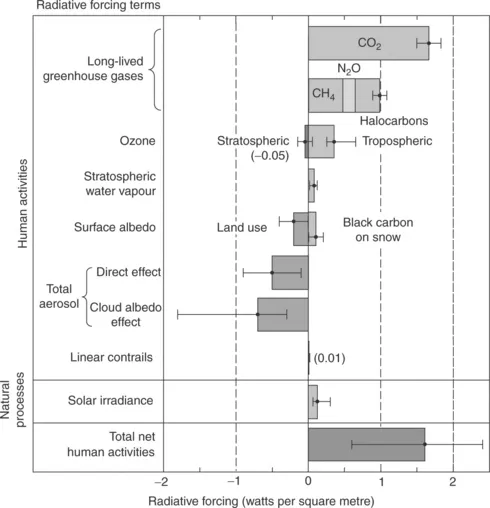
Figure 1.1 The radiative forcing of climate due to various gases emitted between 1750 and 2005. Source: Reproduced with permission from Climate Change 2007: The Physical Science Basis. Working Group I Contribution to the Fourth Assessment Report of the Intergovernmental Panel on Climate Change, FAQ 2.1, Figure 2. Cambridge University Press.
What may happen to the climate is deduced from use of complex mathematical models of the atmosphere, called Global Circulation Models, coupled with models of terrestrial ecosystems and, most importantly, with models of the oceans. With emissions continuing to grow (Boden and Blasing, 2011), these models predict that global temperatures might rise by 3-4 °C by the year 2100 but there is considerable uncertainty in this figure, not only due to uncertainty about future emissions but also due to uncertainty about the sensitivity of the climate to increasing levels of greenhouse gases. After 2100, further change is expected and the rate of change may accelerate, something that provides even more cause for concern.
In order to avoid such changes in the climate, many actions have been proposed – to give some indication of what might be involved, calculations show that, if global emissions of greenhouse gases could be reduced by about 60% by 2100 compared with 1990 levels, the global temperature might be stabilised at 2 °C above 1990 levels by 2100 (with uncertainty of + 1/–0.7 °C) (Eickhout et al, 2003). However, global emissions have increased considerably since 1990 so it is now more realistic to consider that a target of 80% cut in current emissions might be needed to achieve such stabilisation. Although these figures are not at all certain, they help to illustrate the scale of the actions required if emissions are to be controlled sufficiently to halt the change in climate. Further reduction in emissions would be needed to reverse the changes in climate.
The models of the climate are hugely complex and, as indicated, are subjected to considerable uncertainty. Using them to make predictions about the future requires extrapolation beyond the range of data that has been used to build them which must add further uncertainty to the predictions. Further insight into how the climate may be changing, and a testing of the models, can be achieved by considering the state of the climate in prehistoric times.
1.1.1 The relevance of past geological periods for understanding climate change
Looking back to earlier periods provides information on the state of the planet when global temperatures and CO2 concentrations were higher than they are now, or have been in recent history. This allows testing of the climate models over a wider range of conditions. In this way it may also be possible to understand better why the climate changed in the past, which could increase confidence in the predictions of future changes.
A prime source of information on past states of the climate is the analysis of air trapped in polar ice and of the ice itself; such measurements give information on the condition of the prehistoric atmosphere (from which temperature can also be inferred) up to 650 000 years ago (Solomon et al, 2007). Before that time, other geological data can be used but there is greater uncertainty about such ancient atmospheric conditions. Nevertheless such data are important because they can be used to test climate models in conditions outside the range of the data from the ice measurements, in particular testing a key parameter, the sensitivity of the climate to CO2, which is difficult to do in other ways.
Some understandings about the climate in the past (Jansen et al,2007) include:
• Recognition that average temperatures in the Northern Hemisphere during the second half of the twentieth century were higher than during any other 50-year period in the past 500 years. It is also likely that, in the Northern Hemisphere, the second half of the twentieth century was the warmest such period in the past 1300 years.
• The warming of the globe in the twentieth century has been about 10 times faster than any such change since the last period of maximum glaciation (21 000 years ago).
• There have been many other changes in the climate in the past, such as changes in the strength and frequency of El Nino-type events, abrupt changes in the strength of Asian monsoons, occurrence of droughts lasting for tens to hundreds of years in Africa and North America; these indicate that recent unusual events are not without precedent.
• Current atmospheric concentrations of CO2, CH4 and N2O are higher than for the past 650 000 years. Over that period, Antarctic temperatures have been closely related to atmospheric CO2 concentrations, although that does not prove which change caused what.
• In earlier periods (several million years ago) the Earth seems to have been warmer than at present. Indeed there were periods when it was mostly free of ice. The major expansion of Antarctic ice, which started around 35–40 million years ago, was likely due to declining CO2 levels from the peak in the Cretaceous era.
• Around 55 million years ago there was an abrupt warming of the planet and a large release of carbon into the atmosphere; this event lasted about 100 000 years; it is being studied now because it has some similarity with the rapid release of CO2 taking place at present.
• Going further back in time, the warmth of the Earth in the Mesozoic era (65–230 million years ago) was likely associated with high levels of atmospheric CO2. Major glaciations occurred around 300 million years ago which likely coincided with relatively low concentrations of CO2 (compared with the periods immediately before and after).
Such measurements show that the Earth’s climate can change substantially. In some periods of warming, CO2 levels have also been high but cause and effect is less clear. Nevertheless, the risk that changes due to hu...
Table of contents
- Cover image
- Title page
- Table of Contents
- Copyright
- Contributor contact details
- Woodhead Publishing Series in Energy
- Foreword
- Introduction
- Part I: Fundamentals of the geological storage of CO2
- Part II: Environmental, social and regulatory aspects
- Part III: Case studies
- Index
Trusted by 375,005 students
Access to over 1.5 million titles for a fair monthly price.
Study more efficiently using our study tools.
Frequently asked questions
Yes, you can cancel anytime from the Subscription tab in your account settings on the Perlego website. Your subscription will stay active until the end of your current billing period. Learn how to cancel your subscription
No, books cannot be downloaded as external files, such as PDFs, for use outside of Perlego. However, you can download books within the Perlego app for offline reading on mobile or tablet. Learn how to download books offline
Perlego offers two plans: Essential and Complete
- Essential is ideal for learners and professionals who enjoy exploring a wide range of subjects. Access the Essential Library with 800,000+ trusted titles and best-sellers across business, personal growth, and the humanities. Includes unlimited reading time and Standard Read Aloud voice.
- Complete: Perfect for advanced learners and researchers needing full, unrestricted access. Unlock 1.5M+ books across hundreds of subjects, including academic and specialized titles. The Complete Plan also includes advanced features like Premium Read Aloud and Research Assistant.
We are an online textbook subscription service, where you can get access to an entire online library for less than the price of a single book per month. With over 1.5 million books across 990+ topics, we’ve got you covered! Learn about our mission
Look out for the read-aloud symbol on your next book to see if you can listen to it. The read-aloud tool reads text aloud for you, highlighting the text as it is being read. You can pause it, speed it up and slow it down. Learn more about Read Aloud
Yes! You can use the Perlego app on both iOS and Android devices to read anytime, anywhere — even offline. Perfect for commutes or when you’re on the go.
Please note we cannot support devices running on iOS 13 and Android 7 or earlier. Learn more about using the app
Please note we cannot support devices running on iOS 13 and Android 7 or earlier. Learn more about using the app
Yes, you can access Geological Storage of Carbon Dioxide (CO2) by J Gluyas,S Mathias,Jon Gluyas in PDF and/or ePUB format, as well as other popular books in Technology & Engineering & Energy. We have over 1.5 million books available in our catalogue for you to explore.