- 690 pages
- English
- ePUB (mobile friendly)
- Available on iOS & Android
eBook - ePub
About this book
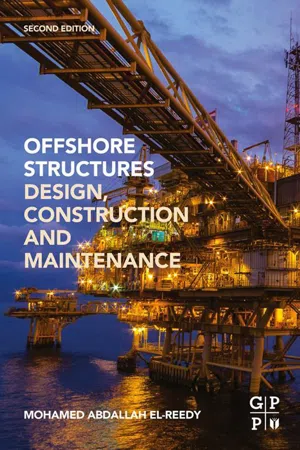
Offshore Structures: Design, Construction and Maintenance, Second Edition covers all types of offshore structures and platforms employed worldwide. As the ultimate reference for selecting, operating and maintaining offshore structures, this book provides a roadmap for designing structures which will stand up even in the harshest environments. Subsea pipeline design and installation is also covered in this edition, as is the selection of the proper type of offshore structure, the design procedure for the fixed offshore structure, nonlinear analysis (Push over) as a new technique to design and assess the existing structure, and more.
With this book in hand, engineers will have the most up-to-date methods for performing a structural lifecycle analysis, implementing maintenance plans for topsides and jackets and using non-destructive testing.
- Provides a one-stop guide to offshore structure design and analysis
- Presents easy-to-understand methods for structural lifecycle analysis
- Contains expert advice for designing offshore platforms for all types of environments
Information
1
Introduction to offshore structures
Abstract
This chapter presents an overview of oil and gas investment and different types of offshore structures, from shallow water to deep water, and other structure configurations such as floating, production, storage, and offloading and tension-leg platforms. The offshore project phase, focusing on control of the engineering from appraisal, selection, definition, and execution, is discussed in this chapter. The offshore project investment and the cost estimate corresponding to each phase of the project are also discussed. To understand the oil and gas business, the first step is to define the offshore project target and objective, and then how to provide a project which is technically matched throughout all phases with the business requirements.
Keywords
Cost estimate; FPSO; FEED; offshore structure; engineering management
1.1 Introduction
Offshore structures have special characteristics from economic and technical points of view, where offshore structure platforms are dependent on oil and gas production which directly, through the oil price, affects worldwide investment.
From a practical point of view, increasing oil prices, as happened in 2008, enable many offshore structure projects to be started.
From a technical point of view the offshore structure platform design and construction is a merger between steel structure design and harbor design, and there are a limited number of faculty engineering areas focusing on offshore structural engineering, such as the design of fixed offshore platforms, whether floating or other types. On the other hand, due to the limited number of offshore structural projects with respect to normal steel structure projects, such as residential, factories, and others, these depend on continuous research and studies over a long time period from many countries around the world.
All the major multinational companies working in the oil and gas business are interested in offshore structures research and studies.
Therefore these companies continuously support research and development to enhance the capability of engineering offices and construction contractor companies that they deal with to support their business need.
1.2 History of offshore structures
As early as 1909 or 1910 wells were being drilled in Louisiana. Wooden derricks were erected on hastily built wooden platforms constructed on top of woodpiles.
Over the past 40 years two majors categories of fixed platforms have been developed—the steel template type which was pioneered in the Gulf of Mexico (GoM) and the concrete gravity type first developed in the North Sea.
Recently a third type has been the tension-leg platform which was used due to the need to drill wells in deep water and for the development of gas projects in deep water.
In 1976 Exxon installed a platform in the Santa Barbara channel with water depth of 259 m (850 ft.).
There are three basic requirements in the design of a fixed offshore platform:
- 1. Withstand all loads expected during fabrication, transportation, and installation;
- 2. Withstand loads resulting from severe storms and earthquakes;
- 3. Function safely as a combined drilling, production, and housing facility.
Around 1950, while the developments were taking place in the GoM and Santa Barbara channel, BP was engaged in similar exploration on the coast of Abu Dhabi in the Persian Gulf.
The water depth there is less than 30 m (100 ft.) and the operation grew steadily over the years.
In the 1960s hurricanes in the GoM caused serious damage to the platform forcing a reevaluation of platform design criteria. The following hurricane history occurred in the GoM:
- • With hurricane Hilda in 1964, wave heights of 13 m and wind gusts up to 89 m/s were experienced, this once-in-100-years storm resulted in 13 platforms being destroyed;
- • The next year another storm with a 100-year recurrence probability, hurricane Betsy, destroyed three platforms and damaged many others;
- • Subsequently, designers abandoned the 25- and 50-year conditions and began designing for storm recurrence intervals of 100 years.
1.3 Overview of field development
Estimates for future oil reserves in different areas of the world, based on geological and geophysical studies and oil and gas discoveries as of January 1996, forecast that about 53% of these reserves are in the Middle East, which may be a reason for the political troubles in that part of the world. Sixty percent of all reserves are controlled by the Organization of Petroleum Exporting Countries (OPEC). This explains why OPEC and Middle East are so important for the world’s current energy needs.
Companies and countries have good assessments of the undiscovered reserves in the Middle East and the former Soviet Republics. Most researchers believe that the major land-based hydrocarbon reserves have been already discovered and most significant future discoveries are expected to be in offshore and arctic regions and other difficult to reach and produce areas of the world.
The geological research depends on studying why North America, northwest Europe, and the coastal areas of West Africa and eastern South America appear to have similar potential for deep water production. At this stage in the geological history, sediments were deposited in basins with restricted circulation, which were later converted to the super source rocks found in the coastal regions of these areas. The presence of these geological formations gives us an initial indication for the discovery of hydrocarbons.
Based on studying the reservoir characteristics, the decision has to be taken whether particular offshore areas have potential economic hydrocarbon reserves or not.
A team of geologists and geophysicists performs an assessment study of the geological formations. Then a feasibility study should be done by preparing the cost, schedule, and studying the economics by calculating the financial parameters based on the rules, laws, and concession agreements that cover production in that area.
At this stage, there are many unknowns and uncertainties of the available data, as there is no comprehensive information about the reservoir characteristics or the oil and gas prices in the future. The experts need to carry out a study and make recommendations based on their past experience for similar projects, on cost and schedule estimates based on data available to the company from their previous history. The success of the oil and gas companies depends on their expertise in these decisions, and so most of these companies keep their expertise within their company and compete with each other. Sometimes, the available data are insufficient and decisions are made as a result of brainstorming sessions attended by experts and management, and can be greatly affected by the company culture and past experience.
The following factors affecting decisions on field development:
- • Reservoir characteristics;
- • Production composition (oil, gas, water, H2S, and others);
- • Reservoir uncertainty;
- • Environment, such as water depth;
- • Regional development status;
- • Local technologies available;
- • Politics;
- • National content;
- • Partners;
- • Company culture;
- • Schedule;
- • Equipment availability;
- • Construction facilities availability;
- • Market availability;
- • Economics.
If the preliminary economic studies in the feasibility study phase are positive, the geophysicists start to generate the seismic data and evaluate them. The main information required to estimate the reserve is to obtain its depth, spread, faults, domes, and other factors, then an estimate of the recoverable reserves of hydrocarbons can be made with reasonable accuracy.
The exploratory drilling shall be started after the seismic testing provides positive results and management make the decision to go ahead.
The selection of a suitable exploration scheme depends on the location, water depth, and environmental conditions.
In the case of shallow water the best option is to use a jack-up exploratory unit. In water depths exceeding 120 m (400 ft.), ships or semisubmersible drilling units are utilized. In the case of 300 m (1000 ft.) water depths, floating drilling units are selected and provide special mooring arrangements or a system of dynamic positioning. The floating semisubmersible drilling rig is capable of operating in 900–1200 m (3000–4000 ft.) water depths
Delineation exploratory drilling work follows the discovery well.
In most cases these drilling wells number from three to six wells at the reservoir. These drilling wells carry out a test for production and provide reasonable detailed data about the size, depth, and extent of the reservoir. In addition to reservoir topography such as fault lines, impermeable layers, etc. and recoverable reserves, the viscosity which is presented by the API grade, and the fluid characteristics such as oil–water ratio and other impurities such as sulfur or other critical components, are calculated.
Reservoir information enables the geologists and...
Table of contents
- Cover image
- Title page
- Table of Contents
- Copyright
- Dedication
- About the author
- Preface
- 1. Introduction to offshore structures
- 2. Offshore structure loads and strength
- 3. Offshore structure platform design
- 4. Geotechnical data and pile design
- 5. Fabrication and installation
- 6. Corrosion protection
- 7. Assessment of existing structures and repairs
- 8. Risk-based inspection technique
- 9. Subsea pipeline design and installation
- Index
Trusted by 375,005 students
Access to over 1.5 million titles for a fair monthly price.
Study more efficiently using our study tools.
Frequently asked questions
Yes, you can cancel anytime from the Subscription tab in your account settings on the Perlego website. Your subscription will stay active until the end of your current billing period. Learn how to cancel your subscription
No, books cannot be downloaded as external files, such as PDFs, for use outside of Perlego. However, you can download books within the Perlego app for offline reading on mobile or tablet. Learn how to download books offline
Perlego offers two plans: Essential and Complete
- Essential is ideal for learners and professionals who enjoy exploring a wide range of subjects. Access the Essential Library with 800,000+ trusted titles and best-sellers across business, personal growth, and the humanities. Includes unlimited reading time and Standard Read Aloud voice.
- Complete: Perfect for advanced learners and researchers needing full, unrestricted access. Unlock 1.5M+ books across hundreds of subjects, including academic and specialized titles. The Complete Plan also includes advanced features like Premium Read Aloud and Research Assistant.
We are an online textbook subscription service, where you can get access to an entire online library for less than the price of a single book per month. With over 1.5 million books across 990+ topics, we’ve got you covered! Learn about our mission
Look out for the read-aloud symbol on your next book to see if you can listen to it. The read-aloud tool reads text aloud for you, highlighting the text as it is being read. You can pause it, speed it up and slow it down. Learn more about Read Aloud
Yes! You can use the Perlego app on both iOS and Android devices to read anytime, anywhere — even offline. Perfect for commutes or when you’re on the go.
Please note we cannot support devices running on iOS 13 and Android 7 or earlier. Learn more about using the app
Please note we cannot support devices running on iOS 13 and Android 7 or earlier. Learn more about using the app
Yes, you can access Offshore Structures by Mohamed A. El-Reedy in PDF and/or ePUB format, as well as other popular books in Technology & Engineering & Civil Engineering. We have over 1.5 million books available in our catalogue for you to explore.