eBook - ePub
High Performance Computing and the Discrete Element Model
Opportunity and Challenge
- 164 pages
- English
- ePUB (mobile friendly)
- Available on iOS & Android
eBook - ePub
About this book
This book addresses the high performance computing of the Discrete Element Model (DEM). It is a comprehensive presentation of parallel implementation of the DEM on three popular parallel computing platforms; the multi-core PC, the GPU computer, and the cluster supercomputer. Featuring accompanying MatLab source this book helps you implement the DEM model for use with high performing technology, for particular implementation of the dynamic failure of solids, granular flow and stress wave propagation through solids.- Features both Pre-processor, Solver, and Post-processor for the DEM- Covers the parallel implementation of DEM on the cluster, multi-core PC, GPU PC- Full of examples of dynamic fracturing, granular flow and stress wave propagation using high performance DEM- Source codes and data files available for hands-on practice
Tools to learn more effectively

Saving Books

Keyword Search

Annotating Text

Listen to it instead
Information
1
Serial Implementation
Abstract
In this chapter, implementation details of a serial DEM code, DICE2D, are described. The target is to provide a programming environment for further parallel implementation of the DEM. Full aspects of DEM coding are covered, such as system design, data structure design, flowchart design, algorithm design and implementation. A number of benchmark examples are designed for verification and debugging purposes.
Keywords
Constitutive model
Contact detection
Damping
Energy calculation
Particle-to-particle constitutive model
Particle-to-particle contact
Serial implementation
Simplified grid cell method
System design
Time step
Wall-to-particle constitutive model
Wall-to-particle contact
In this chapter, implementation details of a serial DEM code, DICE2D, are described. The target is to provide a programming environment for further parallel implementation of the DEM. Full aspects of DEM coding are covered, such as system design, data structure design, flowchart design, algorithm design and implementation. A number of benchmark examples are designed for verification and debugging purposes.
1.1 System design
Unlike the modern commercial DEM codes, which use the object-oriented design concept, DICE2D adopts the process-oriented design concept that is simple to understand and suitable for algorithm research. To release the workload of graphical user interface (GUI) design, MATLAB® was selected as the programming environment. It provides a number of built-in functions to display the particles and computational results. Moreover, the high interactive feature of MATLAB also makes it a good choice for algorithm development and the study of the DEM. The DEM aims to simulate the nature process; therefore, the code is named DICE2D. It is inspired from Einstein’s comment on quantum mechanics: “…God does not throw dice”. To run the code, the first step is to select a folder named DICE2D as the current work directory (Figure 1.1). Then, type “D2D(iEx)” into the command window to run the corresponding example.
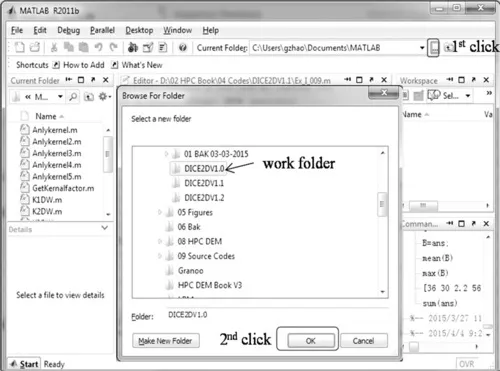
Figure 1.1 DICE2D in MATLAB
Figure 1.2 shows the work flow of DICE2D. First, the user needs to input the example ID. Then, the preprocessor will prepare the corresponding model data. The numerical model will be further processed by the DEM solver to obtain the simulation results, which will be finally processed by the postprocessor. Unlike most commercial software, in DICE2D, users must build up their own pre- and post...
Table of contents
- Cover image
- Title page
- Table of Contents
- Dedication
- Copyright
- Foreword
- Preface
- Introduction
- 1: Serial Implementation
- 2: Multi-core Implementation
- 3: GPU Implementation
- 4: DICE2D and Cluster
- Bibliography
- Index
Frequently asked questions
Yes, you can cancel anytime from the Subscription tab in your account settings on the Perlego website. Your subscription will stay active until the end of your current billing period. Learn how to cancel your subscription
No, books cannot be downloaded as external files, such as PDFs, for use outside of Perlego. However, you can download books within the Perlego app for offline reading on mobile or tablet. Learn how to download books offline
Perlego offers two plans: Essential and Complete
- Essential is ideal for learners and professionals who enjoy exploring a wide range of subjects. Access the Essential Library with 800,000+ trusted titles and best-sellers across business, personal growth, and the humanities. Includes unlimited reading time and Standard Read Aloud voice.
- Complete: Perfect for advanced learners and researchers needing full, unrestricted access. Unlock 1.4M+ books across hundreds of subjects, including academic and specialized titles. The Complete Plan also includes advanced features like Premium Read Aloud and Research Assistant.
We are an online textbook subscription service, where you can get access to an entire online library for less than the price of a single book per month. With over 1 million books across 990+ topics, we’ve got you covered! Learn about our mission
Look out for the read-aloud symbol on your next book to see if you can listen to it. The read-aloud tool reads text aloud for you, highlighting the text as it is being read. You can pause it, speed it up and slow it down. Learn more about Read Aloud
Yes! You can use the Perlego app on both iOS and Android devices to read anytime, anywhere — even offline. Perfect for commutes or when you’re on the go.
Please note we cannot support devices running on iOS 13 and Android 7 or earlier. Learn more about using the app
Please note we cannot support devices running on iOS 13 and Android 7 or earlier. Learn more about using the app
Yes, you can access High Performance Computing and the Discrete Element Model by Gao-Feng Zhao in PDF and/or ePUB format, as well as other popular books in Technology & Engineering & Materials Science. We have over one million books available in our catalogue for you to explore.