- 216 pages
- English
- ePUB (mobile friendly)
- Available on iOS & Android
eBook - ePub
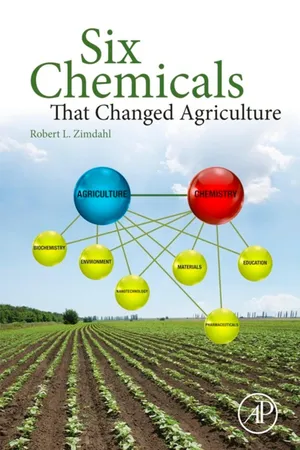
Six Chemicals That Changed Agriculture
About this book
Six Chemicals That Changed Agriculture is a scientific look at how the chemicals used in today's food production were developed, evaluated, and came to be in wide-spread use. From fertilizers to pest management, antibiotics to DNA, chemicals have transformed the way our food is grown, protected, and processed.
Agriculture is the world's most important environment interaction, the essential human activity, and an increasingly controversial activity because of its use and presumed misuse of chemistry. The major characteristics of US agriculture for at least the last six decades have been rising productivity, declining number of mid-size farms, increasing farm size, an increasing percentage of farm production on fewer, large farms, increasing dependence of chemical technology and more developmental research being done by the agricultural chemical industry rather than by independent land-grant universities. Another equally important feature of modern agriculture is wide-spread suspicion of its technology by the public. The book will recount examples of this suspicion related to specific chemicals and present the essence of the suspicion and its results.
- Offers an historical analysis of the discovery and development some aspects of the chemistry of modern agriculture
- Addresses the advantages, disadvantages, desirable and undesirable results of the use of each of the chosen chemicals and compares and contrasts the real and frequently assumed problems of their use
- Provides valuable insights into the history and application of these focused chemicals, enabling readers to apply the lessons to new agricultural chemical developments
Information
Chapter 1
Introduction
Abstract
What is chemistry? What do chemists do? How has chemistry improved our lives, caused some problems, and affected and frequently determined how our agriculture and our society have evolved and flourished. The role of chemistry in creation of the chemicals in the book is described. The characteristics of modern, developed country agriculture and the role of agricultural education and federal legislation in creating productivity of modern agriculture conclude the chapter.
Keywords
Alchemy; Chemistry; Developed countries; Education; Farms; Hatch Act; Morrill Act; Productivity; Smith–Lever ActWe live in a society exquisitely dependent on science and technology, in which hardly anyone knows anything about science and technology
Carl Sagan (Head, 2006)
Chemistry
Chemistry is a physical science that studies the composition, structure, properties, changes, and reactions of elementary forms of matter. It deals specifically with atomic and molecular systems and seeks to know what a substance is composed of, how its properties are related to its composition, and how and why one chemical may or may not react with another. Chemists are also concerned with how atoms and molecules are involved in various forms of energy and energy production. Chemists study the concepts of dynamics, energetics, structure, composition, and synthesis. Some chemical reactions produce energy; others require it. Some reactions cause changes in phases of matter, separation of mixtures, and create the properties of polymers and other complex molecules. In chemistry, as in many scientific endeavors, things are not always exactly as they seem and unexpected, sometimes serendipitous things occur.
For many, chemistry may be remembered as the subject that was most difficult in school. Difficult it may be, but chemistry dominates our lives and agriculture in many ways, most of which few of us know much about. Chemistry is involved in, explains the details of, and helps us understand the food we eat, the air we breathe, the water we drink and bathe in, the clothes we wear, our emotions, and literally every object we see or touch every day. It is the interface between and the bridge that connects the subatomic world of the physicist and the molecular world of the biologist. Chemistry has improved our lives, caused some problems, and affected, frequently has determined, how our society and our agriculture have evolved and flourished.
If we are to understand chemistry’s multiple positive and negative effects on our society and on how agriculture is practiced, we must know and learn from chemical and agricultural history. There are obstacles. In his 1959 Collected Essays, Aldous Huxley (1894–1963) admonished us “That men do not learn very much from the lessons of history is the most important lesson that history has to teach.” Henry Ford (1916) in apparent neglect of the necessity of knowing the history, the story, said “History is more or less bunk.” Ford actually said it, but seemed to have had a very shallow understanding of history and a lack of trust in the little he did understand (Lockerby, 2011). Henry David Thoreau, the careful observer of society told us, but not Mr. Ford, that there is always a story. “Wherever men have lived there is a story to be told, and it depends chiefly on the story-teller or historian whether that is interesting or not. You are simply a witness on the stand….”
The history we know is stories of the exploits of men and women that have caused change, development, or catastrophe. We tend to believe that historical events have occurred because of the direct intervention of people and for much of agricultural history that is true. People have determined the course of agricultural history. It is not all bunk, and the stories that follow verify we have learned from it. Knowing and learning from the stories of chemistry and chemists, the subjects of this book, are essential to understanding the development of the modern agricultural systems that feed the world.
Alchemy
Alchemy, a medieval science, began in pre-Pharaonic Egypt (before 3000 BC), flourished during the Hellenistic period (approximately 300 BC to the emergence of Rome 30 BC), and in twelfth-century medieval Europe (the Middle Ages: fifth to fifteenth centuries). It has remained as an interesting, influential philosophical tradition whose practitioners claimed it to be the precursor to profound powers1; that were never achieved, but it has had a direct influence on modern agriculture. Historically its defining objectives included three goals:
1. Creation of the fabled philosopher’s stone; the ability to transform base metals into the noble metals (gold and silver).
2. Discovery of a universal cure for disease.
3. Development of an elixir of life, which would confer youth and longevity.
Alchemy is properly regarded as a protoscience, and, as such, it did not directly influence agriculture. It is properly regarded as a necessary precursor that contributed to the development and profound powers of modern medicine and chemistry; the latter has played a key role in development of modern agriculture. Alchemists developed, as scientists do, a framework of theory, terminology, experimental process, and basic laboratory techniques that is still recognizable. But its inclusion of Hermetic principles and practices related to mythology, magic, religion, and spirituality,2 although interesting, distinguish it from modern chemistry. The alchemist’s major goal, which they never accomplished, was to convert base metals (Al, Cu, Pb, Ni, Sn, Zn), which oxidize and corrode on exposure to air, and water, into the noble metals silver (Ag) and gold (Au).
Although regarded as a protoscience and in some circles as a pseudo-science, alchemy produced a wide range of contributions to medicine and the physical sciences. Robert Boyle (1627–1691), an alchemist, discovered the inverse relationship between the volume of a gas and pressure, known as Boyle’s law. He also discovered the necessity of air for combustion and animal breathing. His work laid some of the foundation of modern chemistry. He was a pioneer of modern experimental scientific methods. Paracelsian3 iatrochemistry emphasized the study of chemistry in relation to the physiology, pathology, and treatment of disease. Although we don’t know how it is reported that alchemy influenced Isaac Newton’s theory of gravity. Historical research supports the claim that alchemists searched for a material substance using physical methods.
Alchemists contributed to the chemical “industries of the day—ore testing and refining, metalworking, production of gunpowder, ink, dyes, paints, cosmetics, leather tanning, ceramics, glass manufacture, preparation of extracts, and liquors. Alchemists contributed alcohol distillation to Western Europe. Their attempts to arrange information on substances and to clarify and anticipate the products of their chemical reactions resulted in early conceptions of chemical elements and the first rudimentary periodic tables. They learned how to extract metals from ores, and how to compose many types of inorganic acids and bases.”4 Subsequently chemistry was rather dormant for several centuries before the development of modern chemical science. It is generally agreed that Antoine Lavoisier (1743–1794), a French chemist, should be regarded as the father of modern chemistry. His work was revolutionary because of his efforts to fit all experiments into the framework of a single theory and his invention of a system of chemical nomenclature that is still in use. He denied the existence of phlogiston—a hypothetical, volatile constituent of all combustible materials, which was released in flame. He wrote “The Elements of Chemistry” in1787.5 Lavoisier’s book was preceded by Boyle’s 1661 book, “The Skeptical Chymist,” widely regarded as a cornerstone book of chemistry.
Organic chemistry began when Friedrich Wöhler disproved that the theory of vitalism developed by Jöns Berzelius, a Swedish chemist, was false. Vitalism held that there were two categories of chemicals: organic and inorganic. Only the tissues of living creatures had the capability to produce organic chemicals. Therefore, it was not possible to synthesize an organic chemical from inorganic reactants. Wöhler, without specific intent, heated lead cyanate and ammonia and produced crystals of urea, an organic compound from inorganic reactants (see Chapter 4).
His work illustrates an important, essential tenet of science. A scientific hypothesis is falsifiable. New evidence, new data prove the previous theory was wrong.
Chemistry and the Chemicals in this Book
Modern chemists discovered, taught us how to use, and, in some cases, created the chemicals in this book. The purpose of this book is to discuss the history, some of the people involved, the synthesis, chemistry, and uses of some of the chemicals that have determined the structure, practice, and success of modern agriculture. The emphasis is on the chemicals that transformed agriculture from a system of intensive labor with limited to no predictability of crop or animal results, low yields, complete dependence on unpredictable weather, and limited to no external inputs into a system that needs less labor, has great predictability, requires regular external inputs, and has consistently, almost predictable, high yields.
The periodic table of the chemical elements arranges 128 elements by atomic number in such a way that their periodic properties are clear. The table includes 14 naturally occurring lanthanides (rare earth elements6), which have three valence electrons and 15 radioactive actinides—metallic elements with atomic numbers from 89 to 10 that have four valence electrons. Six actinides (actinium through plutonium) can be found in nature; nine (americium through lawrencium) are man-made. The s...
Table of contents
- Cover image
- Title page
- Table of Contents
- Copyright
- Epigraph
- Acknowledgments
- Chapter 1. Introduction
- Chapter 2. The Characteristics of Modern Agriculture Enabled by Chemicals
- Chapter 3. Lime: A Soil Amendment
- Chapter 4. Nitrogen
- Chapter 5. Phosphorus
- Chapter 6. 2,4-D: An Herbicide
- Chapter 7. DDT: An Insecticide
- Chapter 8. Recombinant DNA
- Chapter 9. Antibiotics
- Chapter 10. Conclusion
- Index
Trusted by 375,005 students
Access to over 1.5 million titles for a fair monthly price.
Study more efficiently using our study tools.
Frequently asked questions
Yes, you can cancel anytime from the Subscription tab in your account settings on the Perlego website. Your subscription will stay active until the end of your current billing period. Learn how to cancel your subscription
No, books cannot be downloaded as external files, such as PDFs, for use outside of Perlego. However, you can download books within the Perlego app for offline reading on mobile or tablet. Learn how to download books offline
Perlego offers two plans: Essential and Complete
- Essential is ideal for learners and professionals who enjoy exploring a wide range of subjects. Access the Essential Library with 800,000+ trusted titles and best-sellers across business, personal growth, and the humanities. Includes unlimited reading time and Standard Read Aloud voice.
- Complete: Perfect for advanced learners and researchers needing full, unrestricted access. Unlock 1.5M+ books across hundreds of subjects, including academic and specialized titles. The Complete Plan also includes advanced features like Premium Read Aloud and Research Assistant.
We are an online textbook subscription service, where you can get access to an entire online library for less than the price of a single book per month. With over 1.5 million books across 990+ topics, we’ve got you covered! Learn about our mission
Look out for the read-aloud symbol on your next book to see if you can listen to it. The read-aloud tool reads text aloud for you, highlighting the text as it is being read. You can pause it, speed it up and slow it down. Learn more about Read Aloud
Yes! You can use the Perlego app on both iOS and Android devices to read anytime, anywhere — even offline. Perfect for commutes or when you’re on the go.
Please note we cannot support devices running on iOS 13 and Android 7 or earlier. Learn more about using the app
Please note we cannot support devices running on iOS 13 and Android 7 or earlier. Learn more about using the app
Yes, you can access Six Chemicals That Changed Agriculture by Robert L Zimdahl in PDF and/or ePUB format, as well as other popular books in Technology & Engineering & Agriculture. We have over 1.5 million books available in our catalogue for you to explore.