eBook - ePub
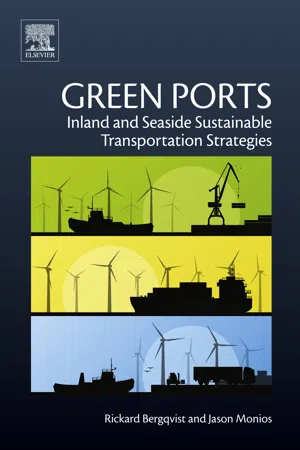
Green Ports
Inland and Seaside Sustainable Transportation Strategies
- 310 pages
- English
- ePUB (mobile friendly)
- Available on iOS & Android
eBook - ePub
About this book
Green Ports: Inland and Seaside Sustainable Transportation Strategies presents the first book to exclusively focus on this important topic that is usually only covered in brief chapters or journal articles that are too theoretical, fragmented or regionally-focused. This book comprehensively and systematically examines the key issues and best practice for understanding green ports and quantifying aspects of their environmental performance. This applied research book will help researchers formulate the needed research questions.
- Includes practical application tools and techniques for increasing sustainability throughout the entire transportation chain
- Provides an overall picture of green ports through a collection of expert specialists
- Examines how ports and surrounding areas are addressing the environmental impacts related to growth in the cruise business
- Presents a theoretical framework to identify best practices for planning and policymaking for the impacts posed by climate change
Information
Chapter 1
Green Ports in Theory and Practice
Rickard Bergqvist1, and Jason Monios2 1Logistics and Transport Research Group, Department of Business Administration, School of Business, Economics and Law at the University of Gothenburg, Go¨teborg, Sweden 2Kedge Business School, Marseille, France
Abstract
This chapter introduces the topic of green ports and establishes the background and motivation for this volume. The chapter provides an overarching view of the key elements of environmental issues in shipping, particularly from the port perspective. This is followed by a discussion of the current, emerging, and potential strategies to introduce more sustainable practices, the different actors involved, and also the importance and changing nature of national and international regulation. The structure of the book is introduced, and a brief outline of each chapter is presented. Finally, the chapter concludes with thoughts on developing trends and the future environmental performance of the port sector.
Keywords
Emissions; Environmental; Green port; Hinterland; Shipping; Sustainability; Vessels
1.1. Why Green Ports?
Ports today play a greater role than simply handling cargo on the quayside. The sources of their competition and the extent of their influence stretch across the sea and also deep into the hinterland. Their management and operational strategies are entwined with stakeholders on several scales and in many spheres, from local to global and from business to government. The port's role in the transport chain has the potential to shape the social and environmental performance of transportation systems extending across the globe. While many ports choose not to act beyond complying with existing environmental regulations in their city, region, or country, in many cases they have exercised their potential for addressing both social and environmental externalities.
While the Kyoto Protocol (adopted in 1997 and entering into force in 2005) introduced legally binding emissions targets, aviation and shipping were not included (Cullinane and Cullinane, 2013). Researchers have in recent years analyzed and quantified the emissions from the maritime sector, which may form a potential baseline for future targets. While the primary focus of this book is on the port perspective, attention to emissions in the maritime sector has focused for the most part on the output of vessels while at sea. These emissions can be divided broadly into greenhouse gas (GHG) emissions affecting climate change and local air pollution, primarily sulfur oxides (SOx), nitrogen oxides (NOx), and particulate matter (PM). In 2007–12 shipping accounted for 2.8% of global GHG emissions or double the level produced by air travel (Smith et al., 2014). Local pollutants are a more pressing issue in coastal areas because of their impact on human health. The World Health Organization (WHO) considers air pollution a major environmental risk to health, estimating that it results in three million deaths per year (World Health Organisation, 2016). Shipping contributes a significant amount to this risk, especially in coastal areas. Worldwide, shipping accounts for approximately 15% of NOx and 5%–8% of SOx emissions (Zis et al., 2016) that cause serious harm both to human health and the environment. As discussed in Chapter 2, Brandt et al. (2011) found that emissions from shipping caused about 50,000 premature deaths in Europe alone in 2000.
In the years leading up to the economic crisis, a common view was that the approach of peak oil would continue to drive an increasing oil price, which would naturally lead to decreased demand for fossil fuels, but we have now had a low oil price for several years, and therefore the economic incentive to switch to alternative fuels has been reduced (see Fig. 1.1).
There are also other environmental challenges at sea, including accidents, oil spills, and water pollution from ballast water. EMSA (2016) reports on figures for the European Union (EU)–flagged vessels and/or within EU waters, revealing that in 1 year alone there were 3296 incidents involving 3669 ships, including 36 lost ships and 115 fatalities. 62% of these have been attributed to human error, and 278 of these incidents resulted in pollution to the water through release of bunker fuel and other residual oils and lubricants. Ballast water is another important topic that has taken decades to address. Microorganisms can be transported across the globe in ballast water and result in extreme devastation of local species as a result of the ballast water discharge. It has taken decades of work by various organizations to produce the IMO ballast water management convention, coming into force in September 2017, 13 years after its adoption, reflecting the challenges of global environmental governance (David and Gollasch, 2015).
As environmental problems at sea (particularly emissions) are more extensive than at ports, a significant body of research has emerged on shipping emissions in recent years (see Chapters 2 and 3). This book, therefore, focuses primarily on the port perspective where there has been somewhat less attention. When thinking of sustainability in shipping and ports, most of the focus tends to be on air pollution; however, as shown through the diversity of topics covered in this volume, there are many other areas of importance for green ports such as noise, dust, waste, and water pollution (Ng and Song, 2010; Lam and Notteboom, 2014). Green port management must also include the broader topic of ecosystem protection through port sustainability plans and environmental planning regulations (Schipper et al., 2017). In addition, we also consider the issue of socioeconomic analysis and planning (Dooms et al., 2015) as relevant to a complete understanding of green ports. As the first book on environmental issues in the port sector, this volume aims to bring together all the up-to-date and state-of-the-art knowledge on the identification and evaluation of environmental issues, practical applications to address them by ports, carriers, and regulators, and also the wider institutional and political understanding of related issues and the difficulties of moving forward in a sometimes contentious arena.

Authors, based on data from EIA (2018).
1.2. Actions Currently Being Taken by Shipping Lines
Shipping lines are already applying several strategies to reduce their environmental impact, mostly to do with reducing emissions as mandated by international regulation. The most obvious issue to consider first is fuel use. Ocean-going vessels continue to rely on heavy fuel oil (HFO) that is actually a by-product of the refining process; therefore it is very cheap but also the most polluting kind of fuel available (Cullinane and Cullinane, 2013). Vessels using HFO will often switch to other fuels such as marine gas oil (MGO) in mandated Sulphur Emission Control Areas (SECA) areas (see Section 1.4) unless they employ scrubbers. Smaller vessels use MGO or marine diesel oil, the former being lighter and also commonly used in the auxiliary engines of larger ships for hoteling needs.
The most promising alternative fuel being considered is liquefied natural gas (LNG). LNG is cheaper than HFO and MGO, has no SOx or PM emissions, and much lower NOx but only produces a 25% CO2 reduction compared with conventional fuel. In November 2017, the third largest global carrier CMA CGM ordered nine ultra-large container ships of 22,000 TEU capacity, which will all have capability of running on LNG. These will be the first vessels of such size to use this fuel. According to the World Port Climate Initiative (WPCI, 2018a), the total world fleet using LNG (excluding LNG carriers) remains small at under 100 vessels, mostly ferries. The main barrier to wide uptake of LNG is the lack of refueling locations, but this may change as demand increases and responses to promotion by the EU for member states to install LNG bunkering facilities (see Section 1.4). However, LNG is still a fossil fuel producing only a 25% reduction on GHG emissions, and there is also some concern regarding the ability to supply the required quantities if a significant portion of the world fleet were to switch (Wang and Notteboom, 2014). Moreover, methane slip in the engine means that methane, a far worse GHG than CO2, is emitted, thus reducing the overall potential reduction in GHG emissions.
Some other options are being investigated, but they remain in their infancy. Hydrogen has been considered a promising fuel for different modes of transport for some time. As its only emission is water vapor, it is obviously an attractive possibility from the environmental perspective. On the other hand, like electricity, hydrogen is a form of energy storage and transportation rather than a genuine fuel source; so the energy is still being produced by other means that may not be green, e.g., coal. Also large investments for infrastructure will be required and their range remains limited; so this is likely to remain a niche fuel (Cullinane and Cullinane, 2013). Biofuels are also being considered a possibility for many modes of transport. In shipping they can be blended with conventional fuel, but growing concerns around production methods and land use suggest that biofuel will not become a large source of maritime fuel (Cullinane and Cullinane, 2013). Electricity stored in batteries has some promise for short-distance trades. Lindstad et al. (2017) reported that oil industry supply vessels could use this technology and gain significant environmental and economic benefits (although retrofitting existing vessels may not be economically viable), and they note that future battery and fuel prices play an important role on the likelihood of take-up. An additional advantage is that an increasing use of shipboard batteries could also support installation of cold ironing that can then be used not just to fuel ships while at berth but also to charge their batteries (Sciberras et al., 2017). Other options include wind (direct propulsion from sails and wind turbines on the vessel) and solar panels, but these remain niche options at present.
Besides alternative fuels, other strategies to reduce emissions include slow steaming and improved hull design. Slow steaming has become a popular way to reduce emissions and cost, as fuel usage increases approximately cubically in relation to speed, therefore decreasing speed from the usual 23–25 knots to around 20–22 knots can achieve significant reductions (see Chapter 2). A speed reduction of 20% can reduce fuel consumption by around 40% and CO2 by about 7% (Cullinane and Cullinane, 2013). Cariou (201...
Table of contents
- Cover image
- Title page
- Table of Contents
- Copyright
- List of Figures
- List of Tables
- List of Boxes
- About the Editors
- About the Contributors
- Chapter 1. Green Ports in Theory and Practice
- Chapter 2. Emissions and Fuel Use in the Shipping Sector
- Chapter 3. Policy on Reducing Shipping Emissions: Implications for “Green Ports”
- Chapter 4. Stakeholder Management for Port Sustainability: Moving From Ad-Hoc to Structural Approaches
- Chapter 5. Ports and the Circular Economy
- Chapter 6. Emissions From Ships in Ports
- Chapter 7. Sustainable Performance and Benchmarking in Container Terminals—The Energy Dimension
- Chapter 8. Climate Change Adaptation by Ports: The Attitude and Perception of Chinese Port Organizations
- Chapter 9. Green Port Dues—Indices and Incentive Schemes for Shipping
- Chapter 10. Port-Driven Measures for Incentivizing Sustainable Hinterland Transport
- Chapter 11. Green Port Strategies in China
- Chapter 12. Socioeconomic Performance Assessment of Port Clusters: More Challenges, Fewer Solutions?
- Chapter 13. Cruise Shipping and Green Ports: A Strategic Challenge
- Index
Trusted by 375,005 students
Access to over 1.5 million titles for a fair monthly price.
Study more efficiently using our study tools.
Frequently asked questions
Yes, you can cancel anytime from the Subscription tab in your account settings on the Perlego website. Your subscription will stay active until the end of your current billing period. Learn how to cancel your subscription
No, books cannot be downloaded as external files, such as PDFs, for use outside of Perlego. However, you can download books within the Perlego app for offline reading on mobile or tablet. Learn how to download books offline
Perlego offers two plans: Essential and Complete
- Essential is ideal for learners and professionals who enjoy exploring a wide range of subjects. Access the Essential Library with 800,000+ trusted titles and best-sellers across business, personal growth, and the humanities. Includes unlimited reading time and Standard Read Aloud voice.
- Complete: Perfect for advanced learners and researchers needing full, unrestricted access. Unlock 1.5M+ books across hundreds of subjects, including academic and specialized titles. The Complete Plan also includes advanced features like Premium Read Aloud and Research Assistant.
We are an online textbook subscription service, where you can get access to an entire online library for less than the price of a single book per month. With over 1.5 million books across 990+ topics, we’ve got you covered! Learn about our mission
Look out for the read-aloud symbol on your next book to see if you can listen to it. The read-aloud tool reads text aloud for you, highlighting the text as it is being read. You can pause it, speed it up and slow it down. Learn more about Read Aloud
Yes! You can use the Perlego app on both iOS and Android devices to read anytime, anywhere — even offline. Perfect for commutes or when you’re on the go.
Please note we cannot support devices running on iOS 13 and Android 7 or earlier. Learn more about using the app
Please note we cannot support devices running on iOS 13 and Android 7 or earlier. Learn more about using the app
Yes, you can access Green Ports by Rickard Bergqvist,Jason Monios in PDF and/or ePUB format, as well as other popular books in Technology & Engineering & Transportation & Navigation. We have over 1.5 million books available in our catalogue for you to explore.