- 294 pages
- English
- ePUB (mobile friendly)
- Available on iOS & Android
eBook - ePub
About this book
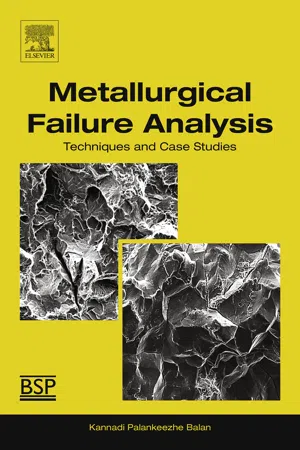
Metallurgical Failure Analysis: Techniques and Case Studies explores how components fail and what measures should be taken to avoid future failures. The book introduces the subject of failure analysis; covers the fundamentals and methodology of failure analysis, including fracture and fractography of metals and alloys and the tools and techniques used in a failure investigation; examines 37 case studies on high performance engineering components; features experimental results comprised of visual-, fractographic-, or metallographic- examination, hardness measurements and chemical analysis; includes illustrations and evidence obtained through test results to enhance understanding; and suggests suitable remedial measures when possible.
The various case studies are classified according to the major causes of failures. The case studies pertain to: Improper Material Selection, Manufacturing Defects, Casting Defects, Overload, Fatigue, Corrosion Induced Failures, Hydrogen Embrittlement and Stress Corrosion Cracking, Wear and Elevated Temperature Failures. The book contains information gathered over three decades of the author's experience handling a variety of failure cases and will go a long way toward inspiring practicing failure analysts. The book is designed for scientists, metallurgists, engineers, quality control inspectors, professors and students alike.
- Explores the fundamentals and methodology of failure analysis
- Examines the major causes of component failures
- Teaches a systematic approach to investigation to determine the cause of a failure
- Features 37 case studies on high performance engineering components
Information
Part One
Fundamentals and Methodology
Chapter One
Introduction
Abstract
The chapter introduces the subject of Failure Analysis first by broadly stating the reasons due to which a failure occurs. It then defines failure analysis and mentions how a component manifests failure. The importance of it being both an art and a science is emphasized. The steps that an analyst adopts to carry out a failure analysis are listed. How important is the knowledge of metallurgy in carrying out analysis of a component failure and how the abuse of metallurgy has been playing a significant role in a large number of metallic component failure are brought out. The readers' attention is drawn toward the role and services of a metallurgist/failure analyst for matters concerning component development projects or component failure.
Keywords
Total technical life; User trial; Fracture; Crack; Failure analysis; Ordinance; Aerospace vehicle; Metallurgy; Abuse of metallurgy; Metallurgist; Failure analyst
An engineering system is designed, developed, and manufactured to fulfill certain human requirements over a total technical life. In addition, the system is also expected to be reliable and cost effective. The realization of the end product goes through the following stages: conceptualizing the system for a given function, designing and development of the prototype, user trials, manufacture, and assembly. An engineering system consists of various components. The designer is required to finalize the geometry and dimension of each and every part, select suitable materials based on availability, draw a fabrication methodology, stipulate the qualitative check and acceptance norms, state the assembling technique, and finally list out the maintenance procedure and schedule. Whenever a system fails to perform a required function, any of the above stage could be the culprit. Human error caused during application and utilization of the system could be another important source responsible for failure. A failure analysis carried out scientifically and systematically alone can pinpoint the cause of such a failure. The suitable remedial measures suggested by the failure analyst can go a long way in minimizing the recurrence of such failures.
Failure of an engineering component is a condition when it no longer is able to perform the desired function due to a breakage, fracture, crack, wear, corrosion, and inaccuracies as regards to dimensional or other parameters. In a large number of engineering failures, it has been noticed that unsuccessful or nonperformance of an engineering system is due to failure of one or more component of the assembly. During preliminary examination the system’s manager is generally able to locate the component that is suspected to have caused the failure. Whenever there is a crack or fracture telltale evidence is left on the failed component. In certain cases, when there is a rubbing action by the mating fracture surfaces or rubbing of the fracture surfaces by some other component it amounts to loss of useful evidences for an analyst. In such a situation, a failure analyst has to resort to the available data and circumstantial evidences to draw a conclusion about the failure. A good failure analysis can be highly useful in understanding the cause of failure and also the methods to prevent occurrence of such failures in future.
Failure analysis is a combination of an art and a science. All material scientists or engineers cannot handle failure analysis as it needs certain amount of experience and skill to handle a case study. Since every failure is reported as a crisis it is also expected to get an investigation carried out within a very short time. However, it should be borne in mind that a failure analysis cannot be performed with a magical wand. The analyst requires a certain amount of time to understand the background, collect suitable samples, make a variety of specimens for a large number of tests, interpret the test results, and then come to a conclusion in order to pronounce the cause. Failure analysis is based on sound metallurgical principles and authentic scientific evidences gathered through standard tests. The time frame demanded by the analyst should be considered to be genuine and must be provided for a job to be well handled. After all everyone involved in the case looks forward to the cause of failure and a suitable remedial measure in order to avoid future recurrence of the same.
Abuse of metallurgy has been the primary reason for a large number of failures of metallic components in our country. Most of the small- and medium-scale industries appoint mechanical engineers in all such fields of shop floor where a metallurgist should actually be taking care of the job, for example, a heat treatment shop. During the design and development of a system, for example, a weapon, ordinance, or an aerospace vehicle; metallurgist or materials experts are seldom part of the team. When some component of the system fails, which is bound to happen, the development team appoints an inquiry committee to look into the matter. Even at this stage a metallurgist is not appointed as one of the members in the inquiry committee. The engineers of the development team arrive at a cause of failure based on the operational error or breakage of some part of the system. Now they approach a metallurgical laboratory with a request for chemical analysis of the failed component. Sometimes the chemical analysis is also accompanied with a request for hardness check. The inquiry committee thinks that it knows the cause of failure and what more they want is a confirmation by a chemical analysis or hardness check. Even at this stage the committee does not realize that what they require is a failure analysis by an expert. What they do not realize is that they need to approach a materials consultant for a thorough failure analysis and appointment of a metallurgist for all future endeavors. This nonrealization leads to failure after failure but fails to wake them up to understand their basic fault—‘abuse of metallurgy’. The day this realization comes and metallurgists get the right place in engineering industries and engineering system development team, the problem of premature failure would minimize to a large extent. Whenever an engineering component fails it is advisable to approach a failure analyst for a detailed failure investigation and apply the remedial measures suggested by him, which will help in avoidance of failures in future.
Chapter Two
Fracture
Abstract
The concept of fracture is introduced in this chapter which is considered as an important aspect of failure analysis. Next the types of fracture usually encountered in a component failure are discussed in some detail. Formation of ductile, brittle, and fatigue fracture and their understanding through macro and micro features and characteristics are explained. Fractography of the fracture surface using scanning electron microscope for studying the mode of failure is discussed with typical fractographs for each type of fracture namely dimpled rupture, transgranular fracture, quasi-cleavage fracture, intergranular fracture, and fatigue fracture. The principle of formation of a particular type of fracture, which depends on the state of stress and the material, is also mentioned.
Keywords:
Fracture; Ductile fracture; Brittle fracture; Fatigue fracture; Fibrous fracture feature; Dimples—equiaxed and elongated; 45° shear fracture; Transgranular cleavage fracture; Quasi-cleavage fracture; Intergranular fracture; Beach marks; Fatigue striations
When a metallic body is subjected to a stress it withstands the applied stress, which can be understood by a typical tensile test. When the body is no longer able to withstand the applied stress it starts cracking. Cracking goes through two stages viz. crack initiation and crack propagation. Formation of crack, due to release of stress in a metallic body that ultimately results in separation of the body into two or more parts, is known as fracture. A majority of component failures is due to fracture and therefore an understanding of this phenomenon forms an important aspect of failure analysis. There are different types of fracture viz. ductile, brittle, fatigue, etc. Each type leaves certain characteristic fracture features on the fractured surface that lead us to know the mode of failure. Knowledge of the mode of fracture helps us in working toward the cause of failure.
2.1 Ductile and Brittle Fractures
Fractures can be classified broadly as ductile fractures and brittle fractures. A ductile fracture is associated with considerable plastic deformation. An appreciable amount of gross plastic deformation in the form of change in dimension (increased length or local decrease in cross section) can actually be observed in the case of a ductile fracture. A typical cup and cone fracture of a ductile metal as observed in a tensile test is an example of a ductile fracture (Fig. 2.1). An appreciable amount of shear lip as seen in Fig. 2.1 is an evidence of a ductile fracture. A ductile fracture is characterized by a fibrous fracture surface with a prominent shear lip. Thus a typical cup and cone fracture of a moderately ductile metal, a rupture following drawing of a highly ductile metal viz. gold or lead to a point and mere separation of a metal by 45° shear are all examples of ductile fractures.

A brittle fracture is characterized by very little micro-deformation and negligible gross deformation. In a brittle fracture the rapid rate of crack propagation ultimately results in fragmentation. A coarse and crystalline fracture surface is an evidence of a brittle fracture. An otherwise ductile metal can fail in a brittle mode due to three main factors viz.
- (i) a triaxial state of stress,
- (ii) a low temperature, and
- (iii) a high strain rate.
Besides the influence of the three physical factors, as mentioned earlier, there are many metallur...
Table of contents
- Cover image
- Title page
- Table of Contents
- Copyright
- Dedication
- Preface
- Acknowledgments
- Part One: Fundamentals and Methodology
- Part Two: Case Studies
- Bibliography
- Index
Trusted by 375,005 students
Access to over 1.5 million titles for a fair monthly price.
Study more efficiently using our study tools.
Frequently asked questions
Yes, you can cancel anytime from the Subscription tab in your account settings on the Perlego website. Your subscription will stay active until the end of your current billing period. Learn how to cancel your subscription
No, books cannot be downloaded as external files, such as PDFs, for use outside of Perlego. However, you can download books within the Perlego app for offline reading on mobile or tablet. Learn how to download books offline
We are an online textbook subscription service, where you can get access to an entire online library for less than the price of a single book per month. With over 1.5 million books across 990+ topics, we’ve got you covered! Learn about our mission
Look out for the read-aloud symbol on your next book to see if you can listen to it. The read-aloud tool reads text aloud for you, highlighting the text as it is being read. You can pause it, speed it up and slow it down. Learn more about Read Aloud
Yes! You can use the Perlego app on both iOS and Android devices to read anytime, anywhere — even offline. Perfect for commutes or when you’re on the go.
Please note we cannot support devices running on iOS 13 and Android 7 or earlier. Learn more about using the app
Please note we cannot support devices running on iOS 13 and Android 7 or earlier. Learn more about using the app
Yes, you can access Metallurgical Failure Analysis by Kannadi Palankeezhe Balan in PDF and/or ePUB format, as well as other popular books in Technology & Engineering & Mining Engineering. We have over 1.5 million books available in our catalogue for you to explore.