- 516 pages
- English
- ePUB (mobile friendly)
- Available on iOS & Android
eBook - ePub
Epigenetic Technological Applications
About this book
Epigenetic Technological Applications is a compilation of state-of-the-art technologies involved in epigenetic research. Epigenetics is an exciting new field of biology research, and many technologies are invented and developed specifically for epigenetics study. With chapters covering the latest developments in crystallography, computational modeling, the uses of histones, and more, Epigenetic Technological Applications addresses the question of how these new ideas, procedures, and innovations can be applied to current epigenetics research, and how they can keep pushing discovery forward and beyond the epigenetic realm.
- Discusses technologies that are critical for epigenetic research and application
- Includes epigenetic applications for state-of-the-art technologies
- Contains a global perspective on the future of epigenetics
Information
Chapter 1
The State of the Art of Epigenetic Technologies
Y. George Zheng, Department of Pharmaceutical and Biochemical Sciences, The University of Georgia, Athens, Georgia, USA
Epigenetics has become a focal point of biological research, significantly impacting biology, health, and medicine. Advances in technological developments enable great strides in epigenetic discovery. Numerous techniques have been developed not only to analyze epigenetic function, process and mechanism at the level of specific genes, but also to study epigenetic changes that occur on the genome-wide scale. The mapping of genome-wide DNA methylation can be readily achieved with ChIP-seq technology. Advances have also been made in technologies devised to assess the enzymes and binders that mediate epigenetic processes. Further, targeting various epigenetic regulators and processes with small molecule chemical probes represents an exciting therapeutic strategy for disease intervention. These technological advances collectively drive epigenetics research forward throughout the courses of discovery and invention, from basic biology to translational biomedical applications.
Keywords
Epigenetics; chromatin; histone; epigenetic technology; epigenetic therapy
1.1 Epigenetics and Chromatin Function
The field of epigenetics is rapidly booming, evolving, and expanding. The term epigenetics (the prefix “epi” comes from Greek, meaning over, upon, above, in addition to) was created by Waddington in the context of connecting developmental biology and genetics [1]. To date, epigenetics is most frequently referred to as the study of meiotically and mitotically heritable changes in gene activities without alterations in the genetic DNA sequence [1–4]. However, in recent years, it has been debated whether the heritability requirement of the term is necessary or too restrictive given that many (perhaps most) changes in gene activity modulated by chromatin modifications can occur in terminally differentiated and nondividing cells [3,5,6]. Examples include short-lived alterations in histone acetylation and methylation caused by DNA repair, cell-cycle phase, or transcription factor binding. Thus, there exist arguments in which epigenetic changes could be more broadly defined to encompass structural and biochemical alterations of the chromatin at any point in time under the condition that the genetic sequence is kept invariable [5,6]. Under this scheme, epigenetics does not merely refer to heritable chromatin states, but also embraces those that are transient or occur in nondividing cells. A new term, memigenetics, has recently been suggested to particularly denote transmissible epigenetics, which pertains to the propagation of a chromatin activity state across cell generations [5].
Chromatin lies at the very core of epigenetic biology. In multicelled organisms, DNA, the macromolecule that contains genetic information, is packed into highly ordered chromatin complexes, accommodative to the narrow space of the nucleus. As the structural framework in which DNA embeds, chromatin executes various nuclear functions such as transcription, replication, and differentiation [7,8]. The basal structural building unit of the chromatin is the nucleosome, which is composed of a core histone octamer (containing two copies of each of H2A, H2B, H3, and H4 molecules) wrapped by 146 bp of DNA in approximately 1.7 turns [9,10]. The linker DNAs between neighboring nucleosomes connect nucleosome core particles, forming the 10-nm “beads-on-a-string” chromatin thread that can be observed under electron microscope [11,12]. A fifth histone, linker histone H1, binds to linker DNA and the entry/exit point of nucleosomal DNA, facilitating the folding of chromatin into higher order chromatin structures, such as the 30 nm filaments [13,14]. All five histones, H1, H2A, H2B, H3, and H4, are highly basic (the calculated pKa values are 10.3–11.4) and rich in positively charged amino acids, most of which are lysines and arginines. The strong basic physicochemical nature of the histones promotes their tight association with the DNA phosphate backbones to form stable chromatin complexes. The nucleosome complex structure represents a physical barrier that hampers the binding of gene regulatory factors, such as the RNA polymerases to gene promoters, thereby suppressing gene expression [15,16].
1.2 Mechanisms of Epigenetic Regulation
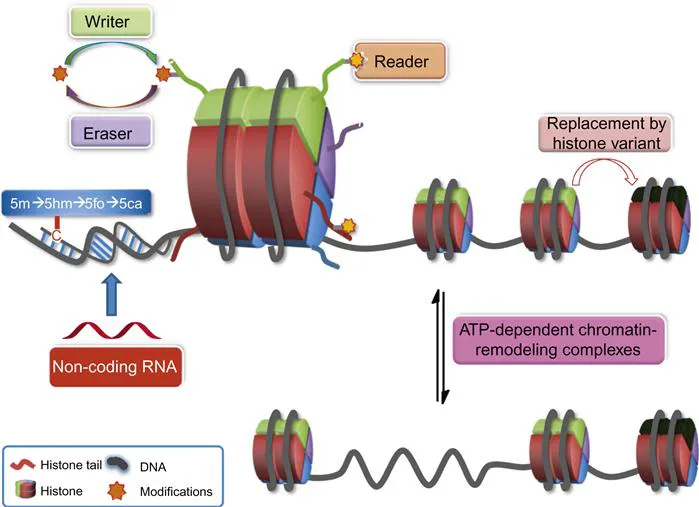
Though stable, the chromatin structure is a dynamic entity rather than static. Its structural state is directly associated with the activity status of the underlying DNA sequences. Regulation of chromatin structure and DNA activity is highly complex and involves several types of epigenetic control mechanisms, including DNA methylation, various histone posttranslational modifications (PTMs), exchange of canonical histones with histone variants, ATP-dependent chromatin remodeling, and recruitment of long and short noncoding RNAs (Figure 1.1). DNA 5-cytosine methylation is the most studied epigenetic mechanism in the field. Methylation of DNA occurs at the carbon-5 position of the cytosine ring, typically in a CpG dinucleotide context which is a characteristic feature of many eukaryotic genomes. Approximately 70% of CpG residues in the mammalian genomes are methylated, leaving a small portion of the genome methylation-free [17]. CpG methylation is an important mechanism for repressing the transcription of repeat elements and transposons, and plays a crucial role in genomic imprinting and X-chromosome inactivation [18].
Compared to DNA methylation, histone modification encompasses much more...
Table of contents
- Cover image
- Title page
- Table of Contents
- Copyright
- List of Contributors
- Foreword
- Chapter 1. The State of the Art of Epigenetic Technologies
- Chapter 2. Technologies for the Measurement and Mapping of Genomic 5-Methylcytosine and 5-Hydroxymethylcytosine
- Chapter 3. High-Throughput Sequencing-Based Mapping of Cytosine Modifications
- Chapter 4. Application of Mass Spectrometry in Translational Epigenetics
- Chapter 5. Techniques Analyzing Chromatin Modifications at Specific Single Loci
- Chapter 6. Comprehensive Analysis of Mammalian Linker-Histone Variants and Their Mutants
- Chapter 7. Crystallography-Based Mechanistic Insights into Epigenetic Regulation
- Chapter 8. Chemical and Genetic Approaches to Study Histone Modifications
- Chapter 9. Peptide Microarrays for Profiling of Epigenetic Targets
- Chapter 10. Current Methods for Methylome Profiling
- Chapter 11. Bioinformatics and Biostatistics in Mining Epigenetic Disease Markers and Targets
- Chapter 12. Computational Modeling to Elucidate Molecular Mechanisms of Epigenetic Memory
- Chapter 13. DNA Methyltransferase Inhibitors for Cancer Therapy
- Chapter 14. Histone Acetyltransferases: Enzymes, Assays, and Inhibitors
- Chapter 15. In Vitro Histone Deacetylase Activity Screening: Making a Case for Better Assays
- Chapter 16. Enzymatic Assays of Histone Methyltransferase Enzymes
- Chapter 17. Histone Methyltransferase Inhibitors for Cancer Therapy
- Chapter 18. Discovery of Histone Demethylase Inhibitors
- Chapter 19. Histone Demethylases: Background, Purification, and Detection
- Chapter 20. Animal Model Study of Epigenetic Inhibitors
- Index
Trusted by 375,005 students
Access to over 1.5 million titles for a fair monthly price.
Study more efficiently using our study tools.
Frequently asked questions
Yes, you can cancel anytime from the Subscription tab in your account settings on the Perlego website. Your subscription will stay active until the end of your current billing period. Learn how to cancel your subscription
No, books cannot be downloaded as external files, such as PDFs, for use outside of Perlego. However, you can download books within the Perlego app for offline reading on mobile or tablet. Learn how to download books offline
Perlego offers two plans: Essential and Complete
- Essential is ideal for learners and professionals who enjoy exploring a wide range of subjects. Access the Essential Library with 800,000+ trusted titles and best-sellers across business, personal growth, and the humanities. Includes unlimited reading time and Standard Read Aloud voice.
- Complete: Perfect for advanced learners and researchers needing full, unrestricted access. Unlock 1.5M+ books across hundreds of subjects, including academic and specialized titles. The Complete Plan also includes advanced features like Premium Read Aloud and Research Assistant.
We are an online textbook subscription service, where you can get access to an entire online library for less than the price of a single book per month. With over 1.5 million books across 990+ topics, we’ve got you covered! Learn about our mission
Look out for the read-aloud symbol on your next book to see if you can listen to it. The read-aloud tool reads text aloud for you, highlighting the text as it is being read. You can pause it, speed it up and slow it down. Learn more about Read Aloud
Yes! You can use the Perlego app on both iOS and Android devices to read anytime, anywhere — even offline. Perfect for commutes or when you’re on the go.
Please note we cannot support devices running on iOS 13 and Android 7 or earlier. Learn more about using the app
Please note we cannot support devices running on iOS 13 and Android 7 or earlier. Learn more about using the app
Yes, you can access Epigenetic Technological Applications by Yujun George Zheng in PDF and/or ePUB format, as well as other popular books in Biological Sciences & Genetics & Genomics. We have over 1.5 million books available in our catalogue for you to explore.