- 360 pages
- English
- ePUB (mobile friendly)
- Available on iOS & Android
eBook - ePub
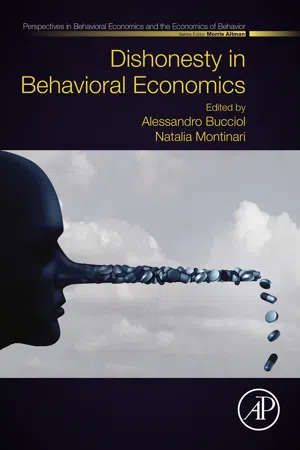
Dishonesty in Behavioral Economics
About this book
Dishonesty in Behavioral Economics provides a rigorous and comprehensive overview of dishonesty, presenting state-of-the-art research that adopts a behavioral economics perspective. Throughout the volume, contributors emphasize the effects of psychological, social, and cognitive factors on the decision-making process. In contrast to related titles, Dishonesty in Behavioral Economics emphasizes the importance of empirical research methodologies. Its contributors demonstrate how various methods applied to similar research questions can lead to different results. This characteristic is important because, of course, it is difficult to obtain reliable measures of dishonesty.
- Reviews many key issues in the literature around lying, cheating, fraudulence, and deception
- Covers both state-of-the-art methods and data collection mechanisms (e.g., laboratory experiments, field experiments, online surveys)
- Discusses novel interdisciplinary research findings and from them proposes new avenues of research
Information
Section 1
Dishonesty in behavioral economics: An overview
Chapter 1
Dishonesty in behavioral economics: An overview
Alessandro Bucciol1; Natalia Montinari2 1 Department of Economics, University of Verona, Verona, Italy
2 Department of Economics, University of Bologna, Bologna, Italy
2 Department of Economics, University of Bologna, Bologna, Italy
Abstract
Dishonesty is a pervasive human behavior occurring virtually in all contexts, and manifests itself as the disposition to lie, cheat, fraud, or deceive. This behavior usually gives individuals a personal advantage at the expense of the society. This chapter briefly reviews the contributions included in the book, which aims to provide a rigorous and comprehensive overview of dishonesty, collecting state-of-the-art research on this topical field adopting a behavioral economics perspective, which focuses on the effects of psychological, social, and cognitive factors of the decision-making process. This book highlights the importance of the empirical research methodologies to study dishonesty both in the lab and in the field.
Keywords
Dishonesty; Cheating; Behavioral economics; Experimental economics; Lab and field experiments
JEL Classification
D91; D63
1 Introduction
Dishonesty is a pervasive human behavior occurring virtually in all contexts, and manifests itself as the disposition to lie, cheat, fraud, or deceive. This behavior usually gives individuals a personal advantage at the expense of the society. Over the last decade, researchers from various disciplines have investigated the topic from theoretical as well as empirical (including experimental) point of view. A recent comprehensive review can be found in Jacobsen et al. (2018). However, much has yet to be learned about the reasons behind dishonesty, and the characteristics of who is more prone to act dishonestly.
This book aims to provide a rigorous and comprehensive overview of dishonesty, collecting state-of-the-art research on this topical field adopting a behavioral economics perspective which focuses on the effects of psychological, social, and cognitive factors of the decision-making process. In contrast to other works dealing with the same or similar topics, this book highlights the importance of the empirical research methodologies discussing how different methods applied to similar research questions can lead to different results. One key reason is that it is difficult to obtain reliable measures of dishonesty. In fact, it is complicate to observe or replicate real-life situations involving misbehavior. On the one hand, those studies where the experimenters try to observe participants acting dishonestly on a cheating task suffer from being artificial and threatened by experimental demand effects, with the consequence that they may affect the magnitude of the phenomenon. On the other hand, self-reported information about dishonesty can be unreliable because people may try to conceal their behavior; therefore studies using self-reported data may underreport the size of the phenomenon. In general, since each method has advantages and disadvantages, in the study of cheating more than in other topics, every research should be seen as complementary—rather than substitute—to other research using different methods.
The book is divided into three parts, which are presented in this introduction in connection with the literature. Each part consists of several contributions on the most recent trends of research on dishonesty, written by influent scholars in behavioral and experimental economics. Unfortunately, we had to make a choice, and exclude from the book topics where dishonesty is also pervasive, such as dishonesty in the financial sector and in the public sector. We briefly discuss them in a separate section.
The remainder of this introductory chapter is as follows: Sections 2–4 provide an overview of the three parts in which the book is organized. Section 2 is about “Dishonesty among children and young adults”; Section 3 is on “Dishonesty, individual and social preferences”; Section 4 is on “Dishonesty in daily life.” Section 5 deals with further issues on dishonesty that are not discussed explicitly in the book, i.e., dishonesty in the financial sector and in the public sector. Finally, Section 6 concludes and mentions desirable avenues of development of the field.
2 Dishonesty among children and young adults
There seems to be consensus in psychology that most of the behavior we observe among adults was present also when adults were children, adolescents, or young adults (e.g., Harbaugh et al., 2002; Sutter and Kocher, 2007). A growing body of literature is therefore paying more attention on the behavior of children to better understand the behavior of adults and to disentangle innate factors and influences due to culture and socialization. This trend applies to the literature on dishonesty as well (Bucciol and Piovesan, 2011; Gneezy et al., 2009; Houser et al., 2016; Maggian and Villeval, 2016). An advantage of studying dishonesty among children is that they have fewer routines than adults and more freedom in deciding how to behave (see e.g., Runco and Cayirdag, 2012, on creativity and Rakoczy and Schmidt, 2013, on the understanding of social norms) and, with their spontaneity and natural capacity to be uninhibited, they can provide to the researcher evidence that is more reliable and less affected by the environment.
In Chapter 2.1, Heyman, Zhao, Compton, and Lee provide a comprehensive overview of the psychological literature on young children’s cheating behavior. The authors document that children manifest whether they are inclined to dishonesty as early as age 4, and that their decision between honest and dishonest behavior is later mitigated by psychosocial factors such as self-concept and social image.
In Chapter 2.2, Cadsby, Song, and Yang try to depict a demographic profile of the dishonest child. In particular, they look at parental presence or absence among children in ages 8–10 living in rural or urban areas. They find widespread cheating and no particular connection with parental presence. However, they observe more frequent cheating among urban females aged 8 and in the presence of low levels of risk aversion.
In Chapter 2.3, Battiston, Gamba, and Rotondi focus their attention on adolescents belonging to a youth organization well known for its values of honesty, integrity, and respect for others. Not surprisingly, in this sample the authors find infrequent cheating. More interestingly, dishonesty seems correlated with self-confidence.
Chapters 2.4 and 2.5 focus on university students and their behavior during academic exams. In Chapter 2.4, Cicognani asks students and former students to indicate if and to what extent they cheated during written exams. She finds that dishonesty is widespread, and that it is more likely associated with trust and the belief that others also cheat, and less likely associated to awareness of the sanction. This research highlights two interesting facts. First, the strong evidence on the belief about the others could reflect a sort of self-justification (“Many cheat, and so do I”). Second, in some cases cheating may arise when there is ignorance about the punishment. Promoting campaigns on advertising the sanctions in response to misbehavior could be a useful dissuading tool.
In Chapter 2.5, Kliger and Siev expose students performing written exams to exam cover pages reporting different statements about the standards of conduct during exams. The authors see that statements are useless unless they are accompanied by checkboxes; moreover, they find that punitive warnings are also ineffective. This research thus suggests that a simple nudge, recalling correct behavior and making the individual responsible for her actions helps to fight dishonesty.
The empirical chapters in this part exploit the methodology of lab-in-the-field experiments (Chapters 2.2 and 2.3), online surveys (Chapter 2.4), and field experiments (Chapter 2.5). Research on dishonesty frequently uses laboratory (lab) experiments where individuals make artificial decisions under controlled conditions. In contrast, field experiments observe individual decisions in real-life scenarios. Here human behavior is expected not to be affected by the artificial environment of the lab experiments but, at the same time, confounding factors can possibly influence decisions. For a thorough definition of field experiments in contrast to lab experiments, see Harrison and List (2004). In recent years, mixtures of lab and field experiments, called lab-in-the-field experiments, have been growing in popularity. Their idea is to test the validity of lab experiments in the field, that is, outside the lab. Lab-in-the-fie...
Table of contents
- Cover image
- Title page
- Table of Contents
- Copyright
- Dedication
- Contributors
- Preface
- Section 1: Dishonesty in behavioral economics: An overview
- Section 2: Dishonesty among children and young adults
- Section 3: Dishonesty, individual, and social preferences
- Section 4: Dishonesty in daily life
- Index
Trusted by 375,005 students
Access to over 1.5 million titles for a fair monthly price.
Study more efficiently using our study tools.
Frequently asked questions
Yes, you can cancel anytime from the Subscription tab in your account settings on the Perlego website. Your subscription will stay active until the end of your current billing period. Learn how to cancel your subscription
No, books cannot be downloaded as external files, such as PDFs, for use outside of Perlego. However, you can download books within the Perlego app for offline reading on mobile or tablet. Learn how to download books offline
Perlego offers two plans: Essential and Complete
- Essential is ideal for learners and professionals who enjoy exploring a wide range of subjects. Access the Essential Library with 800,000+ trusted titles and best-sellers across business, personal growth, and the humanities. Includes unlimited reading time and Standard Read Aloud voice.
- Complete: Perfect for advanced learners and researchers needing full, unrestricted access. Unlock 1.5M+ books across hundreds of subjects, including academic and specialized titles. The Complete Plan also includes advanced features like Premium Read Aloud and Research Assistant.
We are an online textbook subscription service, where you can get access to an entire online library for less than the price of a single book per month. With over 1.5 million books across 990+ topics, we’ve got you covered! Learn about our mission
Look out for the read-aloud symbol on your next book to see if you can listen to it. The read-aloud tool reads text aloud for you, highlighting the text as it is being read. You can pause it, speed it up and slow it down. Learn more about Read Aloud
Yes! You can use the Perlego app on both iOS and Android devices to read anytime, anywhere — even offline. Perfect for commutes or when you’re on the go.
Please note we cannot support devices running on iOS 13 and Android 7 or earlier. Learn more about using the app
Please note we cannot support devices running on iOS 13 and Android 7 or earlier. Learn more about using the app
Yes, you can access Dishonesty in Behavioral Economics by Alessandro Bucciol,Natalia Montinari in PDF and/or ePUB format, as well as other popular books in Economics & Business Mathematics. We have over 1.5 million books available in our catalogue for you to explore.