- 412 pages
- English
- ePUB (mobile friendly)
- Available on iOS & Android
eBook - ePub
Food for the Aging Population
About this book
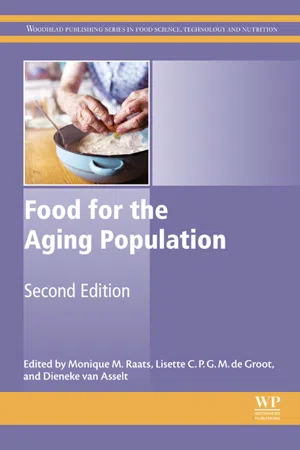
Food for the Aging Population, Second Edition, is a unique volume that reviews the characteristics of the aging population as food consumers, the role of nutrition in healthy aging, and the design of food products and services for the elderly. The first section of the book discusses the older population as consumers of food and beverages, while the second section covers the extension of functionality into later life. The final section highlights tactics on how to develop food products and services for older people.
Fully updated and revised from the first edition, the book covers advances in various fields, introducing a number of new chapters, including, amongst others, topics on the economic determinants of diet in older adults, public policy and older people's diets, and interventions to support healthy eating in later life.
- Covers the topic of food for an aging population more broadly than any other book on the market
- Presents a thoroughly revised and updated edition of a very popular and well regarded book
- Contains new chapters on the implementation of food-related interventions among the elderly population and their relationship to policymakers
Information
Part I
Understanding Older People as Consumers of Food and Beverages
Outline
Chapter 1
Older People, Food, and Satisfaction With Life
K.G. Grunert1, B. Schnettler2, M. Dean3 and M.M. Raats4, 1Aarhus University, Aarhus, Denmark, 2Universidad de La Frontera, Temuco, Chile, 3Queens University Belfast, Belfast, United Kingdom, 4University of Surrey, Guildford, United Kingdom
Abstract
Although multiple factors contribute to health status, nutrition is one of the major determinants of successful aging. Food not only is critical to one’s physiological well-being, but as research has shown, also contributes to social, cultural, and psychological quality of life. Dietary intake and nutritional status not only play a major role in the overall quality of health of older people, but also have an impact on their satisfaction with life. As discussed in this chapter, the type of food eaten and the social cultural context all make significant contributions to older people’s satisfaction with their quality of life. Furthermore, it has been shown that among older people eating is among the most important activities of daily living. Meals add a sense of security, meaning, and structure to an older adult’s day, providing feelings of independence and control and a sense of mastery over his/her environment. This chapter discusses older people’s satisfaction with food and quality of life as it relates to factors such as income level, gender, social connections, and education level. This chapter also looks at older people’s food-related satisfaction with life, identifying some of the determinants and barriers to satisfaction with food-related quality of life, and discusses possible ways of enhancing older people’s quality of life in the domain of food.
Keywords
Nutrition; quality of life measure; dietary intake; older people; well-being; food satisfaction
1.1 Introduction
Although multiple factors contribute to health status, nutrition is one of the major determinants of successful aging. Food not only is critical to one’s physiological well-being, but also contributes to social, cultural, and psychological quality of life (Academic of Nutrition and Dietetics, 2012). Dietary intake and nutritional status not only play a major role in the overall quality of health of older people, but also have an impact on their satisfaction with life (Sahyoun, 1999; Vailas et al., 1998). Silverman et al. (2002) argue that the type of food eaten and the social cultural context all make significant contributions to older people’s satisfaction with their quality of life. Hu et al. (2012) found that in terms of self-rated health, eating was among the most important activities of daily living. Meals add a sense of security, meaning, and structure to an older adult’s day, providing feelings of independence and control and a sense of mastery over his/her environment (Amarantos et al., 2001).
Investigating older people’s satisfaction with food-related life (SWFL) has significance for several reasons. First, food and energy intake tend to decrease with aging for a number of both physiological and practical reasons including reduced activity (immobility), reduced muscle tissue, a lower resting metabolic rate, and smaller meals (Academic of Nutrition and Dietetics, 2012; MacIntosh et al., 2000; Prinsley and Sandstead, 1990). This reduced energy intake, also known as “anorexia of aging,” is a potential health risk because, even though food intake is reduced with age, the need for most nutrients does not decrease with age (Academic of Nutrition and Dietetics, 2012). Second, aging affects the ability to taste and smell. Both the ability to detect tastes and smells and their intensity declines with age and it has been suggested (Academic of Nutrition and Dietetics, 2012; Rolls, 1999; Westenhoefer, 2005) that sensory losses accompanying aging may even be partly responsible for the reduced intake of foods. Indeed, changes in taste and olfaction, which are strictly linked with appetite, can directly affect food intake and nutritional status (Wellman and Kamp, 2008). Further, as people get older, their living circumstances may alter. For example, as people retire their level of income may reduce and their social network may diminish. As health fails, access to shops and amenities may become a problem. As people lose their living companions due to a spouse dying or children leaving home, cooking arrangements may change. All these factors compound as people get older, affecting older people’s relationship with food and in turn their SWFL. By identifying which factors are important and what can be altered, it may be possible to increase older people’s satisfaction with food and in turn contribute to a better quality of life. This chapter looks at older people’s food-related satisfaction with life, identifying some of the determinants and barriers to satisfaction with food-related quality of life, and discusses possible ways of enhancing older people’s quality of life in the domain of food.
1.2 Satisfaction and Quality of Life
Concepts such as quality of life, subjective well-being, and life satisfaction are often used when investigating the impact of aging (Amarantos et al., 2001; Lumbers and Raats, 2006). As society changes, people’s experience of aging and later life also alters (Wiggins et al., 2004). As health care has improved and consequently life expectancy has increased (Blaikie, 1999; Office of National Statistics, 1998) and retirement age has decreased (Gruber and Wise, 1999), these changes have had great impacts on older people’s satisfaction with their quality of life. Gabriel and Bowling (2004) argue that research in the United States investigates variables that contribute to the “good life” and addresses both the positive and negative aspect of aging, whereas in Europe they claim that the emphasis is on the functional aspects of aging, which tend to be negative and more concerned with dependency, poverty, service needs, and decline in mental and physical health, although they acknowledge that there is a gradual shift from this perspective toward one where old age is seen as a time of personal fulfilment.
In Latin America, well-being appears to decrease with age (Steptoe et al., 2015). In a sample of Cuban older adults it was found that an increase in age worsened the perception of quality of life (Dueñas et al., 2009). A study in Brazil found that increases in the levels of physical activity can contribute to improvements in the quality of life of older adults (Guedes et al., 2011). Other variables that play a role in well-being in this population include the presence of social support networks, which contribute to the social functioning of the older adult by providing economic, emotional, and instrumental help from other people (Botero and Pico, 2007). Perceived good quality of life has been found to be associated with a middle-to-high education level (Bilgili and Arpaci, 2014). Studies conducted in Costa Rica (Reyes et al., 2016) and Chile (Loewe et al., 2014) point to the link between health, life satisfaction, and better economic circumstances. Older adults with good self-rated health tend to be less likely to suffer from depressed moods, but decreased self-rated health can be compensated by a good self-rated economic situation, thus maintaining high life satisfaction (Reyes et al., 2016).
Wiggins et al. (2004) claim that older people’s quality of life is shaped by age, gender, accommodation and environment of past life, pension provision, health status, current housing, and whether or not they have access to a car. Sparks et al. (2004) indicate that health, functional status, and social support, especially family and friends’ support, and social relations are among the important factors affecting the quality of life of older people. Furthermore, Low and Molzahn (2007) suggest sufficient economic resources, personal houses, and suitable physical environment are other factors affecting quality of life. More recently, Bilgili and Arpaci (2014) concluded that gender, age, education, marital status, childbearing, social endurance, health status, living arrangement, and income variables contribute to the quality of life of older people.
However, despite its frequent use in the literature, quality of life is not a clearly defined construct and describes different physical and psychological factors (Moons et al., 2006). There is no consensus about how it is defined or how it should be measured (Felce, 1997; Haas, 1999; Moons et al., 2006; Zhan, 1992). Quality of life generally refers to evaluating the overall well-being of individuals and societies (Derek et al., 2009). Quality of life is a broad term that encompasses notions of a good life, a valued life, a satisfying life, and a happy life (McCrea et al., 2006). Das (2008) defines it as the well-being or ill-being of people and the environment in which they live. The measurement of the quality-of-life construct usually includes both objective measures and subjective perceptions (Moons et al., 2006), where the subjective part is often referred to as “subjective well-being,” and is divided into affective and cognitive parts (Andrews and Withey, 1976). The cognitive component is a subjective, judgmental evaluation of life circumstances, and is a global assessment of a person’s quality of life according to his/her chosen criteria. The most well-known measure of subjective well-being is the Satisfaction With Life Scale developed by Diener and colleagues (Diener et al., 1985). If the factors influencing one’s satisfaction with life are known, it is possible to intervene and find ways to improve it.
Researchers have partitioned life into multiple domains and view satisfaction with quality of life as a composite measure of satisfaction in each of these domains (Andrews and Withey, 1976; Campbell et al., 1976; Day, 1987; Diener, 1984; Hsieh, 2003). Here a domain is viewed as an aspect of life about which people have feelings (Andrews and Withey, 1976) or as an area of human experience that most people f...
Table of contents
- Cover image
- Title page
- Table of Contents
- Copyright
- List of Contributors
- Woodhead Publishing Series in Food Science, Technology and Nutrition
- Part I: Understanding Older People as Consumers of Food and Beverages
- Part II: Extending Functionality Into Later Life
- Part III: Developing Food Products and Services for Older People
- Index
Trusted by 375,005 students
Access to over 1.5 million titles for a fair monthly price.
Study more efficiently using our study tools.
Frequently asked questions
Yes, you can cancel anytime from the Subscription tab in your account settings on the Perlego website. Your subscription will stay active until the end of your current billing period. Learn how to cancel your subscription
No, books cannot be downloaded as external files, such as PDFs, for use outside of Perlego. However, you can download books within the Perlego app for offline reading on mobile or tablet. Learn how to download books offline
Perlego offers two plans: Essential and Complete
- Essential is ideal for learners and professionals who enjoy exploring a wide range of subjects. Access the Essential Library with 800,000+ trusted titles and best-sellers across business, personal growth, and the humanities. Includes unlimited reading time and Standard Read Aloud voice.
- Complete: Perfect for advanced learners and researchers needing full, unrestricted access. Unlock 1.5M+ books across hundreds of subjects, including academic and specialized titles. The Complete Plan also includes advanced features like Premium Read Aloud and Research Assistant.
We are an online textbook subscription service, where you can get access to an entire online library for less than the price of a single book per month. With over 1.5 million books across 990+ topics, we’ve got you covered! Learn about our mission
Look out for the read-aloud symbol on your next book to see if you can listen to it. The read-aloud tool reads text aloud for you, highlighting the text as it is being read. You can pause it, speed it up and slow it down. Learn more about Read Aloud
Yes! You can use the Perlego app on both iOS and Android devices to read anytime, anywhere — even offline. Perfect for commutes or when you’re on the go.
Please note we cannot support devices running on iOS 13 and Android 7 or earlier. Learn more about using the app
Please note we cannot support devices running on iOS 13 and Android 7 or earlier. Learn more about using the app
Yes, you can access Food for the Aging Population by Monique Raats,Lisette De Groot in PDF and/or ePUB format, as well as other popular books in Medicine & Geriatrics. We have over 1.5 million books available in our catalogue for you to explore.