- 160 pages
- English
- ePUB (mobile friendly)
- Available on iOS & Android
eBook - ePub
Welded Joint Design
About this book
Based on the European Welding Engineer (EWF) syllabus Part 3 – Construction and Design, this book provides a clear, highly illustrated and concise explanation of how welded joints and structures are designed and of the constraints which welding may impose on the design. It is therefore of value both to the welding engineer and the design engineerMany engineers coming into the profession of welding engineering lack a background in design and construction of welded structures and plant. This book has been written with such engineers very much in mind.The safe performance of a structure relies on materials and methods of fabrication which can respond to the explicit or implicit design requirements. It is essential that the welding engineer has the opportunity of making his specialist input to the design process, and an understanding of the basis of the design will help that contribution to be most effective. It is also important that the practising design engineer acquires a basic knowledge of the relevant aspects of welding to be able to execute satisfactory designs and, equally important, to know when to seek the input of a qualified welding engineer.Designed for both students and practising engineers in welding and design, the book will also be of great value to civil, structural, mechanical and plant engineers. There is also much that will interest test houses, welding equipment and consumable manufacturers, classification societies and steel companies.
Information
1
Fundamentals of the strength of materials
Normal stress
Materials change in length when they are put under normal (or direct) stress which can be either tensile or compressive stress. An elastic material is one in which the change in length is proportional to the stress developed in it and also one in which the material will return to its original length after the stress is removed. Many metals behave in an elastic manner up to a certain level of stress beyond which they will behave in a non-linear manner. The most commonly used weldable structural materials in use are the carbon or carbon-manganese steels and these are the materials generally being considered in this book unless it is stated otherwise. This is a very large family of steels available in a multiplicity of compositions, mechanical properties, grades, qualities, etc, but in some industries these steels may just be called structural steel, perhaps divided into mild steel and high yield steel or, in industries which use only one type, just steel. Where they are introduced in this book other structural materials such as the higher alloy steels, austenitic and ferritic stainless steels and aluminium alloys are referred to specifically.
The magnitude of the stress set up in a wire or a bar under a load, P, is P divided by the cross section area, A, of the bar or wire, see Fig. 1.1.

1.1 Bar under axial load.
If the street is σ

In the preferred units of the international system (SI) the load will bemeasured in Newtons (N) and the cross sectional area in square millimetres (mm2). So the stress is conventionally measured or calculated in units of N/mm2.
If we measure the length of a bar of structural steel under an increasing tensile load and plot the stress against strain (strain = increase in length/original length) we produce a chart such as in Fig. 1.2.
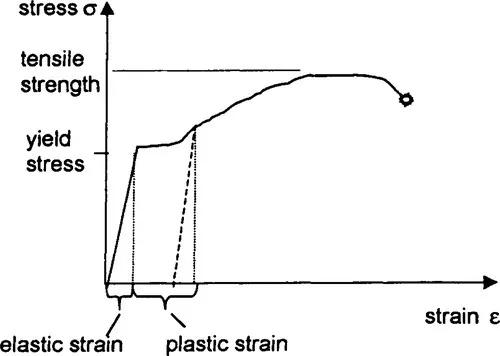
1.2 Typical stress-strain curve for steel.
The steel shows elastic behaviour up to a certain stress but then begins to extend without the stress having to be significantly increased. This behaviour is called yielding, or plastic deformation, and the stress at which it commences is the yield stress. This yielding does not continue indefinitely and the steel begins to offer more resistance to extension until it reaches its tensile strength at which point it fractures. Once the steel has yielded it will not recover the plastic strain but will recover the elastic strain. This yielding property gives mild steel the ability to be made into products by the cold bending or forming of bar, wire, sheet and plate. The slope of the elastic part of the stress-strain curve is called the elastic modulus or Young’s modulus, σ/ε, and has the units N/mm2, typically a figure of 205000 N/mm2 is used for structural steels. (Note that strain being a length divided by a length has no dimensions, it is just a ratio, a number.) In the tensile test it is the load and extension which are measured and not the strain and stress. Beyond the yield point the specimen cross section is reduced by necking and the load starts to reduce although the actual stress may be increasing. The tensile strength is then an imprecise measurement because it represents the load divided by the original cross section of the test specimen which after...
Table of contents
- Cover image
- Title page
- Table of Contents
- Copyright page
- Foreword
- Preface
- 1: Fundamentals of the strength of materials
- 2: Stresses in some common types of structures
- 3: Elementary theories of bending and torsion
- 4: Basis of design of welded structures
- 5: Weld design
- 6: Calculating weld size
- 7: Fatigue cracking
- 8: Brittle fracture
- 9: Assessment of structural integrity
- Answers to problems
- Bibliography
- Index
Trusted by 375,005 students
Access to over 1.5 million titles for a fair monthly price.
Study more efficiently using our study tools.
Frequently asked questions
Yes, you can cancel anytime from the Subscription tab in your account settings on the Perlego website. Your subscription will stay active until the end of your current billing period. Learn how to cancel your subscription
No, books cannot be downloaded as external files, such as PDFs, for use outside of Perlego. However, you can download books within the Perlego app for offline reading on mobile or tablet. Learn how to download books offline
Perlego offers two plans: Essential and Complete
- Essential is ideal for learners and professionals who enjoy exploring a wide range of subjects. Access the Essential Library with 800,000+ trusted titles and best-sellers across business, personal growth, and the humanities. Includes unlimited reading time and Standard Read Aloud voice.
- Complete: Perfect for advanced learners and researchers needing full, unrestricted access. Unlock 1.5M+ books across hundreds of subjects, including academic and specialized titles. The Complete Plan also includes advanced features like Premium Read Aloud and Research Assistant.
We are an online textbook subscription service, where you can get access to an entire online library for less than the price of a single book per month. With over 1.5 million books across 990+ topics, we’ve got you covered! Learn about our mission
Look out for the read-aloud symbol on your next book to see if you can listen to it. The read-aloud tool reads text aloud for you, highlighting the text as it is being read. You can pause it, speed it up and slow it down. Learn more about Read Aloud
Yes! You can use the Perlego app on both iOS and Android devices to read anytime, anywhere — even offline. Perfect for commutes or when you’re on the go.
Please note we cannot support devices running on iOS 13 and Android 7 or earlier. Learn more about using the app
Please note we cannot support devices running on iOS 13 and Android 7 or earlier. Learn more about using the app
Yes, you can access Welded Joint Design by J Hicks in PDF and/or ePUB format, as well as other popular books in Technology & Engineering & Materials Science. We have over 1.5 million books available in our catalogue for you to explore.