- 208 pages
- English
- ePUB (mobile friendly)
- Available on iOS & Android
eBook - ePub
SysML in Action with Cameo Systems Modeler
About this book
System engineering (SE) using models (MBSE) is currently in vogue in the community of SE practitioners, whether they are analysts, architects, developers or testers. INCOSE has contributed greatly to the definition of a language for the community, henceforth standardized under ISO-19514: SysML. However, this language is not associated by default with any particular MBSE procedure. This is a major difficulty hampering its implementation.
In order to overcome this difficulty, this book describes, in addition to the SysML notation, a generic approach based on the main principles of SE and relative standards, serving as the basis for a specific MBSE approach to be built. This is in order to respond to the specificities of the field of projects in which the practitioners evolve. In order to carry out the procedure in a pragmatic way, a simplified but realistic example serves as a guideline from the initial requirements to the validation of the system, putting into action the SysML modeling tool Cameo Systems Modeler by No Magic.
- Based on a realistic example and simplified, yet still useful for professionals (no ATM or traffic lights)
- Explores everything from requirements to validation to cover the classical V cycle
- Utilizes a generic approach, fully suitable to SysML, to apply major system engineering principles and standards
- Helps users learn to make their own model by transcribing their needs and taking advantage of the tool features,
- Conserves time by using recommended workarounds to develop custom processes for this tool, before deploying successfully on real industrial projects
Information
1
SysML: Object Management Group (OMG) Systems Modeling Language
Abstract
SysML is the result of a desire to establish a modeling language common to the stakeholders in a complex project of system engineering as of January 2001. Previous available approaches had great disparity, that is to the level of the languages and the tools, not promoting communication, maintenance etc.
Keywords
Activity diagram Fragment; Labels/tags; Model-based systems engineering; Pseudo-states; State machine diagram; Stereotypes; SysML; Use case diagram; V cycle
1.1 Background
SysML is the result of a desire to establish a modeling language common to the stakeholders in a complex project of system engineering as of January 2001. Previous available approaches had great disparity, that is to the level of the languages and the tools, not promoting communication, maintenance etc.
Moreover, the Unified Modeling Language (UML) language, which had already been available at the time for over several years, was accessible on a large number of modeling tools. Some projects have tried to use UML as a means of system modeling. Unfortunately, its strong computing connotation and the lack of certain concepts (traceability of requirements for example) were a hindrance to the success of UML in Systems Engineering.
A consortium consisting of mainly American and European members has been created within the OMG with industrialists, mainly in the field of space and aeronautics, tool publishers, as well as academic organizations or groups of experts in the field, including the International Council on Systems Engineering (INCOSE), which we will discuss later.

1.2 What is SysML?
SysML is a modeling language consisting of a toolbox offering several ways to describe a complex system. SysML also proposes, in a Model-Based Systems Engineering (MBSE) framework, documenting a system from different points of view or perspectives, in order to make the description accessible to target readers.
SysML is not a method, no specific approach is proposed by the OMG for its implementation.
SysML reuses a subset of UML 2 and extends it to address the additional requirements of system engineering.

The part of UML reused for SysML is generally known as UML4SYSML.
We will see that many UML2 diagrams are repeated without any changes, or with few minor additions, which was one of the objectives of the OMG whereby tool publishers proposed a modeler that facilitated modifications; all SysML modeling tools are indeed based on a UML core, specialized for SysML through a dedicated profile.
The version of SysML described in this book is V1.5, which was the official version at the time of the publication of this book.
1.3 System Engineering in a nutshell
We will focus solely on aspects related to SysML, voluntarily omitting the other aspects (economic, commercial, regulatory, etc.), since they are beyond the context of this book.
System engineering is a multidisciplinary approach designed to enable the production of successful systems.
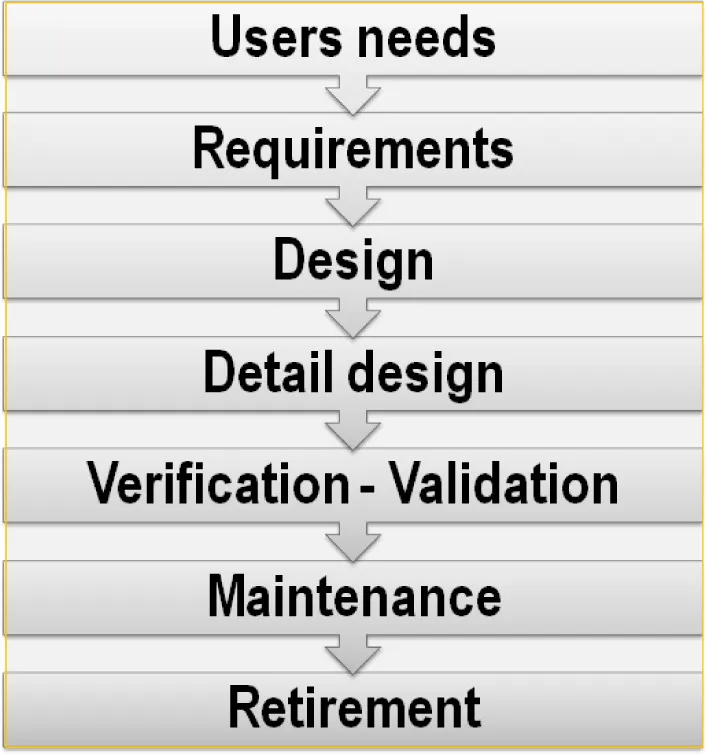
This approach focuses on defining the customer needs and the functionalities necessary for the proper functioning of a system. These needs and expectations must be validated as early as possible in the development cycle, documenting the requirements and then carrying out the design and validation of the system, taking into account the whole topic to be covered: operational aspects, performance, testability, manufacturing constraints, costs and delays, training and support and ultimately disposal.
Several standards govern good Systems Engineering practices, in particular IEEE-15288, as well as EIA 632 and IEEE 1220. The main reference will be to IEEE-15288, for example highlighting these few key steps:
– specifications, interviews and customer requirements;
– defining the stakeholder need process;
– technical specifications;
– requirements analysis;
– definition of the preliminary system;
– design process.
1.4 Advantages of System Engineering
The following is a non-exhaustive list of the main benefits of using a system engineering approach. First, complying with the requirements given for a product ensures an increase in quality by implementing the verification and validation principle as early as possible. Then, mastering the complexity, through modeling and simulation, the decomposition of the system serving as a common basis for the development of the system (single and unified platform), exchanges and collaborative work.
Some advantages also derive from the ...
Table of contents
- Cover
- Title page
- Table of Contents
- Copyright
- Foreword
- Preface
- 1: SysML: Object Management Group (OMG) Systems Modeling Language
- 2: About Cameo Systems Modeler
- 3: Example
- 4: Case Study
- 5: Beyond Modeling
- Glossary
- Bibliography
- Index
Trusted by 375,005 students
Access to over 1.5 million titles for a fair monthly price.
Study more efficiently using our study tools.
Frequently asked questions
Yes, you can cancel anytime from the Subscription tab in your account settings on the Perlego website. Your subscription will stay active until the end of your current billing period. Learn how to cancel your subscription
No, books cannot be downloaded as external files, such as PDFs, for use outside of Perlego. However, you can download books within the Perlego app for offline reading on mobile or tablet. Learn how to download books offline
Perlego offers two plans: Essential and Complete
- Essential is ideal for learners and professionals who enjoy exploring a wide range of subjects. Access the Essential Library with 800,000+ trusted titles and best-sellers across business, personal growth, and the humanities. Includes unlimited reading time and Standard Read Aloud voice.
- Complete: Perfect for advanced learners and researchers needing full, unrestricted access. Unlock 1.5M+ books across hundreds of subjects, including academic and specialized titles. The Complete Plan also includes advanced features like Premium Read Aloud and Research Assistant.
We are an online textbook subscription service, where you can get access to an entire online library for less than the price of a single book per month. With over 1.5 million books across 990+ topics, we’ve got you covered! Learn about our mission
Look out for the read-aloud symbol on your next book to see if you can listen to it. The read-aloud tool reads text aloud for you, highlighting the text as it is being read. You can pause it, speed it up and slow it down. Learn more about Read Aloud
Yes! You can use the Perlego app on both iOS and Android devices to read anytime, anywhere — even offline. Perfect for commutes or when you’re on the go.
Please note we cannot support devices running on iOS 13 and Android 7 or earlier. Learn more about using the app
Please note we cannot support devices running on iOS 13 and Android 7 or earlier. Learn more about using the app
Yes, you can access SysML in Action with Cameo Systems Modeler by Olivier Casse in PDF and/or ePUB format, as well as other popular books in Computer Science & Hardware. We have over 1.5 million books available in our catalogue for you to explore.