eBook - ePub
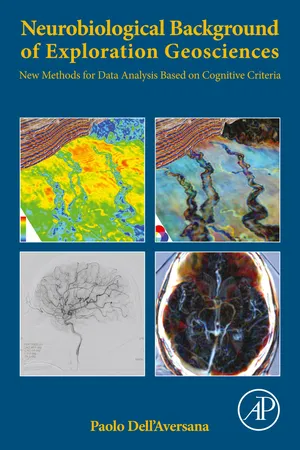
Neurobiological Background of Exploration Geosciences
New Methods for Data Analysis Based on Cognitive Criteria
- 248 pages
- English
- ePUB (mobile friendly)
- Available on iOS & Android
eBook - ePub
Neurobiological Background of Exploration Geosciences
New Methods for Data Analysis Based on Cognitive Criteria
About this book
Neurobiological Background of Exploration Geosciences: New Methods for Data Analysis Based on Cognitive Criteria examines the neurobiological background of earth science disciplines. It presents the fundamental features of the human brain that form the cognitive basis of exploration geophysics and investigates how their analysis can drive the development of new brain-based technologies. Crucial aspects of human cognition include the impulse to explore the environment, the ability of our brain to create mental maps and virtual images of the world, and the human ability to recognize, integrate and save patterns of information in a shared memory.
Geoscience technology can be made more effective by taking the working neurobiological principles of our brains into account. This book is appropriate for multiple audiences, including neuroscientists, cognitive scientists and geoscientists, presenting both theoretical and experimental results.
- Presents the neurological background of human brain function and cognition as it relates to the geosciences
- Explores possible links between geophysics, neural anatomy and neural physiology
- Dissects topics with a multidisciplinary approach and balanced combination of theory and applications
- Examines the potential mechanism by which exploration geoscience is triggered by specific neural systems located in primordial areas of the subcortical brain
- Proposes working hypotheses and possible scenarios for future research in neuroscience and the geosciences
Information
Part I
Two (Apparently) Different Worlds
Chapter 1
The Exploratory Brain
Abstract
In this introductive chapter, I describe my personal experience of a small-scale geophysical survey at the beginning of my professional activity. Using a narrative style, I explain the relevance of some crucial aspects of exploration geosciences. Independently from the specific nature of the final target, exploration Earth disciplines are based on a combination of the same cognitive abilities. These include the capability to create mental maps and images, to recognize anomalies and patterns of information, and to integrate heterogeneous information into coherent models. All these cognitive attitudes are triggered and sustained by our primordial exploratory instinct. Furthermore, they are supported by advanced technology and, finally, are filtered by our cultural background.
Keywords
Anomalies; Cognition; Discovery; Emotions; Exploratory process; Geo-radar; Integration; Patterns
1.1. A Small-Scale Exploration Case History
When I was a young geophysicist, I started working in a service company specialized in geophysical methods applied to civil engineering, environmental, and archaeological studies. The main part of my work consisted in acquisition, processing, and interpretation of geophysical data in railway tunnels for estimating their stability conditions. However, from time to time, I was asked to give a geophysical support to small-scale archaeological projects. Although I ventured into the fascinating domain of the archaeological exploration just few times, I was lucky to work in important locations, such as Pompeii and other historical areas in southern Italy. I learned to use the ground penetrating radar, often called geo-radar or briefly GPR (Clark, 1996; Conyers, 2004; Gaffney and Gater, 2003; Himi et al., 2016; Jol, 2008), combined with other geophysical techniques. Thus, I started the hard life of field geophysicist, doing many direct experiences in geophysical surveys in different sites of Italy. I remember that one of the most exciting “adventures” was a small geophysical project addressed to explore the interior of an ancient church built at the beginning of the 17th century in the historical center of Bari (Italy). The problem that I was asked to solve was theoretically simple, but very complex in practice. Based on ambiguous and fragmentary information extracted from ancient documents, the monks knew about the presence of rooms and/or tunnels located below the floor of their church. Unfortunately, nobody was able to confirm either the reliability of the old documents or the underground distribution of the cavities. An additional problem, very difficult to solve, was detecting the exact location of the entry (the trapdoor) of the underground cavities. In fact, the floor of the church was very ancient and precious. For that reason, the monks asked me to detect the original entrance of the cavities and to allow the access from the top. They wanted to avoid any large excavation for limiting the damages to the floor of their church. There was an additional, good motivation for detecting the small entrances with extreme accuracy: reducing the risk of structural collapse. In fact, opening a new way of access different from the original one and entering from the roof of the underground rooms would have affected the stability of the building itself.
We decided to explore the subsoil of the church using the GPR. I would like to recall just some basic information about geo-radar, for who has not any familiarity with this type of geophysical method. GPR uses radar pulses to image the subsurface. It works in the high-frequency range (from megahertz to gigahertz). Thus, resolution is extremely high (from meters to centimeters), but the investigation range is necessarily limited. This is because of the rapid attenuation of high-frequency electromagnetic waves, especially in conductive materials. For these reasons, the use of GPR is mainly directed to civil engineering, archaeological, and environmental applications. A GPR transmitter emits electromagnetic energy into the medium to be investigated. This can be the ground, but it can also be an artificial structure, like the wall of a building. When the electromagnetic waves encounter a boundary between materials characterized by different electric properties, they may be reflected, refracted, or scattered back to a receiving antenna. The signal detected by the receiver can be displayed in real time on the computer screen while the acquisition proceeds. These data can be interpreted immediately, when fast detection of buried objects is required. Alternatively, these data can be analyzed and interpreted later in the office. In the latter case, a complex processing workflow can be applied to enhance the signal-to-noise ratio, to convert the response from time to depth domain, and so forth. Similar to reflection seismic (but using a different type of waves), stack and/or migrated GPR sections (or volumes) represent the final output.
Before starting our survey inside the church, we collected all the available data about the building, including ancient documents, approximate descriptions by the monks, and fragmentary indications by local people. Then we tried to compose the puzzle of this fragmentary “a priori information.” This was useful for limiting the investigation area, for defining an accurate acquisition program, and for optimizing the recording parameters. In this project, we planned to use two antennas having central frequency of 500 and 300 MHz, respectively. That choice was due to the expected size and depth of our targets. In fact, based on the available initial information, we expected to find the top of the rooms/tunnels at depth of less than 1 m below the ground. As I said, the access to these tunnels was expected to have a very small size (the monks talked about possible small trapdoors of about half meter width). Using an antenna of 500 MHz represented an ideal compromise between resolution and depth of investigation. Moreover, using also a 300-MHz antenna allowed us extending the exploration depth down to 4 to 5 m. That was a good setup for detecting relatively large rooms and tunnels and, at the same time, for detecting their small entrance with sufficient accuracy. With my team, I defined a dense network of reference points covering the floor. Finally, we started our survey using the 500-MHz antenna first.
I admit that, moving the antenna on the floor of the ancient church and looking at the GPR display in real time represented a unique experience for me. I was conscious that the target was something with high historical value. What did the tunnels represent? Were there any secret underground paths or something else? What did they hide? Could we discover ancient objects, relics, artifacts, paintings, old coins?
I think that geophysical prospecting addressed to archaeological exploration is one of the most exciting fields of applied geosciences. In fact, it represents a perfect combination of technology, science, and historical culture. Moreover, ability to capture weak signals, curiosity, enthusiasm, impulse toward the discovery, and serendipity are all instinctual attitudes necessary for a successful exploratory process. I felt these sensations all together while I was moving the antenna on the church floor.
Similar emotions motivated me to work for 12 h a day when I performed a similar geophysical survey in the area of Pompeii, just few months later. Back then, I was not conscious about that mix of feelings. Honestly, I did not try to investigate the nature of my emotions. I was just happy to do that work: a perfect integration of technical background and instinctual attitude to exploration.
1.2. Macabre Discovery
After 1 h of GPR surveying, we detected several large electromagnetic anomalies showing their top a few decimeters below the floor of the church. Fig. 1.1 shows two of these strong anomalies exactly as they appeared on the original display of the GPR instrument back then (February 1990).

Figure 1.1 Ground penetrating radar anomalies detected from the floor of the church using the 500-MHz antenna (original display of 1990).
Although strong linear noise affects the quality of the image, two main anomalies emerge from the background. They are caused by the reflections and by many reverberations (black regions i...
Table of contents
- Cover image
- Title page
- Table of Contents
- Copyright
- Preface
- Part I. Two (Apparently) Different Worlds
- Part II. Bridging the Gap
- Part III. Brain-Basedtechnologies and Brain Empowerment
- Appendix 1. Overview About Inversion
- Appendix 2. Overview About Simultaneous Joint Inversion
- Index
Trusted by 375,005 students
Access to over 1.5 million titles for a fair monthly price.
Study more efficiently using our study tools.
Frequently asked questions
Yes, you can cancel anytime from the Subscription tab in your account settings on the Perlego website. Your subscription will stay active until the end of your current billing period. Learn how to cancel your subscription
No, books cannot be downloaded as external files, such as PDFs, for use outside of Perlego. However, you can download books within the Perlego app for offline reading on mobile or tablet. Learn how to download books offline
We are an online textbook subscription service, where you can get access to an entire online library for less than the price of a single book per month. With over 1.5 million books across 990+ topics, we’ve got you covered! Learn about our mission
Look out for the read-aloud symbol on your next book to see if you can listen to it. The read-aloud tool reads text aloud for you, highlighting the text as it is being read. You can pause it, speed it up and slow it down. Learn more about Read Aloud
Yes! You can use the Perlego app on both iOS and Android devices to read anytime, anywhere — even offline. Perfect for commutes or when you’re on the go.
Please note we cannot support devices running on iOS 13 and Android 7 or earlier. Learn more about using the app
Please note we cannot support devices running on iOS 13 and Android 7 or earlier. Learn more about using the app
Yes, you can access Neurobiological Background of Exploration Geosciences by Paolo Dell'Aversana in PDF and/or ePUB format, as well as other popular books in Biological Sciences & Neuroscience. We have over 1.5 million books available in our catalogue for you to explore.