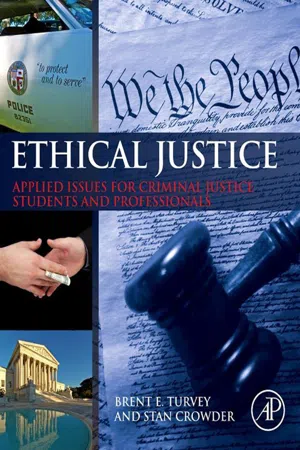
eBook - ePub
Ethical Justice
Applied Issues for Criminal Justice Students and Professionals
- 496 pages
- English
- ePUB (mobile friendly)
- Available on iOS & Android
eBook - ePub
Ethical Justice
Applied Issues for Criminal Justice Students and Professionals
About this book
This textbook was developed from an idiom shared by the authors and contributors alike: ethics and ethical challenges are generally black and white - not gray. They are akin to the pregnant woman or the gunshot victim; one cannot be a little pregnant or a little shot. Consequently, professional conduct is either ethical or it is not. Unafraid to be the harbingers, Turvey and Crowder set forth the parameters of key ethical issues across the five pillars of the criminal justice system: law enforcement, corrections, courts, forensic science, and academia. It demonstrates how each pillar is dependent upon its professional membership, and also upon the supporting efforts of the other pillars - with respect to both character and culture.With contributions from case-working experts across the CJ spectrum, this text reveals hard-earned insights into issues that are often absent from textbooks born out of just theory and research. Part 1 examines ethic issues in academia, with chapters on ethics for CJ students, CJ educators, and ethics in CJ research. Part 2 examines ethical issues in law enforcement, with separate chapters on law enforcement administration and criminal investigations. Part 3 examines ethical issues in the forensic services, considering the separate roles of crime lab administration and evidence examination. Part 4 examines ethical issues in the courts, with chapters discussing the prosecution, the defense, and the judiciary. Part 5 examines ethical issues in corrections, separately considering corrections staff and treatment staff in a forensic setting. The text concludes with Part 6, which examines ethical issues in a broad professional sense with respect to professional organizations and whistleblowers.Ethical Justice: Applied Issues for Criminal Justice Students and Professionals is intended for use as a textbook at the college and university, by undergraduate students enrolled in a program related to any of the CJ professions. It is intended to guide them through the real-world issues that they will encounter in both the classroom and in the professional community. However, it can also serve as an important reference manual for the CJ professional that may work in a community that lacks ethical mentoring or leadership.
- First of its kind overview of the five pillars of criminal justice: academia, law enforcement, forensic services, courts and corrections
- Written by practicing criminal justice professionals, from across every pillar
- Offers a realistic overview of ethical issues confronted by criminals justice students and professionals
- Examines sensitive subjects often ignored in other criminal justice ethics texts
- Numerous cases examples in each chapter to facilitate instruction and learning
Information
Chapter 1
Ethics in the Criminal Justice Professions
Stan Crowder and Brent E. Turvey
Legislative enactment has never been, and never will be, a panacea for moral turpitude. It is absurd, and stupid as well, to think that fines and jail sentences can change the character of an individual.
August Vollmer (1971, p. 81)
Contents
Ethics Defined
Ethics and Morality
Moral Dilemmas
Ethical Dilemmas
Professional Ethics
Relative Justice
Legal Justice
Constitutional Rights
Due Process
The Pillars of the Criminal Justice System
Academia
Law Enforcement
Forensic Services
The Judiciary
Corrections
The Character of an Adversarial System
The Prosecution
The Defense
The Value of Professional Ethics in the Criminal Justice System
The Value of Professional Ethics to Criminal Justice Practitioners
Employability
Preparedness
Trustworthiness
Resistance to Serious Corruption
Protection
Summary
Key Terms
Academia The pillar of the criminal justice system comprised of those criminal justice researchers and educators working in colleges, universities, academics, and institutions around the world.
Adversarial system A “jurisprudential network of laws, rules and procedures characterized by opposing parties who contend against each other for a result favorable to themselves. In such a system, the judge acts as an independent magistrate rather than prosecutor; distinguished from an inquisitorial system” (Black, 1990, p. 53).
Corrections The pillar of the criminal justice system that deals with the probation, incarceration, management, rehabilitation, treatment, parole, and in extreme cases the execution of convicted criminals.
Criminal justice system The network of government and private agencies intended to manage accused and convicted criminals.
Due process The preservation of federal and state constitutional rights; the rights of citizens as described in these constitutions may not be violated or taken away without strict adherence to the law.
Ethical dilemma A type of ethical issue that arises when the available choices and obligations in a specific situation do not allow for an ethical outcome.
Ethics The specific institutional rules of conduct constructed from morality and other elements of character (e.g., motivation, libido, courage, loyalty, integrity, and empathy); they are, consequently, the result of reflection and deliberation (Ethics Across the Curricula Committee, 2007).
Forensic services The pillar of the criminal justice system that deals with the examination and interpretation of evidence – physical, behavioral, and testimonial alike (Turvey and Petherick, 2010).
Judiciary The pillar of the criminal justice system that deals with the adjudication or criminal defendants to include exoneration, punishment, treatment, and efforts to reform.
Justice Fair and impartial treatment during the resolution of conflict.
Law enforcement The pillar of the criminal justice system that deals with reported crime.
Legal justice The result of forging the rights of individuals with the government’s corresponding duty to ensure and protect those rights.
Moral dilemma Exists when available choices and obligations do not allow for moral outcomes.
Morality A significant contributor to the development of ethics and is most commonly associated with individual feelings or beliefs regarding actions.
Professional ethics The specific ideals, principles, values, and constraints imposed on practitioners by the mandates of their profession and workplace.
The purpose of this textbook is to provide an instructional guide for any criminal justice student or professional that needs help identifying, understanding, or resolving ethical issues and dilemmas. To accomplish this, it is necessary to examine the five interdependent pillars of the criminal justice system: academia, law enforcement, forensic services, the courts, and corrections. No matter where in this foundation a professional finds employment, they will depend on or work directly with those within the other supporting pillars. Readers will therefore come to understand the necessity of the different roles and ethical obligations held by each pillar with respect to ensuring that justice is ultimately being served.
In this chapter, readers will be introduced to the basic concepts necessary for understanding and contextualizing each of the chapters that follow: the concepts of ethics and justice will be defined; the mandates of legal justice will be spelled out; the pillars of the criminal justice system will be distinguished from each other; and the value of ethics to both the criminal justice system and individual professionals will be explained.
Ethics Defined
There is a great deal of confusion with respect to ethics in the justice system – including what they actually are, how they should be derived, and their relationship to morality. This occurs when those discussing professional ethics inappropriately conflate philosophy and religion when attempting to understand or explain fundamental issues. For example, the criminal justice literature is rife with publications treating personal morality, religious dogma, and professional ethics as though they are interchangeable constructs. Although often treated as synonymous in common usage, they are quite different.
Ethics and Morality
In philosophy, ethics involves the study of individual or group character, which is comprised of many different elements, including variably developed morality, ideals, values, and virtues (Thornton, 2012).1 Morality, a significant contributor to the development of ethics, is most commonly associated with individual feelings or beliefs regarding actions. This is to say that morality provides a thematic basis for making judgments as to whether actions or choices are considered right, wrong, good, or bad. Ethics are the specific situational rules of conduct constructed from morality and other elements of character (e.g., motivation, libido, courage, loyalty, integrity, and empathy); they are, consequently, the result of reflection and deliberation (Ethics Across the Curricula Committee, 2007). The influence of morality on ethics can be absolute or finite, shifting wildly depending on individual or group dogma.
For example, groups with a variety of different belief systems consider the act of killing another human being immoral. Consequently, a moral imperative2 exists within such groups to refrain from killing of any kind. However, careful deliberation of this imperative, in consideration of related ideals, values, and virtues, has caused some to develop ethical guidelines that permit killing under specific circumstances. In this way killing may be considered generally immoral, but there may also be specific ethical exceptions (e.g., self-defense, time of war, and capital punishment).
At this point, it is crucial to acknowledge that every belief system (e.g., institutional, political, religious, cultural) has its own set of values, morals, and ideals, with its own subsequent ethical canon. Consider that in some cultures women can drive a car, wear revealing clothes, own property, get an education, and marry or date whomever they prefer. In other cultures, such conduct by a woman is considered immoral; in extreme cases it may even be a violation of religious law. This reality provides that there are no truly universal moral imperatives or obligations: even rape and torture are considered by some to be acceptable, depending on the context (e.g., honor killings, time of war). By the same token, there are also no universally held taboos.
Moral Dilemmas
A moral dilemma exists when available choices and obligations do not allow for moral outcomes. In such instances, a choice or an action is anticipated or required, and all of the available alternatives violate some moral obligation. Moral dilemmas are not uncommon when organizations and individuals are working to satisfy competing interests, or when personal morals and professional obligations are directly opposed.
An example would be a devout Catholic that marries, has children, and later discovers that their spouse is abusing one of them. According to the Catholic Church, marriage is a sacrament and is indissoluble – therefore, a moral obligation exists to repair a failing marriage, especially when children are involved. However, a moral obligation also exists to protect one’s children. Both choices – getting a divorce and remaining with an abusive spouse – are morally unacceptable at best. This moral dilemma is not unique to those with strong religious beliefs and has resulted in some of the most horrific consequences that can be observed in the criminal justice system.
Notably, the phrase “moral dilemma” is used throughout the criminal justice literature by those unaware of its actual meaning. In many works, authors use it when referring to immoral or unethical behavior with severe consequences – to the choice that must made between moral and immoral behavior. The choice that exists between moral and immoral behavior does not involve a genuine dilemma – unless the moral path conflicts with some other moral obligation.
Ethical Dilemmas
An ethical dilemma is a type of ethical issue that arises when the available choices and obligations in a specific situation do not allow for an ethical outcome. In such instances, a choice or an action is required and all of the available alternatives violate an explicit ethical principle or guideline. This should not be confused with ignorance of what is ethical or with the discomfort that often comes from having to make difficult ethical decisions. It also bears mentioning that ethical dilemmas are essentially unavoidable when working with others that maintain different moral foundations or ethical obligations, or when serving in multiple roles with diverse obligations.
Ethical dilemmas commonly occur along one of the following themes:
(1) Truth v. Loyalty: Choosing between maintaining personal integrity or keeping fidelity pledged to others (e.g., friends, family members, co-workers, employers, and organizations).
(2) Individual v. Group: Choosing between the interests of an individual, or a few, and those of a larger community.
(3) Immediate v. Future: Choosing between present benefits and those that that are long-term.
(4) Justice v. Compassion: Choosing between fair and dispassionate application of consequences and the individual need or warrant for charity.
One example of an ethical dilemma encountered frequently within the criminal justice system involves the necessity of promotion. When a supervisory position (e.g., sergeant or lieutenant) opens in a police agency, the managing supervisor (usually a l...
Table of contents
- Cover image
- Title page
- Table of Contents
- Copyright
- Preface: True North
- About the Authors
- Chapter 1. Ethics in the Criminal Justice Professions
- Chapter 2. Ethical Issues for Students of Criminal Justice
- Chapter 3. Criminal Justice Educators: Ethical Issues in Teaching
- Chapter 4. Criminology Research: Theory Testing and Publishing
- Chapter 5. Ethical Issues in Police Administration
- Chapter 6. Ethical Issues for Police Officers and Criminal Investigators
- Chapter 7. Ethical Issues in Crime Lab Administration
- Chapter 8. Ethical Issues in Forensic Examination
- Chapter 9. Ethical Issues for Criminal Prosecutors
- Chapter 10. Ethical Issues for Criminal Defense Attorneys
- Chapter 11. Judicial Ethics
- Chapter 12. Ethical Issues for Corrections Staff
- Chapter 13. Ethical Issues for Treatment Staff in Forensic Settings
- Chapter 14. Professional Organizations in the Criminal Justice System
- Chapter 15. Whistleblowers in the Criminal Justice System
- Glossary
- Index
Trusted by 375,005 students
Access to over 1.5 million titles for a fair monthly price.
Study more efficiently using our study tools.
Frequently asked questions
Yes, you can cancel anytime from the Subscription tab in your account settings on the Perlego website. Your subscription will stay active until the end of your current billing period. Learn how to cancel your subscription
No, books cannot be downloaded as external files, such as PDFs, for use outside of Perlego. However, you can download books within the Perlego app for offline reading on mobile or tablet. Learn how to download books offline
Perlego offers two plans: Essential and Complete
- Essential is ideal for learners and professionals who enjoy exploring a wide range of subjects. Access the Essential Library with 800,000+ trusted titles and best-sellers across business, personal growth, and the humanities. Includes unlimited reading time and Standard Read Aloud voice.
- Complete: Perfect for advanced learners and researchers needing full, unrestricted access. Unlock 1.5M+ books across hundreds of subjects, including academic and specialized titles. The Complete Plan also includes advanced features like Premium Read Aloud and Research Assistant.
We are an online textbook subscription service, where you can get access to an entire online library for less than the price of a single book per month. With over 1.5 million books across 990+ topics, we’ve got you covered! Learn about our mission
Look out for the read-aloud symbol on your next book to see if you can listen to it. The read-aloud tool reads text aloud for you, highlighting the text as it is being read. You can pause it, speed it up and slow it down. Learn more about Read Aloud
Yes! You can use the Perlego app on both iOS and Android devices to read anytime, anywhere — even offline. Perfect for commutes or when you’re on the go.
Please note we cannot support devices running on iOS 13 and Android 7 or earlier. Learn more about using the app
Please note we cannot support devices running on iOS 13 and Android 7 or earlier. Learn more about using the app
Yes, you can access Ethical Justice by Brent E. Turvey,Stan Crowder in PDF and/or ePUB format, as well as other popular books in Social Sciences & Forensic Science. We have over 1.5 million books available in our catalogue for you to explore.