eBook - ePub
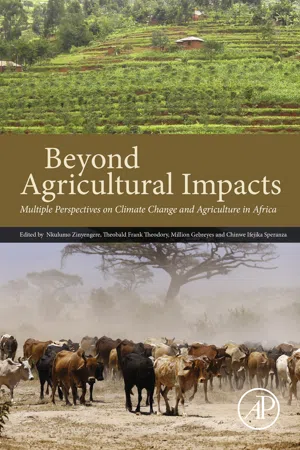
Beyond Agricultural Impacts
Multiple Perspectives on Climate Change and Agriculture in Africa
- 306 pages
- English
- ePUB (mobile friendly)
- Available on iOS & Android
eBook - ePub
Beyond Agricultural Impacts
Multiple Perspectives on Climate Change and Agriculture in Africa
About this book
Beyond Agricultural Impacts: Multiple Perspectives on Climate Change in Africa presents the theories and methods commonly applied in climate change assessment from various locations in Africa, also inspiring further research that addresses the broad spectrum of societal impacts that result from altered climate status. Using case studies, the work provides insights into climate change impacts and adaptation with a lens on vulnerable groups in African agriculture, e.g. smallholder crop and livestock farmers, women and youth. The book also highlights areas of further interest in climate change and agriculture research in Africa, all done through views from multiple disciplines in the agriculture and climate change nexus.
- Presents themes, theories, tools and methods for mitigating the impact of climate change in African agriculture
- Highlights the research gaps and opportunities in research on climate change and agriculture
- Uses examples and cases to provide insights into shaping future research
- Provides insights from African countries, including Lesotho, Malawi, Zimbabwe, Zambia, Tanzania, Ethiopia, Eritrea, Uganda, Ghana and Cameroon
Information
Chapter 1
Introduction
Grounding Climate Change, Vulnerability, and Adaptation in Africa
Million Gebreyes1, Nkulumo Zinyengere2,3, Theobald F. Theodory4, and Chinwe Ifejika Speranza5 1University of Bonn, Bonn, Germany 2Climate and Development Knowledge Network (Africa), Cape Town, South Africa 3SouthSouthNorth, Cape Town, South Africa 4Mzumbe University, Mzumbe, Tanzania 5University of Bern, Bern, Switzerland
Abstract
This chapter introduces the volume by setting the scene for the agriculture and climate change nexus in sub-Saharan Africa (SSA). It shows that agriculture is central to economies and livelihoods in SSA, yet considerably vulnerable to climate change and variability. The impacts of climate change are expected to be severe in SSA agricultural systems, calling for urgent adaptive and resilience-building actions. However, nonclimatic factors present considerable stress to the agricultural systems and these need to be fully considered in all actions that seek to address the challenges presented by climate change. These include the peculiar circumstances of rural men, women, and youth. An enabling policy environment is thus fundamental to overcoming barriers to adaptive actions, as it determines farmers’ access to agricultural inputs, including knowledge, and the degree of their participation in agriculture value chains.
Keywords
Adaptation; Agriculture; Climate change; Development; Public policy; Sub-Saharan Africa; Vulnerability
1. Agriculture and Development in Africa
In sub-Saharan Africa (SSA), agricultural growth and productivity and economic development are intricately linked. Agriculture directly contributes to up to 34% of the gross domestic product and 64% of employment (Osbahr et al., 2008). Since 1987, agricultural growth in states in SSA has largely been modest, whereas the poverty rate has remained high (AGRA, 2014). This is particularly concerning given that, by the year 2050, the population of Africa is expected to double to 2.3 billion (PDDESA-UN, 2013), meaning there will be considerably more people to feed and livelihoods to sustain. For agriculture to meet this growing food and livelihoods demand, and needs from agribusiness in SSA, production will be required to increase from current levels at a rate twice that of the global average until 2055 (FAO, 2003).
Growth in agriculture is at least two to four times more effective in reducing poverty than in other sectors (Comenetz and Caviedes, 2002). Therefore, there is no doubt that improvement in the agricultural sectors in SSA will have positive implications on food security, livelihoods, and state economies. In recognition of the importance of agriculture in African economies, the Comprehensive Africa Agriculture Development Programme (CAADP) was initiated by African states through the Maputo Declaration in 2003. CAADP signatories committed to ensuring sustained growth of at least 6% per year in agriculture by allocating at least 10% of their national budget to agriculture (NEPAD-CAADP, 2010). This has been followed up more recently by the Malabo Declaration of 2014, which reaffirms African states’ commitment to the Maputo Declaration.
Despite the good intentions of African states regarding growth in agriculture as espoused through the Maputo and Malabo declarations, a plethora of factors has placed immense challenges on the agricultural sector and economic development in SSA; these include political instability, insecure land rights, disease burden (e.g., HIV/AIDS and malaria), poor access to markets, and fluctuating world market prices (World Bank, 2009). Large-scale land investments are also dispossessing smallholder crop farmers and pastoralists of their land rights and threatening their livelihoods (De Schutter, 2011).
To add to these challenges, agriculture in SSA (crop production, livestock rearing, fisheries, and forestry) has historically had to contend with the vagaries of climate. Climate change and variability has exposed agriculture in Africa to additional stress, largely because SSA’s agricultural systems rely heavily on the climate (AGRA, 2014). The largest contributors to growth in agriculture in SSA are smallholder crop farmers and livestock keepers operating largely under marginal, dryland conditions, contributing to more than 60% of agricultural production in countries like Zimbabwe, Zambia, and Malawi (World Bank, 2009). Climate change and variability, coupled with the marginal nature of the agricultural systems and the socioeconomic vulnerability of the ill-resourced farmers that operate in them, presents one of the leading challenges to economic development in Africa in the 21st century.
2. Climate Change and Variability and Agriculture in Sub-Saharan Africa
The fifth assessment report of the Intergovernmental Panel on Climate Change shows that the climate has been changing in SSA over the past century (IPCC, 2014). There is evidence of warming throughout the past century, with temperatures rising by 0.5–2°C. Rainfall trends in SSA since the early 1900s vary considerably, with trends of decrease in some parts of West Africa, increase in large parts of Southeast Africa, and greatly varying trends of both increase and decrease in East Africa in time and space over the past 30–60 years. Despite data challenges that make it difficult to ascertain historical climatic trends across SSA, there is a satisfactory set of evidence to suggest that there is justification for the increasing importance placed on climate change and variability and the risks it poses on productive sectors like agriculture and by extension the economies of SSA states.
Climate variability is highly reflected in the varying levels of production over time in African dryland agricultural systems. For example, a strong relationship exists between climate and crop yields, with climate variability explaining 30%–75% of all crop yield variation on the continent (Ray et al., 2015). Driven by phenomena such as the El Niño Southern Oscillation (ENSO) and monsoons, the regional seasonal climate continues to play an important role in agricultural productivity, livelihoods, and economies of SSA states. Seasonal rainfall variability in selected SSA states increases disproportionally from wetter locations to the drier semiarid parts. This is particularly concerning for SSA agriculture because the larger portion of the region receives rainfall below 1000 mm per year and is where most dryland crop and livestock farmers operate (Cooper et al., 2008). ENSO and monsoons are also related to extreme climatic events such as droughts and floods in SSA and have historically had far-reaching implications. Strong ENSO-related droughts in the past, especially in 1982/83, 1991/92, and 1997/98, had strong effects in SSA states through widespread devastation of crops and livestock, e.g., in Zimbabwe, Swaziland, Lesotho, Botswana, and Zambia. Flooding has also been known to cause severe damage in countries like Mozambique and Malawi (Zinyengere, 2016). Although farming communities in SSA have learned over time to cope with climate variability through historical experiences, climate change may present novel climates that may go beyond recent historical experiences, thereby demanding that agricultural systems adjust differently.
Despite future greenhouse gas emissions, we are already locked into some warming in the future, such that to keep global temperatures increases at below 2°C as espoused in the 2015 Paris Agreement, there will be a need for urgent concerted global efforts. As it stands, warming in SSA is projected to continue and to be larger than the global annual mean warming, especially in the more arid regions, averaging around 2°C by the end of the 21st century (IPCC, 2014). Under business-as-usual high emissions scenarios, projections show an increase in average temperatures above the 2°C set by the Paris Agreement by the mid-21st century and up to 4°C by the end of the century (IPCC, 2014). Temperatures will rise highest in the southern and northern regions of Africa and relatively less in the central regions. Rainfall projections are more uncertain than temperature projections. Projections show, however, declining average rainfall in southern Africa and increasing rainfall in parts of central and eastern Africa by the mid-21st century (IPCC, 2013). As the climate changes significantly into the 21st century, the intensity and frequency of extreme climatic events in SSA will also grow in importance. Heavy rainfall events, extreme hot days, in-season dry spells, heat waves, and droughts are likely to increase, whereas the timing of the beginning of the rainy seasons will become more uncertain. Hot days are likely to increase significantly in the Sahel and parts of western and southern Africa and heavy rainfall events are likely to increase significantly in southern and eastern Africa (IPCC, 2014). These future climatic changes will have considerable impacts on agriculture in SSA, with the greatest impact expected to occur in the most marginal agricultural areas, where low and irregular rainfall is already experienced (Davis, 2011).
3. Impacts of Climate Change on Agriculture in Sub-Saharan Africa
Climate change will present considerable challenges to agriculture in SSA owing to the climate sensitivity of the predominantly dryland farming systems across the continent and the low adaptive capacity due to high prevalence of poverty. The aggregate impacts of climate change on crop production will probably be negative. Yields for maize in southern Africa are projected to decline on average by 18% and the aggregate yield for all crops combined by as high as 30% (Schlenkler and Lobell, 2010; Zinyengere et al., 2013). Yield changes of all crops combined in West Africa are also likely to be negative, with median yield losses projected at −11% by the end of the 21st century (Roudier ...
Table of contents
- Cover image
- Title page
- Table of Contents
- Copyright
- List of Contributors
- About the Editors
- About the Authors
- Preface
- Chapter 1. Introduction: Grounding Climate Change, Vulnerability, and Adaptation in Africa
- Chapter 2. Assessing Local Impacts of Climate Change on Crop Production in Southern Africa: Critiquing an Approach
- Chapter 3. A Cross-Region Study: Climate Change Adaptation in Malawi’s Agro-based Systems
- Chapter 4. Adaptation to and Coping Strategies for Climate Change and Variability by Rural Farmers in Kigezi Highlands, Uganda
- Chapter 5. Conservation Agriculture Among Farmers in Kalomo, Zambia: Potential for Productivity Under Climate Change
- Chapter 6. A Landscape Approach Toward Adaptation Under a Changing Climate in Omay Communal Lands, Zimbabwe
- Chapter 7. Vulnerability and Adaptation to Climate Change Among Mixed Farmers in Muleba and Missenyi Districts, Tanzania
- Chapter 8. Climate Change Adaptation Strategies and Gender Inequality Among Pastoralists in Tanzania
- Chapter 9. Climate, Gender, and Ethnicity: A Study on Vulnerability and Adaptation of Eritrean Farmers
- Chapter 10. “Not Migrating After All”: Young Farmers and Climate Change Adaptation in Cameroon
- Chapter 11. Dialoguing Advisory Service and Adaptation to Climate Change: Implications for African Agriculture
- Chapter 12. Agricultural Resilience to Climate Change in Anambra State, Southeastern Nigeria: Insights From Public Policy and Practice
- Chapter 13. Conclusion: Localize Responses to Climate Change Impacts
- Index
Trusted by 375,005 students
Access to over 1.5 million titles for a fair monthly price.
Study more efficiently using our study tools.
Frequently asked questions
Yes, you can cancel anytime from the Subscription tab in your account settings on the Perlego website. Your subscription will stay active until the end of your current billing period. Learn how to cancel your subscription
No, books cannot be downloaded as external files, such as PDFs, for use outside of Perlego. However, you can download books within the Perlego app for offline reading on mobile or tablet. Learn how to download books offline
Perlego offers two plans: Essential and Complete
- Essential is ideal for learners and professionals who enjoy exploring a wide range of subjects. Access the Essential Library with 800,000+ trusted titles and best-sellers across business, personal growth, and the humanities. Includes unlimited reading time and Standard Read Aloud voice.
- Complete: Perfect for advanced learners and researchers needing full, unrestricted access. Unlock 1.5M+ books across hundreds of subjects, including academic and specialized titles. The Complete Plan also includes advanced features like Premium Read Aloud and Research Assistant.
We are an online textbook subscription service, where you can get access to an entire online library for less than the price of a single book per month. With over 1.5 million books across 990+ topics, we’ve got you covered! Learn about our mission
Look out for the read-aloud symbol on your next book to see if you can listen to it. The read-aloud tool reads text aloud for you, highlighting the text as it is being read. You can pause it, speed it up and slow it down. Learn more about Read Aloud
Yes! You can use the Perlego app on both iOS and Android devices to read anytime, anywhere — even offline. Perfect for commutes or when you’re on the go.
Please note we cannot support devices running on iOS 13 and Android 7 or earlier. Learn more about using the app
Please note we cannot support devices running on iOS 13 and Android 7 or earlier. Learn more about using the app
Yes, you can access Beyond Agricultural Impacts by Nkulumo Zinyengere,Theobald Frank Theodory,Million Gebreyes,Chinwe Ifejika Speranza in PDF and/or ePUB format, as well as other popular books in Technology & Engineering & Environmental Science. We have over 1.5 million books available in our catalogue for you to explore.