eBook - ePub
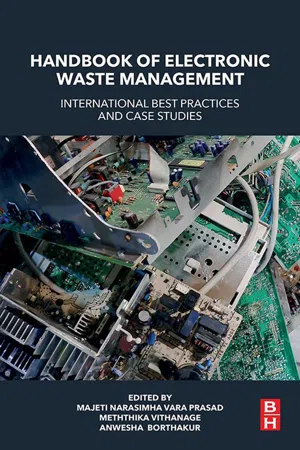
Handbook of Electronic Waste Management
International Best Practices and Case Studies
- 642 pages
- English
- ePUB (mobile friendly)
- Available on iOS & Android
eBook - ePub
Handbook of Electronic Waste Management
International Best Practices and Case Studies
About this book
Handbook of Electronic Waste Management: International Best Practices and Case Studies begin with a brief summary of the environmental challenges associated with the approaches used in international e-waste handling. The book's authors offer a detailed presentation of e-waste handling methods that also includes examples to further demonstrate how they work in the real world. This is followed by data that reveals the geographies of e-waste flows at global, national and subnational levels. Users will find this resource to be a detailed presentation of e-waste estimation methods that also addresses both the handling of e-waste and their hazardous effect on the surrounding environment.
- Includes case studies to illustrate the implementation of innovative e-waste treatment technologies
- Provides methods for designing and managing e-waste management networks in accordance with regulations, fulfilment obligations and process efficiency
- Reference guide for adapting traditional waste management methods and handling practices to the handling and storage of electronic waste until disposal
- Provides e-waste handling solutions for both urban and rural perspectives
Information
Topic
Scienze biologicheSubtopic
Scienze ambientali1
An overview of treatment technologies of E-waste
Peeranart Kiddee1, Jatindra Kumar Pradhan2, Sanchita Mandal3, Jayanta Kumar Biswas4 and Binoy Sarkar3, 1Faculty of Science, Thaksin University, Phatthalung Campus, Phatthalung, Thailand, 2Department of Zoology, Government College (Autonomous), Bhawanipatna, India, 3Department of Animal and Plant Sciences, The University of Sheffield, Sheffield, United Kingdom, 4Enviromicrobiology, Ecotoxicology and Ecotechnology Research Unit, Department of Ecological Studies, and International Centre for Ecological Engineering, University of Kalyani, Kalyani, West Bengal, India
Abstract
Electronic waste (E-waste) has been stated as one of the most rapidly growing waste streams in the world. It consists of a wide range of elements and compounds including both valuable and hazardous materials. E-waste can contaminate the environment and threaten human health through its improper recycling and disposal methods. Moreover, E-waste represents a significant potential source of valuable materials to make the recycling of this waste economically fascinating. This chapter presents an overview of E-waste treatment technologies including sanitary landfill and recycling of precious metals, nonmetal elements, plastics, and glasses. The recycling of E-waste has become a significant issue because of the strange growth in the production of E-waste and increased awareness among people regarding environmental protection. Consequently, the primitive treatment technologies cannot reach the future obligations of industry because of the potential risk of environmental contamination, high cost, and low efficiency. An effective utilization of the reusable resources is therefore a prerequisite for developing new technologies to treat E-waste.
Keywords
E-waste; environmental protection; E-waste recycling; resource recovery
1.1 Introduction
During the last two decades, technological advancement has rapidly happened causing obsolete and end-of-life electronic devices to become electronic wastes (E-waste) (Kiddee et al., 2013a). For instance, lifespan of a computer has reduced from 4–6 years in 1992 to 2–3 years in 2015 (Widmer and Lombard, 2005; Yazici and Deveci, 2013; Shamim et al., 2015). In 2016, the quantity of E-waste generated globally grew up to approximately 44.7 million tons equivalent to 6.1 kg per inhabitant (Ilankoon et al., 2018). The increase rate of E-waste generation is 3%–5% per annum globally (Kumar et al., 2017; Ilankoon et al., 2018). Despite problem in terms of quantity, E-waste itself is also toxic. E-waste contains up to 1000 toxic substances (Puckett and Smith, 2002). Common toxicants found in E-waste include toxic metals and metalloids such as arsenic, barium, beryllium, cadmium, cobalt, chromium, copper, iron, lead, mercury, nickel, and zinc, and persistent organic pollutants such as dioxin, brominated flame retardants (BFRs), polycyclic aromatic hydrocarbons (PAHs), polychlorinated biphenyls (PCBs), polybrominated dibenzo-p-dioxins, dibenzofurans (PBDD/Fs), polychlorinated dibenzo-p-dioxins, dibenzofurans (PCDD/Fs), polyvinyl chloride (PVC), and alternative halogenated flame retardants (AHFRs). Such a variety of toxicants could cause environmental problems and harm human health unless appropriate management procedure applied.
E-waste disposal to landfills and incineration can produce significant quantities of toxicants. Hazardous substances found in landfill leachates are worsened specifically with the old landfills that were not initially designed to receive E-waste, and do not have proper liners or barriers to prevent leakage of leachates (Kiddee et al., 2014). Landfill leachates can be a source of contamination to the soil, surface water, and groundwater (Baccini et al., 1987). A number of studies (e.g., Osako et al., 2004; Danon-Schaffer et al., 2006; Spalvins et al., 2008; Odusanya et al., 2009; Hearn et al., 2011; Kiddee et al., 2014) reported high level of heavy metals and polyhalogenated organics including polybrominated diphenyl ether (PBDE) found in landfill leachates. During incineration of E-waste, greenhouse gases, mercury, and dioxins are also released into the environment (Balde et al., 2015).
Although E-waste is simply categorized as hazardous waste, it has significant potential for value recovery. E-waste in fact consists of several valuable materials (such as iron, copper, aluminum, and plastics) as well as precious metals (such as gold, silver, platinum, and palladium). Hence, it could be said that E-waste is a feasible urban mine. It provides materials for remanufacture, refurbishment as well as recycling. For example, 11% of the global gold production (2,770 tons) came from mines in 2013 while approximately 300 tons of gold was recovered from E-waste in 2014 (USGS, 2014). The resource in E-waste is normally recycled by both formal and informal procedures. Manual E-waste recycling inescapably leads to the release of toxins and persistent organic pollutants into the environment in addition to harming the health of the recycling person due to the primitive techniques used (Wong et al., 2007). The hazards of E-waste contamination to the surrounding environment including soil, sediment, water, and air has become a serious issue in many countries such as in China (Tang et al., 2010; Wang et al., 2011; Bi et al., 2018; Wu et al., 2019), India (Ha et al., 2009), and Thailand (Muenhor et al., 2010; Kiddee and Decharat, 2018). In case of humans, exposure to toxic substances through inhalation, ingestion and dermal contact can harm the human health in both chronic and acute conditions (Julander et al., 2014). Several studies demonstrated high level of health risks in E-waste recycling sites (Ha et al., 2009; Bi et al., 2018: Kiddee and Decharat, 2018; Oguri et al., 2018; Singh et al., 2018; Wu et al., 2019). Therefore, E-waste recycling industries become increasingly aware of such danger, and start to mitigate impacts from unsafe procedures along with applying appropriate E-waste treatment technologies. Innovative technologies including pyrometallurgy, hydrometallurgy, biometallurgy, high-pressure compaction, thermal treatment, organic dissolution, thermal plasma coupled with acid leaching, substrate oxidation and bioleaching can be applied to recover the potential resources in E-waste. This chapter provides an overview of the toxicity of hazardous substances in E-waste and various E-waste treatment strategies.
1.2 Types of contaminants in E-waste
E-waste is a complex mixture of many materials that contain up to 1,000 toxic substances (Puckett and Smith, 2002). E-waste is classified as a hazardous waste because it is composed of toxic substances such as antimony, arsenic, barium, cadmium, chromium, lead, manganese, mercury, indium, selenium, brominated flame retardants, polyaromatic hydrocarbons, polybrominated diphenyl ethers, and polychlorinated biphenyls. Distinct from other categorization, E-waste also has signi...
Table of contents
- Cover image
- Title page
- Table of Contents
- Copyright
- List of contributors
- About the authors
- Preface
- Acknowledgments
- 1. An overview of treatment technologies of E-waste
- 2. Urban mining of E-waste: treasure hunting for precious nanometals
- 3. Biochemical hazards associated with unsafe disposal of electrical and electronic items
- 4. Policy issues for efficient management of E-waste in developing countries
- 5. E-waste as a challenge for public and ecosystem health
- 6. Electrochemical enhanced metal extraction from E-waste
- 7. Phytoremediation for E-waste contaminated sites
- 8. Organic pollutants from E-waste and their electrokinetic remediation
- 9. Mapping the emergence of research activities on E-waste: a scientometric analysis and an in-depth review
- 10. Waste electrical and electronic equipment in India: diversity, flows, and resource recovery approaches
- 11. Socio-technological challenges in formalization of E-waste recycling in India
- 12. Electrical and electronic waste in Pakistan: the management practices and perspectives
- 13. Challenges in E-waste management in Sri Lanka
- 14. Electronic waste management practices in Nigeria
- 15. E-waste recycling slum in the heart of Accra, Ghana: the dirty secrets
- 16. E-waste situation and current practices in Brazil
- 17. The impact of waste of electrical and electronic equipment public police in Latin America: analysis of the physical, economical, and information flow
- 18. Environmental pollution of E-waste: generation, collection, legislation, and recycling practices in Mexico
- 19. Improving sustainability of E-waste management through the systemic design of solutions: the cases of Colombia and Ecuador
- 20. E-waste management in Ecuador, current situation and perspectives
- 21. The Chilean regulation of waste electrical and electronic equipment (WEEE): some of the challenges and opportunities to incorporate informal E-waste recyclers
- 22. Electronic waste management in Romania: pathways for sustainable practices
- 23. E-waste management practices in Australia
- 24. E-waste policies in the United States: minimalistic federal action and fragmented subnational activities
- Index
Trusted by 375,005 students
Access to over 1.5 million titles for a fair monthly price.
Study more efficiently using our study tools.
Frequently asked questions
Yes, you can cancel anytime from the Subscription tab in your account settings on the Perlego website. Your subscription will stay active until the end of your current billing period. Learn how to cancel your subscription
No, books cannot be downloaded as external files, such as PDFs, for use outside of Perlego. However, you can download books within the Perlego app for offline reading on mobile or tablet. Learn how to download books offline
Perlego offers two plans: Essential and Complete
- Essential is ideal for learners and professionals who enjoy exploring a wide range of subjects. Access the Essential Library with 800,000+ trusted titles and best-sellers across business, personal growth, and the humanities. Includes unlimited reading time and Standard Read Aloud voice.
- Complete: Perfect for advanced learners and researchers needing full, unrestricted access. Unlock 1.5M+ books across hundreds of subjects, including academic and specialized titles. The Complete Plan also includes advanced features like Premium Read Aloud and Research Assistant.
We are an online textbook subscription service, where you can get access to an entire online library for less than the price of a single book per month. With over 1.5 million books across 990+ topics, we’ve got you covered! Learn about our mission
Look out for the read-aloud symbol on your next book to see if you can listen to it. The read-aloud tool reads text aloud for you, highlighting the text as it is being read. You can pause it, speed it up and slow it down. Learn more about Read Aloud
Yes! You can use the Perlego app on both iOS and Android devices to read anytime, anywhere — even offline. Perfect for commutes or when you’re on the go.
Please note we cannot support devices running on iOS 13 and Android 7 or earlier. Learn more about using the app
Please note we cannot support devices running on iOS 13 and Android 7 or earlier. Learn more about using the app
Yes, you can access Handbook of Electronic Waste Management by Majeti Narasimha Var Prasad,Meththika Vithanage,Anwesha Borthakur,Majeti Narasimha Vara Prasad in PDF and/or ePUB format, as well as other popular books in Scienze biologiche & Scienze ambientali. We have over 1.5 million books available in our catalogue for you to explore.