- 188 pages
- English
- ePUB (mobile friendly)
- Available on iOS & Android
eBook - ePub
About this book
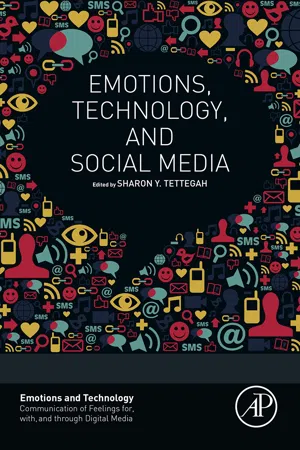
Emotions, Technology, and Social Media discusses the ways the social media sphere uses emotion and technology, and how each of these has become part of the digital culture. The book explores this expression within a psychological theoretical framework, addressing feelings about social media, and its role in education and knowledge generation. The second section investigates the expression of feelings within social media spaces, while subsequent sections adopt a paradigm of active audience consumption to use social media to express feelings and maintain social connectivity.
- Discusses the significant relationships between Web 2.0 technologies and learning traits
- Presents studies about Facebook usage and individual emotional states
- Investigates the shared emotions in the construction of "cyberculture
- Shows the extent to which scientists use social media in their work, and the ways in which they use the social media
- Analyzes the consequences of the online disinhibition effect
- Examines YouTube as a source of opinions and discussions which can be used to track the emotions evoked by videos and the emotions expressed through textual comments
- Details how Reddit users' media choices are emotionally useful and gratifying in the "memeplex
- Links social interaction and the emotional life with that of digital devices and resources
Information
Section 1
Human Affect and Its Effect in Social Media Technology
Chapter 1
Affect, People, and Digital Social Networks
Adam Nash RMIT University, Melbourne, VIC, Australia
Abstract
What constitutes an affect cycle in the medium of digital data, how it is enacted, and what are the consequences for individuals, for digital data, and for the society that comprises both individuals and digital data? Guided by contemporary theories of both affect and digital networks, this chapter traces cycles of affect through and between the overdetermined and underexamined sites constituted by digital networks. Examining interactions across social networks and other multiuser virtual environments, an attempt is made to identify who and what are participating in the capture and escape of affect, how this is facilitated, and what is changed during, and as a result of, these affective interactions. Combining a deep understanding of the technical workings of digital networks with a keen receptiveness to the affective potential of emotional and artistic agency in our digital world, this chapter situates human affective practice in the uneasy environment of algorithmic digital corporate networks.
Keywords
Affect; Digital networks; Social networks
Introduction
What constitutes an affect cycle in digital networks? How is it enacted and what are the consequences for individuals, for digital data, and for the society that comprises individuals and digital data? Further, what is the relationship between affect and emotion, and what is their relationship with digital networks? Is it possible for an affect cycle to be established between people and digital networks, between people via digital networks, and between digital networks themselves? By examining recent affect theory in combination with Simondon's theories of technical evolution and other theories of interaction and knowledge, I will define the nature of affect as it emerges through the cycle of interaction between people and digital networks. I trace these cycles through and between the overdetermined and underexamined sites of interaction across digital networks in order to identify who and what are participating in the capture and escape of affect. I also show how this is facilitated and what is changed during, and as a result of, these affective interactions. Using a deep understanding of the technical workings of digital networks, combined with receptiveness to the affective potential of emotional agency in our digital world, I situate human affective practice in the uneasy environment of algorithmic digital corporate networks.
At the core of these networks is an understanding of the way digital networks work—technically and socially. With the onslaught of everything, everywhere, in real time, the mass amount of information that floods our networks is meaningless until it surfaces, as it is stored in a manner that is indecipherable to people until it has passed through filters. Filters reign as contextualizers, modulators, and curators of data. Peoples' digital screens—once wildly free of filters—are now dominated by capitalist constructs that are designed to filter, on behalf of advertisers, while being presented as empowering tools in the service of every individual. Age, gender, place, and likes compile targeted content purified for our unwitting consumption. Culture is being curated algorithmically and on-the-fly to create virtualized, quantified versions of individuals with all possibility for change removed. These parodies of the individual are created in order to have them produce and consume the same product. As Pariser (2011) puts it in The Filter Bubble, these filters create a “kind of informational determinism in which … [y]ou can get stuck in a static, ever narrowing version of yourself - an endless you-loop” (p. 14). What are the consequences of this for individuals, for their society, and for the digital networks that increasingly have come to define both? To begin to answer these questions, we look first at the relationship between emotion, cognition, affect, and technical networks.
Affect, Emotion, and Cognition
Affect theory attempts to maintain a distinction between affect and cognition, with some affect theorists equating affect with emotions, but classing them as precognitive or nonintentional events over which we have no conscious control (Clough, 2010, p. 206). Other affect theorists, notably Massumi (2002), equate emotion to a post facto cognitive rationalization of a precognitive affect. The distinction between affect and cognition arises, to a certain extent, from findings in neuroscience that precognitive responses govern humans' most “basic emotions,” and “occur independently of intention or meaning” (Leys, 2011, p. 437). Thus, affect theory holds that there is a gap between the cause of an affect and an individual's interpretation of it. Further, the cause of the affect is not what an embodied emotion approach would see as the object of an intentional state governed by ideology and desire, rather it is a generic trigger for some kind of built-in physiological response that is devoid of meaning and that occurs prior to any cognitive intention (Leys, 2011, p. 438; Tomkins, 2008, p. 137). This mechanistic view of affect therefore raises questions about the relationship between ideology, emotion, and affect. This is of interest in relation to digital networks for several reasons, not least of which is related to questions of the nature of affect as it relates to digital entities along with other more obvious questions around the role of emotion in the uptake and use of digital social networks.
One of the problems with separating affect and cognition is that it has the potential to replicate a Cartesian mind/body duality that most affect theorists would actually set out to dissolve, as Leys (2011) is keen to point out, or to “a return to the subject as the subject of emotion” (Clough, 2010, p. 207). Sedgwick (2003) noted,
But of course it's far easier to deprecate the confounding, tendentious effects of binary modes of thinking - and to expose their often stultifying perseveration - than it is to articulate or model other structures of thought. Even to invoke nondualism, as plenty of Buddhist sutras point out, is to tumble right into a dualistic trap. (p. 2, emphasis in original)
Inherent in a privileging of precognitive affect is the denial of rational agency in the formation of a subject or, in an extreme projection of the “basic emotions” model, that change is not even possible. This is clearly not what affect theory proposes, but it is useful to stay attentive to any conflations or elisions that may result in contradictory or nonsensical conclusions formed in haste to reject psychoanalytical readings of emotions. This is especially true when a cultural theory, such as affect theory, tries to balance itself between a robust critique of positivist scientific findings and actually uses some of those same findings to reinforce its own theories (Massumi, 1995, 2002). The potential paradoxical pitfalls along the way to affect theory are many, as well as positivism, they include mechanistic determinism and transcendent or teleological vitalism. There is also a noticeable scarcity of discussion of emotion in the canon of affect theory as it currently exists, which possibly arises from an underlying desire to deanthropocentrize theory and create a distance from psychoanalytic and poststructuralist techniques.
If such unproductive problems result from a stubborn insistence on the priority (or at least “priorness”) of noncognitive affect over cognitive ideology or emotion, along with an accompanying confusion over which camp emotions belong to, perhaps it is better to take the attitude of proto-affect theory philosopher James (2008) who suggests, in line with Sedgwick's ambivalence, that this emotional undecidability is entirely appropriate for human experience of emotion in the world as well as for a philosophy that attempts to resist simple binaries. Viewing emotion as the human response to affect neither prescribes emotion as a response to affect nor proscribes nonhuman entities from engaging with affect. I am going to suggest that this open approach may also serve as an attempt to understand the complex assemblage of relationships between physiological and psychological affects, emotions, digital networks, and time, by leveraging the thought of French philosopher Gilbert Simondon.
Ontogenesis and Individuation
Simondon's philosophy of ontogenesis and individuation was very influential on Gilles Deleuze (Iliadis, 2013), who has himself been very influential on affect theory. It is Deleuze, along with Guattari, Spinoza, and Bergson, who Patricia Clough invokes to envisage a new concept of a body that is expanded through digitization and informationally open to its environment. In this, Clough is echoing similar philosophies to Luciana Parisi, Rosi Braidotti, and, most notably, Anna Munster. Such philosophies are inspired by Deleuze's concept of the virtual and his reading of Spinoza's definition of bodies as “compositions of relations” (Deleuze, 1988, p. 124) and therefore of affect that may not be reduced to physical interactions. This is in apparent contrast with contemporary neuroscience. Much of Deleuze's thinking about the virtual/actual continuum and becoming is heavily influenced by Simondon's ontogenetic philosophy of the metastable preindividual, transduction, and individuation. Take, for example, this passage from Deleuze's (1994) Difference and Repetition:
All individuality is intensive, and therefore serial, stepped and communicating, comprising and affirming in itself the difference in intensities by which it is constituted. Gilbert Simondon has shown recently that individuation presupposes a prior metastable state - in other words, the existence of a ‘disparateness’ such as at least two orders of magnitude or two scales of heterogeneous reality between which potentials are distributed. (p. 246)
Later in the same book, Deleuze (1994) puts this concept—of individuation as an ongoing Simondonian procedural resolution of disparate entities within a metastable environment—in the context of Nietzsche's Dionysian will to power that recognizes the concept of the individual as abstract, replaced in actuality by individuation:
What cannot be replaced is individuation itself. Beyond the self and the I we find not the impersonal but the individual and its factors, individuation and its fields, individ...
Table of contents
- Cover image
- Title page
- Table of Contents
- Copyright
- Contributors
- Foreword
- Preface
- Section 1: Human Affect and Its Effect in Social Media Technology
- Section 2: Development, Social Media, Emotions, and the Psychology of Learning
- Index
Trusted by 375,005 students
Access to over 1.5 million titles for a fair monthly price.
Study more efficiently using our study tools.
Frequently asked questions
Yes, you can cancel anytime from the Subscription tab in your account settings on the Perlego website. Your subscription will stay active until the end of your current billing period. Learn how to cancel your subscription
No, books cannot be downloaded as external files, such as PDFs, for use outside of Perlego. However, you can download books within the Perlego app for offline reading on mobile or tablet. Learn how to download books offline
Perlego offers two plans: Essential and Complete
- Essential is ideal for learners and professionals who enjoy exploring a wide range of subjects. Access the Essential Library with 800,000+ trusted titles and best-sellers across business, personal growth, and the humanities. Includes unlimited reading time and Standard Read Aloud voice.
- Complete: Perfect for advanced learners and researchers needing full, unrestricted access. Unlock 1.5M+ books across hundreds of subjects, including academic and specialized titles. The Complete Plan also includes advanced features like Premium Read Aloud and Research Assistant.
We are an online textbook subscription service, where you can get access to an entire online library for less than the price of a single book per month. With over 1.5 million books across 990+ topics, we’ve got you covered! Learn about our mission
Look out for the read-aloud symbol on your next book to see if you can listen to it. The read-aloud tool reads text aloud for you, highlighting the text as it is being read. You can pause it, speed it up and slow it down. Learn more about Read Aloud
Yes! You can use the Perlego app on both iOS and Android devices to read anytime, anywhere — even offline. Perfect for commutes or when you’re on the go.
Please note we cannot support devices running on iOS 13 and Android 7 or earlier. Learn more about using the app
Please note we cannot support devices running on iOS 13 and Android 7 or earlier. Learn more about using the app
Yes, you can access Emotions, Technology, and Social Media by in PDF and/or ePUB format, as well as other popular books in Psychology & Computer Science General. We have over 1.5 million books available in our catalogue for you to explore.