eBook - ePub
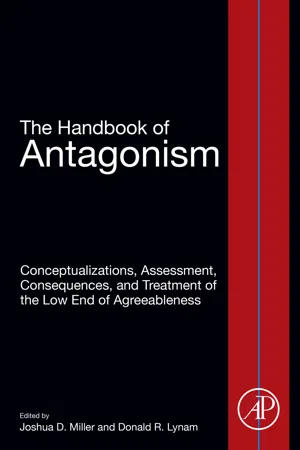
The Handbook of Antagonism
Conceptualizations, Assessment, Consequences, and Treatment of the Low End of Agreeableness
- 438 pages
- English
- ePUB (mobile friendly)
- Available on iOS & Android
eBook - ePub
The Handbook of Antagonism
Conceptualizations, Assessment, Consequences, and Treatment of the Low End of Agreeableness
About this book
The Handbook of Antagonism: Conceptualizations, Assessment, Consequences, and Treatment of the Low End of Agreeableness looks at the theoretical and empirical underpinnings of antagonism, highlighting the consequences of the trait, its role in a number of problem behaviors and psychiatric disorders, and how it exerts itself on externalizing behaviors. Covering the biological and evolutionary roots of antagonism, the book provides clinical insight on assessment strategies, while also outlining a number of treatment techniques, including motivational interviewing, cognitive behavioral therapy, interpersonal psychology and psychodynamic treatment approaches.
In addition, the book explores the development of antagonism across childhood and adolescence, discussing the societal consequences of the trait, as well as its role in a number of problem behaviors, such as aggression, violence, crime and substance use.
- Provides an overview on the development, assessment and treatment of antagonism
- Looks at antagonism's role in work, romantic relationships and other domains
- Outlines self-report and non-self-report assessment approaches
- Studies the links between antagonism, psychopathy, narcissism and antisocial personality
- Approaches antagonism from a dimensional trait model
- Analyzes the role antagonism plays in several prominent psychiatric disorders
Information
1
On the ubiquity and importance of antagonism
Donald R. Lynam⁎; Joshua D. Miller† ⁎ Department of Psychological Sciences, Purdue University, West Lafayette, IN, United States
† Department of Psychology, University of Georgia, Athens, GA, United States
† Department of Psychology, University of Georgia, Athens, GA, United States
Abstract
Antagonism, defined here as the low pole of trait Agreeableness, references traits related to immorality, combativeness, grandiosity, callousness, and distrustfulness. It is a robust correlate of externalizing behaviors such as antisocial behavior, aggression, and substance use; in many cases, it is by far the strongest correlate of these behaviors among the traits that make up the five-factor model of personality. It similarly represents the core of many psychopathological constructs that are of great interest to the public and researchers alike (e.g., psychopathy, antisocial and narcissistic personality disorders) due to their relations with externalizing behaviors. As Neuroticism is core to understanding the intense distress and suffering that comes with internalizing disorders, Antagonism is core to understanding the impairment and suffering (to the individual and society at large) that comes with externalizing disorders.
Keywords
Antisocial behavior; Aggression; Personality disorders; Psychopathy; Narcissism
What is antagonism?
Antagonism can be defined in many ways. Most minimally, Antagonism, in this chapter and throughout this book, is conceptualized as one end of a bipolar personality domain dealing with an orientation toward others that runs from Antagonistic to Agreeable. Slightly less minimally, we can define this domain extensionally, through more basic trait terms that comprise Antagonism. Crowe, Lynam, and Miller (2018; see chap. 4) recently examined the structure of Antagonism/Agreeableness among personality inventories designed to capture this domain. The authors administered 131 items from 22 scales to a large sample of participants (N = 1205) recruited from Amazon's Mechanical Turk (MTurk) website. After deleting redundant items, the authors conducted a bass-ackward analysis (Goldberg, 2006) which allows one to examine the factor emergence of the domain, from a single factor to increasingly more specific factors. An optimal five-factor structure was identified through this procedure. Accordingly, the Antagonism/Agreeableness dimension can be said to include these more basic bipolar traits: callousness versus compassion, immorality versus morality, distrust versus trust, combativeness versus affability, and arrogance versus modesty. Table 1 includes these bipolar dimensions as well as traits describing both the Antagonistic and Agreeable poles.
Table 1
| Facet | Antagonism | Agreeableness |
|---|---|---|
| Callousness vs compassion | Exploitative Callous Ruthless | Altruistic Empathic Tender-minded |
| Immorality vs morality | Manipulative Deceptive Cunning | Confiding Honest Straightforward |
| Distrust vs trust | Skeptical Suspicious Cynical | Trusting Naïve Gullible |
| Combativeness vs affability | Oppositional Aggressive Quarrelsome | Cooperative Polite Docile |
| Arrogance vs modesty | Boastful Egocentric Self-centered | Humble Unassuming Self-effacing |
More broadly, this domain can be characterized as individual differences in the motivation to maintain positive social relations with others; as such, Antagonism/Agreeableness is firmly grounded in an interpersonal context (Graziano & Eisenberg, 1997; Graziano & Tobin, 2017). Antagonistic individuals place less value on interpersonal harmony, being more likely to sacrifice interpersonal harmony for other goals. Agreeable individuals, on the other hand, are likely to be motivated to maintain harmonious relations across many interpersonal contexts, whether it be with a romantic partner or an acquaintance. This domain also has theoretical links to behaviors that have figured prominently in human evolutionary history, such as altruism and social cooperation (Axelrod, 1984; Brown & Brown, 2006; Riolo, Cohen, & Axelrod, 2001). Indeed, the consistent cross-cultural emergence of an Antagonism/Agreeableness domain using natural language approaches (e.g., Costa & McCrae, 1992; Heaven, Connors, & Stones, 1994) suggests that Antagonism-related traits describe fundamental ways in which human beings think, feel, and relate to one another.
We have two goals for the remainder of the chapter. First, we review the role of Antagonism in personality, personality disorders, and general psychopathology. Second, we examine the role of Antagonism in various sorts of interpersonal problems. We seek to answer two questions. How ubiquitous is Antagonism in models of behavior? How important is it to outcomes we care about? Our answer to both questions is very.
Antagonism in basic models of personality
Antagonism/Agreeableness appears in all major models of personality. It has its most explicit representation in the Five-Factor Model of personality (FFM) which was derived from studies of the English...
Table of contents
- Cover image
- Title page
- Table of Contents
- Copyright
- Contributors
- Preface
- 1: On the ubiquity and importance of antagonism
- 2: Five-Factor Model antagonism
- 3: Antagonism from a developmental perspective
- 4: The structure of antagonism
- 5: Self-report assessment of antagonism
- 6: Biological correlates of antagonism
- 7: Agreeableness, antagonism, and mental health across cultures
- 8: Translational value of nonhuman primate models of antagonism
- 9: Theoretical conceptualizations of agreeableness and antagonism
- 10: A social cognitive analysis of antagonism and reactive aggression
- 11: Antagonism from the perspective of interpersonal theory
- 12: Antagonism's place in psychiatric nosology
- 13: Antagonism and the DSM-5 alternative model of personality disorders
- 14: Antagonism in psychopathy
- 15: A Trifurcated Model of Narcissism: On the pivotal role of trait Antagonism
- 16: Antagonism and borderline personality disorder
- 17: Antagonism in the Dark Triad
- 18: Antagonism and romantic relationships
- 19: Antagonism and work outcomes: Implicit and explicit considerations
- 20: Antagonism and crime
- 21: Stability and change in antagonism over the lifespan
- 22: Treatment of antagonism: Motivational Interviewing
- 23: Psychodynamic approaches to treating antagonism
- 24: Treatment of antagonism: Cognitive behavioral therapy
- 25: Addressing antagonism in a Dialectical Behavior Therapy framework
- 26: Pharmacologic interventions for antagonism and related disorders
- 27: Volitional change in antagonism
- Index
Trusted by 375,005 students
Access to over 1.5 million titles for a fair monthly price.
Study more efficiently using our study tools.
Frequently asked questions
Yes, you can cancel anytime from the Subscription tab in your account settings on the Perlego website. Your subscription will stay active until the end of your current billing period. Learn how to cancel your subscription
No, books cannot be downloaded as external files, such as PDFs, for use outside of Perlego. However, you can download books within the Perlego app for offline reading on mobile or tablet. Learn how to download books offline
Perlego offers two plans: Essential and Complete
- Essential is ideal for learners and professionals who enjoy exploring a wide range of subjects. Access the Essential Library with 800,000+ trusted titles and best-sellers across business, personal growth, and the humanities. Includes unlimited reading time and Standard Read Aloud voice.
- Complete: Perfect for advanced learners and researchers needing full, unrestricted access. Unlock 1.5M+ books across hundreds of subjects, including academic and specialized titles. The Complete Plan also includes advanced features like Premium Read Aloud and Research Assistant.
We are an online textbook subscription service, where you can get access to an entire online library for less than the price of a single book per month. With over 1.5 million books across 990+ topics, we’ve got you covered! Learn about our mission
Look out for the read-aloud symbol on your next book to see if you can listen to it. The read-aloud tool reads text aloud for you, highlighting the text as it is being read. You can pause it, speed it up and slow it down. Learn more about Read Aloud
Yes! You can use the Perlego app on both iOS and Android devices to read anytime, anywhere — even offline. Perfect for commutes or when you’re on the go.
Please note we cannot support devices running on iOS 13 and Android 7 or earlier. Learn more about using the app
Please note we cannot support devices running on iOS 13 and Android 7 or earlier. Learn more about using the app
Yes, you can access The Handbook of Antagonism by Joshua W. Miller,Donald Lynam in PDF and/or ePUB format, as well as other popular books in Psychology & History & Theory in Psychology. We have over 1.5 million books available in our catalogue for you to explore.