eBook - ePub
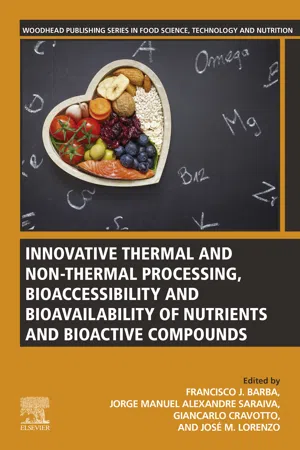
Innovative Thermal and Non-Thermal Processing, Bioaccessibility and Bioavailability of Nutrients and Bioactive Compounds
- 370 pages
- English
- ePUB (mobile friendly)
- Available on iOS & Android
eBook - ePub
Innovative Thermal and Non-Thermal Processing, Bioaccessibility and Bioavailability of Nutrients and Bioactive Compounds
About this book
Innovative Thermal and Nonthermal Processing, Bioacessibility and Bioavailability of Nutrients and Bioactive Compounds presents the implications of conventional and innovative processing on the nutritional and health aspects of food products. Chapters cover the relationship between gastronomic science, nutrition and food science in the development of healthy products, introduce the most commonly used conventional and innovative approaches to preserve foods and extract valuable compounds, describe how processing affects bioavailability and bioaccessibility of lipids, particularly fatty acids, protein, amino acids and carbohydrates, and discuss how processing affects bioavailability and bioaccessibility of minerals, water-soluble vitamins, and fat soluble vitamins.
Final sections cover processing, bioavailability and bioaccessibility of bioactive compounds, describing how processing (conventional and non-conventional) is affecting to bioavailability and bioaccessibility of bioactive sulphur compounds, polyphenols, flavonoids, and bioactive peptides.
- Presents the implications of conventional and innovative processing on the nutritional and health aspects of food products
- Introduces the most commonly used conventional and innovative approaches to preserve foods and extract valuable compounds
- Explains how processing (conventional and non-conventional) affects the bioavailability and bioaccessibility of bioactive sulphur compounds, polyphenols, flavonoids and bioactive peptides
Information
Section 1
Introduction
1
An integrated strategy between gastronomic science, food science and technology, and nutrition in the development of healthy food products
Elena Roselló-Soto*; Rohit Thirumdas†; José M. Lorenzo‡; Paulo Eduardo Sichetti Munekata‡,§; Predrag Putnik¶; Shahin Roohinejad‖; Kumar Mallikarjunan‖; Francisco J. Barba* ⁎ Nutrition and Food Science Area, Preventive Medicine and Public Health, Food Sciences, Toxicology and Forensic Medicine Department, Faculty of Pharmacy, Universitat de València, València, Spain
† Department of Food Process Technology, College of Food Science and Technology, PJTSAU, Telangana, India
‡ Meat Technology Center of Galicia, Parque Tecnológico de Galicia, Ourense, Spain
§ Department of Food Engineering, Faculty of Animal Science and Food Engineering, University of Sao Paulo (USP), Pirassununga, Brazil
¶ Faculty of Food Technology and Biotechnology, University of Zagreb, Zagreb, Croatia
‖ Department of Food Science and Nutrition, University of Minnesota, Saint Paul, MN, United States
† Department of Food Process Technology, College of Food Science and Technology, PJTSAU, Telangana, India
‡ Meat Technology Center of Galicia, Parque Tecnológico de Galicia, Ourense, Spain
§ Department of Food Engineering, Faculty of Animal Science and Food Engineering, University of Sao Paulo (USP), Pirassununga, Brazil
¶ Faculty of Food Technology and Biotechnology, University of Zagreb, Zagreb, Croatia
‖ Department of Food Science and Nutrition, University of Minnesota, Saint Paul, MN, United States
Abstract
The development and introduction of healthier products into the marketplace is an important topic of discussion. Three main knowledge areas are involved: gastronomy, food science and technology, and nutrition. The many intersections among these areas are essential since the digestion of nutrients and bioactive compounds can be influenced by thermal food processing and preparation. Conversely, nonthermal technologies are interesting alternatives to reduce and even prevent the loss of nutrients and bioactive compounds from foods. However, at this stage of development little is known about the impact of these innovative nonthermal technologies on the subsequent bioaccessibility and bioavailability of nutrients and bioactive compounds. There are some challenges in the use of nonthermal technologies on a large scale by the food industry, particularly the lack of specific regulation for such technologies, especially in Europe. In this introductory chapter, the basic concepts of food processing, preparation, and nonthermal technologies will be presented.
Keywords
High-pressure processing; Pulsed electric fields; Microwave; Ultrasound; Food industry; Novel foods; Functional products; Safety
Acknowledgments
The authors José M. Lorenzo and Paulo E.S. Munekata are members of the MARCARNE network, funded by CYTED (ref. 116RT0503). Paulo E. Munekata acknowledges postdoctoral fellowship support from Ministry of Economy and Competitiveness (MINECO, Spain) ‘‘Juan de la Cierva” program (FJCI-2016-29486). Moreover, F.J.B. and J.M.L. would like to thank Generalitat Valenciana for the financial support (IDIFEDER/2018/046—Procesos innovadores de extracción y conservación: pulsos eléctricos y fluidos supercríticos) through European Union ERDF funds (European Regional Development Fund). P. Putnik, wish to thank Croatian Science Foundation for support through the funding of the project: “High voltage discharges for green solvent extraction of bioactive compounds from Mediterranean herbs (IP-2016-06-1913).”
1.1 Introduction
A diverse and balanced diet, along with healthy choices, is considered as one of the necessary actions to maintain wellbeing and reduce the risk of diseases (Aranceta Bartrina et al., 2016; Musina et al., 2017). The World Health Organization (WHO) recognizes the importance of diet, by means of adequate consumption of nutrients and bioactive compounds, and sets important recommendations for consumers, health professionals, food industries, and researchers. These recommendations are substantiated in a large body of scientific evidence that highlights the importance of eating healthy as preventive action against new cases of the most prevalent noncommunicable diseases worldwide, such as obesity, diabetes, heart disease, stroke, and cancer (WHO, 2013). Due to the importance of diet and the role of food in this context, an important question can be raised here: “How to produce and cook foods in a way to take advantage of maximum nutritional value and natural bioactive compounds already present or subsequently added during production?” Value-added compounds from foods are mainly referred to the concepts of functional foods that can be designed from almost any foods through enrichments, fortifications, and alterations with various extracts obtained from plants or food by-products (Čukelj et al., 2016; Formato, Gallo, Ianniello, Montesano, & Naviglio, 2013; Granato, Nunes, & Barba, 2017; Lorenzo et al., 2018; Montesano, Gennari, Seccia, & Albrizio, 2011; Musina et al., 2017; Naviglio, Gallo, Vitulano, Montesano, & Faralli, 2014; Putnik, Barba, Španić, Zorić, et al., 2017; Vinceković et al., 2017).
This challenging task involves three main knowledge areas: gastronomy (food preparation), food science and technology (food structure and composition as well as processing), and nutrition (digestion, absorption, and efficient use of nutrients and bioactive compounds) (Barba, Mariutti, et al., 2017; Carbonell-Capella, Buniowska, Barba, Esteve, & Frígola, 2014). Each area has a fundamental role to improve food processing and preparation because along with nutritional and health benefits, food properties and characteristics are also influenced (Coveney & Santich, 1997) (Fig. 1.1).

Gastronomy can be defined as the set of knowledge and activities that are related to food ingredients, recipes, and culinary techniques, as well as their historical usage. In other words, it is the outcome of interaction among food and culture. The constant evolution of gastronomy has led us to develop a more scientific approach to food preparation and consumption, formally called molecular gastronomy. This new and exciting branch of food science provides the scientific-based explanations for transformation of physical and chemical properties of food (Caporaso & Formisano, 2016). However, the number of studies evaluating the effects of culinary techniques and nonconventional processing methods on bioaccessibility and bioavailability of nutrients and bioactive compounds is limited. At this stage of development, it is of great importance to have data about bioaccessibility and bioavailability of nutrients and their association with new and conventional processing techniques, as they represent a limiting factor for the development of new and healthy products.
1.2 Culinary techniques
Cooking techniques are a set of methods and procedures for preparing, cooking, and presenting food, which have a key role in the physicochemical and organoleptic characteristics of food as well as food’s nutritional quality. The use of appropriate processing conditions and culinary techniques is essential for the development of nutritious meals and for planning a healthy diet. Food processing and p...
Table of contents
- Cover image
- Title page
- Table of Contents
- Copyright
- Contributors
- Section 1: Introduction
- Section 2: Processing, bioavailability and bioaccessibility
- Section 3: Processing, bioavailability and bioaccessibility of micronutrients
- Section 4: Processing, bioavailability and bioaccessibility of bioactive compounds
- Index
Trusted by 375,005 students
Access to over 1.5 million titles for a fair monthly price.
Study more efficiently using our study tools.
Frequently asked questions
Yes, you can cancel anytime from the Subscription tab in your account settings on the Perlego website. Your subscription will stay active until the end of your current billing period. Learn how to cancel your subscription
No, books cannot be downloaded as external files, such as PDFs, for use outside of Perlego. However, you can download books within the Perlego app for offline reading on mobile or tablet. Learn how to download books offline
Perlego offers two plans: Essential and Complete
- Essential is ideal for learners and professionals who enjoy exploring a wide range of subjects. Access the Essential Library with 800,000+ trusted titles and best-sellers across business, personal growth, and the humanities. Includes unlimited reading time and Standard Read Aloud voice.
- Complete: Perfect for advanced learners and researchers needing full, unrestricted access. Unlock 1.5M+ books across hundreds of subjects, including academic and specialized titles. The Complete Plan also includes advanced features like Premium Read Aloud and Research Assistant.
We are an online textbook subscription service, where you can get access to an entire online library for less than the price of a single book per month. With over 1.5 million books across 990+ topics, we’ve got you covered! Learn about our mission
Look out for the read-aloud symbol on your next book to see if you can listen to it. The read-aloud tool reads text aloud for you, highlighting the text as it is being read. You can pause it, speed it up and slow it down. Learn more about Read Aloud
Yes! You can use the Perlego app on both iOS and Android devices to read anytime, anywhere — even offline. Perfect for commutes or when you’re on the go.
Please note we cannot support devices running on iOS 13 and Android 7 or earlier. Learn more about using the app
Please note we cannot support devices running on iOS 13 and Android 7 or earlier. Learn more about using the app
Yes, you can access Innovative Thermal and Non-Thermal Processing, Bioaccessibility and Bioavailability of Nutrients and Bioactive Compounds by Francisco J. Barba,Jorge M.A. Saraiva,Giancarlo Cravotto,Jose M. Lorenzo,Jorge Manuel Alexandre Saraiva in PDF and/or ePUB format, as well as other popular books in Technology & Engineering & Nutrition, Dietics & Bariatrics. We have over 1.5 million books available in our catalogue for you to explore.