eBook - ePub
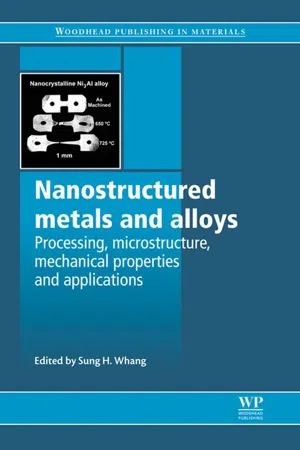
Nanostructured Metals and Alloys
Processing, Microstructure, Mechanical Properties and Applications
- 840 pages
- English
- ePUB (mobile friendly)
- Available on iOS & Android
eBook - ePub
Nanostructured Metals and Alloys
Processing, Microstructure, Mechanical Properties and Applications
About this book
Tensile strength, fatigue strength and ductility are important properties of nanostructured metallic materials, which make them suitable for use in applications where strength or strength-to-weight ratios are important. Nanostructured metals and alloys reviews the latest technologies used for production of these materials, as well as recent advances in research into their structure and mechanical properties.One of the most important issues facing nanostructured metals and alloys is how to produce them. Part one describes the different methods used to process bulk nanostructured metals and alloys, including chapters on severe plastic deformation, mechanical alloying and electrodeposition among others. Part two concentrates on the microstructure and properties of nanostructured metals, with chapters studying deformation structures such as twins, microstructure of ferrous alloys by equal channel angular processing, and characteristic structures of nanostructured metals prepared by plastic deformation. In part three, the mechanical properties of nanostructured metals and alloys are discussed, with chapters on such topics as strengthening mechanisms, nanostructured metals based on molecular dynamics computer simulations, and surface deformation. Part four focuses on existing and developing applications of nanostructured metals and alloys, covering topics such as nanostructured steel for automotives, steel sheet and nanostructured coatings by spraying.With its distinguished editor and international team of contributors, Nanostructured metals and alloys is a standard reference for manufacturers of metal components, as well as those with an academic research interest in metals and materials with enhanced properties.
Information
Part I
Processing bulk nanostructured metals and alloys
1
Producing bulk nanostructured metals and alloys by severe plastic deformation (SPD)
R.Z. Valiev, Ufa State Aviation Technical University, Russia
Abstract:
Despite its promise, the use of nanostructured metals and alloys as a new generation of structural and functional materials has only recently been realized. Only in recent years has a breakthrough been made in this area, associated both with developing new methods for fabricating bulk nanostructured materials and with investigating the fundamental mechanisms that lead to novel properties in these materials. This chapter presents new concepts and principles in using severe plastic deformation (SPD) techniques to fabricate bulk nanostructured metals with advanced properties. Special emphasis is laid on analysing of the effect of the microstructural features of nanostructured materials fabricated by SPD on mechanical properties such as strength and ductility, fatigue strength and life, and superplasticity, as well as describing early examples of their innovative applications.
Key words
bulk nanostructured materials
severe plastic deformation
advanced properties
strength and ductility
equal-channel angular pressing
high pressure torsion
1.1 Introduction
The concept of ‘large plastic strains’, or deformations that are characterized by a high value of true accumulated strain (e ≥ 0.5) and are realized at relatively low temperature (≤ 0.4 melting point), is widely used in the branches of physics and mechanics that deal with the problems of strength and ductility of solid states.1−3 Large plastic deformations are actively engaged in practice, for example, in metal forming for shaping in the process of manufacturing semi-products and parts as well as for materials hardening. Traditionally, such methods of metal forming as drawing, extrusion, rolling and others are used for these purposes. Experimental methods for achieving very large strains are usually based on the rolling of strips or thin foils, e.g. with initial thickness of ~ 10 mm up to a final one of ~ 0.1 mm, which is equivalent to a 99% reduction in thickness (true strain e = 4.6). Therefore, true strains 4–4.5 are critical for shaping bulk billets by conventional metal forming methods, and as it was noticed in earlier works, the achievement of larger strains requires radically different processing techniques.4 It was suggested4,5 that such techniques may comprise the die-sets combining shear (torsion) and compression straining as they make it possible to deform the material without changing its form.
Fracture in material is another problem encountered when achieving super-high strains. As is known, many metallic materials are exposed to quick fracture at room temperature even in the early stages of deformation. However, it is possible to increase the deformability of metals and alloys by imposing hydrostatic pressure. The phenomenon was first studied in detail by P.W. Bridgman (Harvard University), who was awarded the Nobel Prize for Physics in 1946 for his works in the sphere of high pressure.6
In the 1980s these ideas were realized by Polish4 and Russian scientists from Yekaterinburg, (formerly Sverdlovsk, USSR)7 in creating experimental die-sets for combined torsion and compression. The application of these devices achieved very large strains with true strains exceeding 8–10, which resulted in strong grain refinement in metals. The basic work was performed by scientists in Ufa in 1988,8 where this method was demonstrated for the first time, of producing ultrafine-grained (UFG) metals and alloys with high-angle grain boundaries that led to new properties. The latter was evidenced by revealing the so-called ‘low-temperature superplasticity’ in an UFG Al alloy. Later, in 1991 UFG materials were first obtained by means of another technique – equal-channel angular pressing (ECAP),9 during which the billet shape is also preserved and therefore very large strains are achieved by multi-pass processing. As demonstrated below, ECAP allows the production of UFG structures in bulk billets from different metals and alloys. Moreover, the technique is very promising for practical applications. This new approach to grain refinement, based on the achievement of very large true strains with e ≥ 6–8 under high pressure, was termed ‘severe plastic deformation’ (SPD)10 and attracted much attention with the further development of many SPD techniques.11−13 Besides, SPD processing routes and regimes for grain refinement were established for various metals and alloys.14 More complete definitions of SPD processing and ultrafine-grained (UFG) materials are presented in several recent overviews.11,12,15,16 It is important to emphasize that SPD-produced UFG materials are fully dense and their large geometric dimensions make it possible to study their properties thoroughly by means of mechanical and other tests. As a result, the subject of bulk ultrafine-grained materials produced by severe plastic deformation was introduced into scientific literature. The next important step along with the formation of UFG was finding nanostructural features in SPD-processed metals (non-equilibrium grain boundaries, dislocation substructures, segregations and nanoparticles and other elements) resulting in novel properties16 (see also section 1.3.3, this chapter). At this time, the fabrication of bulk nanostructured materials by SPD is becoming one of the most actively developing areas in the field of nanomaterials.12,17
The present chapter considers new trends in the development of SPD techniques, basic requirements for processing nanostructured materials with enhanced properties by means of SPD, and prospects for their practical applications.
1.2 The principles of severe plastic deformation (SPD) processing
Since the pioneering work on tailoring ultrafine-grained structures by SPD processing,9,10 two SPD techniques have attra...
Table of contents
- Cover image
- Title page
- Table of Contents
- Copyright
- Contributor contact details
- Introduction
- Part I: Processing bulk nanostructured metals and alloys
- Part II: Microstructure
- Part III: Mechanical properties
- Part IV: Applications
- Index
Trusted by 375,005 students
Access to over 1.5 million titles for a fair monthly price.
Study more efficiently using our study tools.
Frequently asked questions
Yes, you can cancel anytime from the Subscription tab in your account settings on the Perlego website. Your subscription will stay active until the end of your current billing period. Learn how to cancel your subscription
No, books cannot be downloaded as external files, such as PDFs, for use outside of Perlego. However, you can download books within the Perlego app for offline reading on mobile or tablet. Learn how to download books offline
Perlego offers two plans: Essential and Complete
- Essential is ideal for learners and professionals who enjoy exploring a wide range of subjects. Access the Essential Library with 800,000+ trusted titles and best-sellers across business, personal growth, and the humanities. Includes unlimited reading time and Standard Read Aloud voice.
- Complete: Perfect for advanced learners and researchers needing full, unrestricted access. Unlock 1.5M+ books across hundreds of subjects, including academic and specialized titles. The Complete Plan also includes advanced features like Premium Read Aloud and Research Assistant.
We are an online textbook subscription service, where you can get access to an entire online library for less than the price of a single book per month. With over 1.5 million books across 990+ topics, we’ve got you covered! Learn about our mission
Look out for the read-aloud symbol on your next book to see if you can listen to it. The read-aloud tool reads text aloud for you, highlighting the text as it is being read. You can pause it, speed it up and slow it down. Learn more about Read Aloud
Yes! You can use the Perlego app on both iOS and Android devices to read anytime, anywhere — even offline. Perfect for commutes or when you’re on the go.
Please note we cannot support devices running on iOS 13 and Android 7 or earlier. Learn more about using the app
Please note we cannot support devices running on iOS 13 and Android 7 or earlier. Learn more about using the app
Yes, you can access Nanostructured Metals and Alloys by S H Whang in PDF and/or ePUB format, as well as other popular books in Technology & Engineering & Mining Engineering. We have over 1.5 million books available in our catalogue for you to explore.