- 348 pages
- English
- ePUB (mobile friendly)
- Available on iOS & Android
eBook - ePub
Fuel Systems for IC Engines
About this book
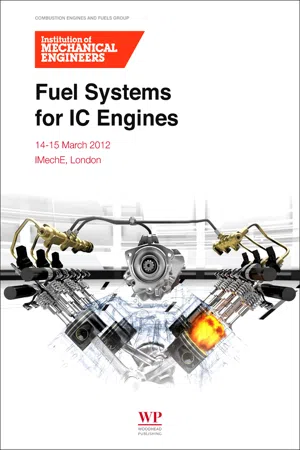
This book presents the papers from the latest conference in this successful series on fuel injection systems for internal combustion engines. It is vital for the automotive industry to continue to meet the demands of the modern environmental agenda. In order to excel, manufacturers must research and develop fuel systems that guarantee the best engine performance, ensuring minimal emissions and maximum profit. The papers from this unique conference focus on the latest technology for state-of-the-art system design, characterisation, measurement, and modelling, addressing all technological aspects of diesel and gasoline fuel injection systems. Topics range from fundamental fuel spray theory, component design, to effects on engine performance, fuel economy and emissions.
- Presents the papers from the IMechE conference on fuel injection systems for internal combustion engines
- Papers focus on the latest technology for state-of-the-art system design, characterisation, measurement and modelling; addressing all technological aspects of diesel and gasoline fuel injection systems
- Topics range from fundamental fuel spray theory and component design to effects on engine performance, fuel economy and emissions
Information
Systems Architecture
CO2 savings due to electronically controlled fuel pumps in fuel delivery modules
D. Collins(1), A. Frilling(2), I. Hislaire(2), A.V. Iseghem(2), H. Cremer(2), M. Sanchez(2), S. Schilling(2) and R. Bouloc(3), (1)Delphi – Mexico Technical Center, Mexico; (2)Delphi – Customer Technology Center, Luxembourg; (3)Delphi – Blois Technical Center, France
ABSTRACT
Since the start of the CO2 reduction discussions, the internal combustion engines and all necessary subsystems to run the engine are directly affected. Moreover the new proposed targets for the CO2 emissions of new registered vehicles in 2020 are very challenging.This paper is describing Delphi’s next generation of fuel delivery modules, entering production in 2013. Such a module is equipped with a brushless electronically controlled fuel pump (EC-pump) and a controller integrated in the cover in order to minimize the power losses.Thanks to the brushless technology it is possible to reduce the CO2 emissions between 1 to 3 grams/km, depending on the flow/pressure requirement for the engine.
1 INTRODUCTION
Road transport (passenger cars and commercial vehicles) contributes 14 percent of total man-made carbon dioxide (CO2) emissions (1). Although new cars now emit significantly less CO2, road transportation remains one of the few sectors where emissions keep rising.
In Europe a system of tax incentives have be settled up to force car OEMs to contribute containing the CO2 emissions. The European legislation, in addition to exhaust emissions standards (CO, HC, NOx, …), also specified CO2 emissions targets, whereas some others regions / authorities stay focused on fuel consumption to address the passenger car contribution in global warming. (See Table 1)
Table 1
Overview of regulations specifications (2)

In 2006, actors involved in EU-ETS (European – Emission Trading System) traded a ton of CO2 at prices around or below 20€, the penalty was 100€ per tons of CO2. This level could also be applied to manufacturers as of 2012 by translating the amount of g/km into tons of CO2, taking into account the typical mileage of the cars concerned.
First predictions say that still a minimum of 95% of the vehicles in 2020 will be equipped with an internal combustion engine. Out of this knowledge it is much more important to understand and analyze what kind of C02 saving potential could be found in the subsystems which are necessary to run the engines.
2 REFERENCE VEHICLE EMISSION CYCLE FOR CO2 EMISSIONS
The CO2 emissions are measured on a standardized driving cycle: NEDC which stands for New European Driving Cycle, which is also called NMVEG (New Motor Vehicle Emissions Group).
This cycle has been designed in order to reflect the typical driving conditions one can expect to see in Europe. It is being used to evaluate passenger cars emissions and fuel economy; it is basically a repetition of four times the former driving cycle ECE-15, corresponding to urban driving conditions, and one repetition of the EUDC (Extra Urban Driving Cycle). The total duration of the cycle is 1200 seconds, and is divided in several portions of accelerations and deceleration phases; the description of the cycle is shown on Figure 1.

Figure 1 NEDC cycle description
The various fuel consumptions are measured either in portion of the cycle (urban and extra-urban) either on the entire cycle (average fuel consumption). Even if the CO2 emissions are measured on the entire cycle, the main portion of the cycle does not correspond to full engine demand / power. Therefore one can easily imagine that the contribution of the Fuel System in CO2 emissions can be optimized by adjusting the demand to the actual needs of the vehicle during the NEDC.
3 STATE OF THE ART
3.1 Diesel Common rail architecture
Most OEMs are only proposing in their Diesel fleet Common Rail (CR) engines, which have already experienced several optimizations: second, third and even further generation of CR. They are all following the same drivers: meeting new regulation (particles, emissions, fuel economy…) while containing system costs. The new regulation levels (Euro 6 and Euro 7) forcing the system suppliers to chase any efficiency gain.
The CR architectures are all based on following key components:
- High Pressure (HP) pump: injection pressure is in the range of 1500 to 2000 bars, the efficiency of this pump is improved by pressurizing its inlet.
- Lift Pump or Low pressure Pump: could either be inside the fuel tank (electrical), in-line (electrical) or attached to the High Pressure pump (mechanical). The service pressure for this component is the range of 2 to 7 bars.
- Common Rail including injectors: injection pressure may reach 2000 bars.
An example of a Delphi Common Rail system is described on Figure 2.

Figure 2 Example of current Delphi Common Rail system
3.2 Fuel Module / Low pressure F...
Table of contents
- Cover image
- Title page
- Table of Contents
- Copyright
- Keynote Address
- Systems Architecture
- Gasoline di Systems
- Medium/Heavy-Duty Diesel
- Light-Duty Diesel
- Gasoline di Spray Generation
- Diesel Spray
- Development and Methodology
- Author Index
Trusted by 375,005 students
Access to over 1.5 million titles for a fair monthly price.
Study more efficiently using our study tools.
Frequently asked questions
Yes, you can cancel anytime from the Subscription tab in your account settings on the Perlego website. Your subscription will stay active until the end of your current billing period. Learn how to cancel your subscription
No, books cannot be downloaded as external files, such as PDFs, for use outside of Perlego. However, you can download books within the Perlego app for offline reading on mobile or tablet. Learn how to download books offline
Perlego offers two plans: Essential and Complete
- Essential is ideal for learners and professionals who enjoy exploring a wide range of subjects. Access the Essential Library with 800,000+ trusted titles and best-sellers across business, personal growth, and the humanities. Includes unlimited reading time and Standard Read Aloud voice.
- Complete: Perfect for advanced learners and researchers needing full, unrestricted access. Unlock 1.5M+ books across hundreds of subjects, including academic and specialized titles. The Complete Plan also includes advanced features like Premium Read Aloud and Research Assistant.
We are an online textbook subscription service, where you can get access to an entire online library for less than the price of a single book per month. With over 1.5 million books across 990+ topics, we’ve got you covered! Learn about our mission
Look out for the read-aloud symbol on your next book to see if you can listen to it. The read-aloud tool reads text aloud for you, highlighting the text as it is being read. You can pause it, speed it up and slow it down. Learn more about Read Aloud
Yes! You can use the Perlego app on both iOS and Android devices to read anytime, anywhere — even offline. Perfect for commutes or when you’re on the go.
Please note we cannot support devices running on iOS 13 and Android 7 or earlier. Learn more about using the app
Please note we cannot support devices running on iOS 13 and Android 7 or earlier. Learn more about using the app
Yes, you can access Fuel Systems for IC Engines by Institution of Mechanical Engineers in PDF and/or ePUB format, as well as other popular books in Technology & Engineering & Mechanical Engineering. We have over 1.5 million books available in our catalogue for you to explore.