eBook - ePub
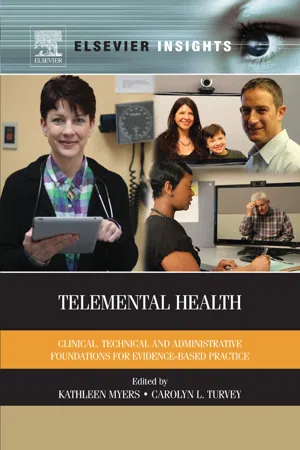
Telemental Health
Clinical, Technical, and Administrative Foundations for Evidence-Based Practice
- 400 pages
- English
- ePUB (mobile friendly)
- Available on iOS & Android
eBook - ePub
Telemental Health
Clinical, Technical, and Administrative Foundations for Evidence-Based Practice
About this book
Acquiring access to mental health treatments can be difficult for those who are not near mental health facilities. The growing field of telemental health addresses this problem by using video and telephone conferencing to provide patients with access to psychiatric professionals. However, the process faces challenges to gain adoption into mainstream medical practice and to develop an evidence base supporting its efficacy. In this comprehensive text, leading professionals in the field provide an introduction to telemental health and explore how to construct a therapeutic space in different contexts when conducting telemental health, how to improve access for special populations, and how to develop an evidence base and best practice in telemental health. In the past 15 years, implementation of telemental health has seemed to follow more from need than from demonstrated efficacy. The thorough and insightful chapters within this book show the importance of continued research and thoughtful development of ethical and responsible practice that is needed in the field and begin to lay out steps in constructing this process. Telemental Health will be an essential book for all clinical practitioners and researchers in mental health fields.
- Information in this book is focused on the clinical practice of telemental health, no other text is similarly oriented to clinical practice. Limited options for interested audience makes this text a top choice
- The Editors are experienced in multiple aspects of e-health across diverse clinical settings, and the authors are national leaders who are most knowledgeable regarding developments in the field
- Emphasis is on providing evidence-based care, and telemental health emerges as comparable to usual care, not a "second best" option; material is not esoteric but relevant to clinical practice. Readers will be able to readily find the equipment and other technology to establish their practice
Information
Section Four
Improving Access for Special Populations Through Telemental Health
9. Telemental Health in Primary Care
10. Geriatric Telemental Health
11. Child and Adolescent Telemental Health
12. Rural Veterans and Telemental Health Service Delivery
13. Videoteleconferencing in Forensic and Correctional Practice
9
Telemental Health in Primary Care
The Rationale for Collaborative and Integrative Care
Telemental health (TMH) as discussed in this chapter is defined as the provision of behavioral health services through real-time videoteleconferencing (VTC) and telephone conferencing. To consider the utility of TMH in primary care, one must first consider evolving models of care in which patients receive behavioral health services from specialists who work in collaboration with primary care providers. This may also include models of care in which patients’ mental and behavioral health services are integrated within primary care as part of their customary health care (Strosahl, 1998). Strosahl has noted that only 30% of primary care visits are for an identified medical condition. Other visits involve problems related to mental health, substance abuse, or lifestyle issues. Yet, primary care has traditionally not had access to models of care sufficient to meet these needs. Thus, Blount and Miller (2009) have summarized the rationale for developing collaborative and integrative models as follows: (a) most people with mental health needs rely exclusively on a primary care provider for care; (b) the majority of those who have been treated in primary care do not then receive care from behavioral health specialists and/or care in specialty settings; (c) the course of complex and/or chronic medical disorders is complicated by comorbid mental illness, substance abuse, and/or unhealthy behaviors requiring mental health/behavioral health intervention; and (d) if unaddressed, patients’ problematic behaviors, lifestyles, and psychosocial problems inflate medical costs and impede optimal outcomes. Finally, primary care patients with mental/behavioral health concerns are often reluctant to discuss these problems with their primary care providers due to stigma and/or lack of motivation related to the underlying disorder (Thielke, Vannoy, & Unutzer, 2007). Mental health and physical health problems are intricately entwined. Collaboration between primary care and mental/behavioral health systems of care is the most viable way of closing the treatment gap and making sure people receive the mental/behavioral health treatment they need.
A Continuum of Collaboration
Doherty, McDaniel, and Baird (1996) describe a Levels of Collaboration Model with a five-point continuum of collaboration between primary care and behavioral health providers from: (a) minimum collaboration in separate facilities and/or systems; to (b) off-site linkages; to (c) on-site collaboration; to (d) teamwork; to (e) close collaboration in a fully integrated system as members of the same multidisciplinary, colocated team. They “… suggest that the Levels of Collaboration Model can be used by organizations to evaluate their current structures and procedures in light of their goals for collaboration and to set realistic next steps for change.”
Four Key Concepts in Collaborative Care
The Levels of Collaboration Model dovetails with four overarching concepts related to the implementation of mental and behavioral health services within primary care. The Milbank report (Collins, Hewson, Munger, & Wade, 2010) summarizes these concepts as follows:
a. The patient-centered medical home including: (i) patient tracking and registry functions; (ii) the use of nonphysician staff for care management; (iii) the adoption of evidence-based treatment guidelines; (iv) patient self-management support, (v) screenings, and (vi) referral tracking.
b. A team of health care professionals to share responsibility for a patient’s care.
c. Stepped care on a continuum from: (i) basic educational efforts; to (ii) psychoeducational interventions; to (iii) behavioral health interventions provided by highly trained behavioral health care professionals within primary care; to (iv) specialty mental health services.
d. The four-quadrant clinical integration model in which Quadrant I patients have low mental health and physical health care needs and are served in primary care; Quadrant II patients have high behavioral health and low physical health care needs and are served in specialty behavioral health systems; Quadrant III patients have high physical health care needs and low behavioral ones and are served in primary care and/or medical specialty systems; and Quadrant IV patients have high needs in both categories, requiring a strong collaboration between specialty behavioral health settings and primary and medical specialty care settings. These patients are more likely to have co-occurring disorders in all categories as well as the lack of a stable medical home.
These models of collaborative care and integrated care are the ideal toward which many health care systems now strive. They are also a major focus for health services research in which investigators assess the effectiveness of these models in improving mental and behavioral health care and outcomes. However, many factors remain to be resolved. One core issue is how to provide the mental health and behavioral health specialists who will collaborate with or integrate into primary care. TMH provides one such approach by telecommuting a broad array of specialists across vast expanses of land and diverse communities to help build new models of care. However, this work is in its infancy.
The remainder of this chapter presents some of the current approaches, successes, and challenges in using TMH to provide specialty mental/behavioral health care. While these efforts are not yet fully collaborative nor integrative, they show the way.
Tailoring TMH to Models of Care
To optimally facilitate collaborative and integrative models of care, TMH must be tailored to the needs of the health care system with which it partners. Four models for the partnering of TMH with primary care have been described.
Direct care models: This model is often considered the traditional referral or replacement model in which the telepsychiatrist is the principal provider of mental health and/or behavioral health services after an initial TMH consultation (Hilty, Yellowlees, Cobb et al., 2006). Often, patients go to a telepsychiatry clinic, separate from their primary care clinic, at which a high-definition, secured network is available that approximates in-person care. Patients and providers have endorsed high satisfaction with this model and early research supports good outcomes in equivalency trials (Fortney, Pyne et al., 2007; Morland et al., 2010; O’Reilly et al., 2007). Primary care physicians (PCPs) may prefer this approach as the telepsychiatrist assumes primary responsible for mental and behavioral health care. This model is most consistent with Doherty’s aforementioned “minimum collaboration in separate facilities” and/or “off-site linkages systems” and thus does not really advance collaborative or integrative models. If the telepsychiatry site could be colocated within the primary care space, this model would approach Doherty’s third level of “on-site collaboration.”
Consultation care model: This model is probably the most commonly used model in telepsychiatry practice. The PCP remains the principal provider of mental and behavioral health services following a telepsychiatric consultation (Hilty, Yellowlees, Cobb et al., 2006). The consultation may be consultee centered, i.e., the telepsychiatrist consults to a referring PCP, the “consultee,” either with or without the patient present (Caplan & Caplan, 2000). This approach is geared to reinforcing PCPs’ skills by incorporating some training and education regarding assessment, treatment planning, interventions, disposition planning, and resource navigation. In a variation of this model, the referring PCP accompanies the patient and makes final decisions regarding implementation of the consultant’s (telepsychiatrist’s) recommendations. The technology that is most appropriate to these two consultative approaches has not been addressed but may be especially appropriate for PCPs who have some expertise in mental/behavioral health or seek to expand their skills and can use their office desktop computers for ready consultation with the telepsychiatrist. Szeftel et al. (2011) describe such a model in which the telepsychiatrist at the hub site and the PCP at the spoke site provide consultation to a patient. This approach best fits Doherty’s level of “on-site collaboration” or perhaps “teamwork” if the PCP or telepsychiatrist incorporate other health care staff in managing the patient’s care, e.g., a care manager to track follow-up visits and health indicators.
Transition to these consultative models occurs only after a considerable investment by the telepsychiatrist in relationship building which confirms ongoing commitment to the support of involved clinicians, training of staff, and linkages to resources. It also involves consciousness raising with stakeholders regarding the scarcity of psychiatric resources, a population-based health perspective, community strategies to enhance local mental health services (Foy & Perrin, 2010), and the importance of providing culturally appropriate care, especially for rural, remote, and, underserved populations (Shore, Savin, Novins, & Manson, 2006).
Collaborative care model: In outpatient care, this model fits Doherty’s level of “close collaboration in a fully integrated system as members of the same multidisciplinary, colocated team.” It also utilizes the aforementioned core principles described in the Milbank report (Collins et al., 2010). Approaches may vary in how the collaboration is implemented. These issues have been minimally addressed in the telepsychiatry literature (Fortney, Pyne et al., 2007). The core issue is that after initial consultation, the telepsychiatrist follows patients jointly with the PCP, using frequent communication and/or a care manager who liaises between these clinicians and who tracks patients’ visits, health indicators, and “steps up” care as clinically needed (Unützer, Schoenbaum, Druss, & Katon, 2006). The optimal technology remains to be addressed. Determining factors may include cost, number of PCPs involved in the collaboration, the frequency of use, and whether the collaboration can be done from a clinician’s or care manager’s office or requires dedicated space. Thus, choices vary from high-definition, secure, point-to-point end point systems using T1 lines to inexpensive, publically available commercial systems that operate on desktop computers.
A fully implemented model of collaborative care involves a major paradigm shift for PCPs, as well as other health care providers and systems. Making this paradigm shift concurrently with introducing telepsychiatry (Shore & Manson, 2005), or more generally TMH, for the provision of mental/behavioral health care will likely take considerable time and adjustment for participants, ideally led by committed TMH staff (Kessler, Stafford, & Messier, 2009; National Council for Community Behavioral Health Care, 2009).
Kriechman, Salvador, and Adelsheim (2010) have described a variant of this collaborative care model. Our model coordinates and supports the efforts of a patient’s network of care. The network may include family members, peer supports, behavioral care providers, specialty care providers, educators, case managers, paraprofessionals, and other community supports in addition to referring PCPs. In this model, the collaboration is between specialty mental/behavioral health care and the patient’s “medical home.” It is consistent with Doherty’s level of “close collaboration in a fully integrated system as members of the same multidisciplinary, colocated team.” Our model transcends Doherty’s levels as it also actively includes patients’ families and community supports thereby basing care on patients’ culture, language, and healing belief systems and practices (Bitar, Springer, Gee, Graff, & Schydlower, 2009; Foy & Perrin, 2010). Further, our model does not require the patient’s support system to assemble in the same facility, nor even by videoconferencing, to integrate care. Working parents, providers, paraprofessionals, and community members may join by telephone, which is a more convenient modality for gathering the patient’s network together, and is more likely to involve individuals who might otherwise not be able to join. Further, it precludes the technical difficulties that can be encountered when attempting to link multiple sites through videoconferencing.
When implementing one of these models of care and utilizing TMH as the mechanism to provide specialty mental/behavioral health care, appropriate steps need to be taken to ensure that TMH will be a “good fit,” such as obtaining an assessment of the services needed, the population to be served, PCPs’ comfort with TMH, and the technical and support resources available (Shore & Manson, 2005). Additionally, providers should be familiar with the evolving best practice guidelines for TMH (Telemental Health Standards and Guidelines Working Group, 2009).
TMH Consultation and Collaboration for Children, Adolescents, and Their Families
Case reports and program descriptions have generally supported the feasibility and acceptability to stakeholders of using TMH for the evaluation and treatment of children and adolescents. Mostly consultative models have been described.
Primary Care Sites
Several states have funded consultee-centered consultation services by telephone to aid PCPs in their management of children’s mental/behavioral health problems. Sarvet, Gold, and Straus (2011) developed the first such program, the Massachusetts Child Psychiatry Acce...
Table of contents
- Cover image
- Title page
- Table of Contents
- Copyright
- Acknowledgments
- Contributors
- Section One: Introduction to Telemental Health
- Section Two: Developing a Therapeutic Space During Telemental Health
- Section Three: Establishing a Telemental Health Practice
- Section Four: Improving Access for Special Populations Through Telemental Health
- Section Five: Assessment and Intervention
- Section Six: Next Steps in Disseminating Telemental Health and Establishing an Evidence Base
- Appendix I: Glossary
- Appendix II: Telehealth Resource Centers (TRCs)
- Appendix III: Useful Websites Providing Practical Information Regarding Telemental Health Practice
Trusted by 375,005 students
Access to over 1.5 million titles for a fair monthly price.
Study more efficiently using our study tools.
Frequently asked questions
Yes, you can cancel anytime from the Subscription tab in your account settings on the Perlego website. Your subscription will stay active until the end of your current billing period. Learn how to cancel your subscription
No, books cannot be downloaded as external files, such as PDFs, for use outside of Perlego. However, you can download books within the Perlego app for offline reading on mobile or tablet. Learn how to download books offline
Perlego offers two plans: Essential and Complete
- Essential is ideal for learners and professionals who enjoy exploring a wide range of subjects. Access the Essential Library with 800,000+ trusted titles and best-sellers across business, personal growth, and the humanities. Includes unlimited reading time and Standard Read Aloud voice.
- Complete: Perfect for advanced learners and researchers needing full, unrestricted access. Unlock 1.5M+ books across hundreds of subjects, including academic and specialized titles. The Complete Plan also includes advanced features like Premium Read Aloud and Research Assistant.
We are an online textbook subscription service, where you can get access to an entire online library for less than the price of a single book per month. With over 1.5 million books across 990+ topics, we’ve got you covered! Learn about our mission
Look out for the read-aloud symbol on your next book to see if you can listen to it. The read-aloud tool reads text aloud for you, highlighting the text as it is being read. You can pause it, speed it up and slow it down. Learn more about Read Aloud
Yes! You can use the Perlego app on both iOS and Android devices to read anytime, anywhere — even offline. Perfect for commutes or when you’re on the go.
Please note we cannot support devices running on iOS 13 and Android 7 or earlier. Learn more about using the app
Please note we cannot support devices running on iOS 13 and Android 7 or earlier. Learn more about using the app
Yes, you can access Telemental Health by Kathleen Myers,Carolyn Turvey in PDF and/or ePUB format, as well as other popular books in Psychology & Applied Psychology. We have over 1.5 million books available in our catalogue for you to explore.