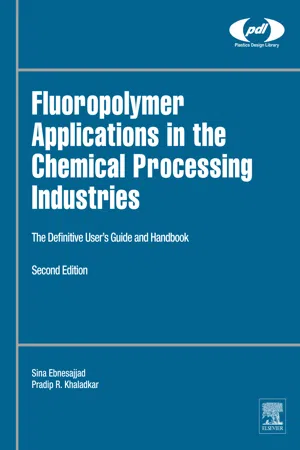
Fluoropolymer Applications in Chemical Processing Industries: The Definitive User's Guide and Handbook, Second Edition, contains the most extensive collection of data and information on fluoropolymer applications in chemical processing industries. Because of their superior properties, fluoropolymers have been rapidly replacing metal alloys for corrosion inhibition in chemical processing equipment. This book is a complete compendium of information about fluoropolymer lining materials and structural piping and tubing.
Fluoropolymer surfaces preserve purity of processing streams in the chemical processing, plastics, food, pharmaceutical, semiconductor, and pulp and paper industries. Updated to reflect major changes since 2004, this book contains practical, problem-solving tools for professionals in those industries. Equipment manufacturers, plant operators, and product design and manufacturing engineers all will benefit from the in-depth knowledge provided.
This new edition includes new fluoropolymer grades and new examples of the fluoropolymer role in preventing corrosion. New fabrication techniques have been added, and additional emphasis has been placed on adhesion and welding techniques. New sections have been added on inspection of new linings, and in-service inspection – including inspection frequency, acceptance criteria, fitness for service evaluation, and reparability.
- Includes extensive guidelines for the selection of fluoropolymers for corrosion control
- Features a detailed 'how-to' on processes that convert fluoropolymers into shapes and parts
- Discusses fabrication techniques to finish the fluoropolymer components before exposure to harsh chemical environments
- Includes laboratory techniques to determine the cause of part failure, and a modeling methodology to predict and analyze failure of fluoropolymer parts
Carbon and fluorine are the major elements that form polytetrafluoroethylene (PTFE) homopolymers. The C
F bond is the main reason these plastics have many special properties surpassing those of most other polymers. These properties span mechanical, electrical, and thermal characteristics of the fluoropolymers in addition to their chemical resistance.
This book describes fluoropolymers in chemical processing industries. These industries often handle chemicals, usually corrosive, during the manufacturing of diverse products. Examples of important industries include chemical manufacturing, plastics manufacturing and processing, semiconductor manufacturing, pharmaceutical and biopharmaceutical industries, and food processing.
Carbon and fluorine are the major elements that form polytetrafluoroethylene (PTFE) homopolymers. The C
F bond is the main reason these plastics have many special properties surpassing those of most other polymers. These properties span mechanical, electrical, and thermal characteristics of the fluoropolymers in addition to their chemical resistance.
This book describes fluoropolymers in chemical processing industries. These industries often handle chemicals, usually corrosive, during the manufacturing of diverse products. Examples of important industries include chemical manufacturing, plastics manufacturing and processing, semiconductor manufacturing, pharmaceutical and biopharmaceutical industries, and food processing.
Fluoropolymers replace stainless steel and exotic alloys such as Hastelloy in processes involving highly reactive chemicals. This plastic family has successfully met the requirement of purity, which is essential in semiconductor, food, and biopharmaceutical production. The nonstick surface and extreme temperature characteristics of fluoropolymers have reserved a special place for them in the world of equipment construction materials. This chapter offers a brief history of the discovery and the evolution of fluoropolymers, their applications, and the introduction of various types of this plastic family.
Inception of fluoropolymers began with a small incident that did not go undetected by the careful and observant Dr. Roy Plunkett of DuPont Company [1]. In 1938, he had been at DuPont for 2years, concentrating mostly on the development of fluorinated refrigerants. He was experimenting with tetrafluoroethylene (TFE) for synthesis of a useful refrigerant tetrafluorohydrochloro ethane (CClF2
CHF2) [2]. The objective was to create safe, nonflammable, nontoxic, colorless, and odorless refrigerants. On the morning of April 6, 1938, when Plunkett checked the pressure gauge on a full cylinder of TFE, he found no pressure. The cylinder, however, had not lost weight. Removal of the valve and opening the cylinder yielded a few grams of a waxy white powder—the first polymer of TFE [2].
Plunkett analyzed the white powder, which was conclusively proven to be PTFE. He could not dissolve the slippery PTFE in any solvent, acid, or base. After melting, it formed a stiff clear gel with no tendency to flow [3,4]. Later, researchers were able to fabricate parts from PTFE by processing techniques similar to those used to make parts from metal powders. At the time, the Manhattan Project was seeking new corrosion-resistant materials for gaskets, packings, and liners for uranium hexafluoride (UF6) handling. PTFE provided the answer because of its extreme resistance to chemicals. The US Government maintained a veil of secrecy over the PTFE project until the end of World War II.
Large-scale monomer synthesis and controlled polymerization were technical impediments to be overcome. Intense research resolved these problems, and small-scale production of Teflon (trademark, 1944) began in 1947. In 1950, DuPont scaled up the commercial production of Teflon in the Uni...
Table of contents
Cover image
Title page
Table of Contents
Series Page
Copyright
Dedication
Preface
Acknowledgments
1. Introduction to Fluoropolymers
2. Materials of Construction
3. Properties of Neat (Unfilled) and Filled Fluoropolymers
4. Selecting Fluoropolymers for Corrosion Control
5. Manufacturing of Parts From Tetrafluoroethylene Homopolymers
6. Manufacturing Parts From Melt-Processible Fluoropolymers
7. Fabrication Techniques of Fluoropolymers
8. Design and Construction of Linings and Vessels
9. Operation, Inspections, Maintenance, and Repairs
10. Failure Analysis of Fluoropolymer Parts
11. Cost Analysis
12. Safety, Health, Environmental, Disposal, and Recycling
13. Future Trends
Index
Trusted by 375,005 students
Access to over 1.5 million titles for a fair monthly price.
Study more efficiently using our study tools.
Frequently asked questions
Yes, you can cancel anytime from the Subscription tab in your account settings on the Perlego website. Your subscription will stay active until the end of your current billing period. Learn how to cancel your subscription
No, books cannot be downloaded as external files, such as PDFs, for use outside of Perlego. However, you can download books within the Perlego app for offline reading on mobile or tablet. Learn how to download books offline
Perlego offers two plans: Essential and Complete
Essential is ideal for learners and professionals who enjoy exploring a wide range of subjects. Access the Essential Library with 800,000+ trusted titles and best-sellers across business, personal growth, and the humanities. Includes unlimited reading time and Standard Read Aloud voice.
Complete: Perfect for advanced learners and researchers needing full, unrestricted access. Unlock 1.5M+ books across hundreds of subjects, including academic and specialized titles. The Complete Plan also includes advanced features like Premium Read Aloud and Research Assistant.
Both plans are available with monthly, semester, or annual billing cycles.
We are an online textbook subscription service, where you can get access to an entire online library for less than the price of a single book per month. With over 1.5 million books across 990+ topics, we’ve got you covered! Learn about our mission
Look out for the read-aloud symbol on your next book to see if you can listen to it. The read-aloud tool reads text aloud for you, highlighting the text as it is being read. You can pause it, speed it up and slow it down. Learn more about Read Aloud
Yes! You can use the Perlego app on both iOS and Android devices to read anytime, anywhere — even offline. Perfect for commutes or when you’re on the go. Please note we cannot support devices running on iOS 13 and Android 7 or earlier. Learn more about using the app
Yes, you can access Fluoropolymer Applications in the Chemical Processing Industries by Sina Ebnesajjad,Pradip R. Khaladkar in PDF and/or ePUB format, as well as other popular books in Technology & Engineering & Chemical & Biochemical Engineering. We have over 1.5 million books available in our catalogue for you to explore.