- 612 pages
- English
- ePUB (mobile friendly)
- Available on iOS & Android
eBook - ePub
About this book
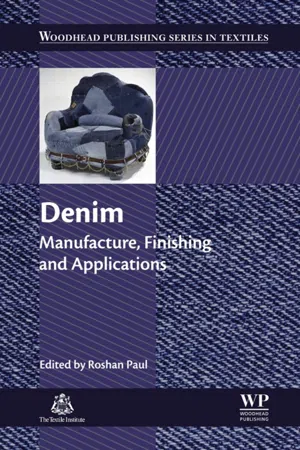
Denim: Manufacture, Finishing and Applications provides exhaustive coverage of denim manufacture, jeans washing, novel applications and environmental impacts. It also contains information on the history and social influence of denim, and includes the details relevant to the fashion and apparel industry. The topics covered are comprehensive with contributions from experts the world over, and the book is offered as an authentic reference book for any relevant information on denim.
- Provides a thorough review of denim manufacturing and jeans washing technologies
- Includes details relevant to the fashion and apparel industry while maintaining a high level of technological content on spinning, dyeing, weaving, garments, washing, finishing and other applications
- Includes several contributions from industry experts
Information
1
Denim and jeans
An overview
R. Paul Hohenstein Institut für Textilinnovation gGmbH, Boennigheim, Germany
Abstract
The story of denim starts with cotton fibre grown in a field, which is then spun into yarns, indigo dyed and woven. The most important garment made from denim is jeans, which can be further dyed, digitally printed or washed with a variety of techniques. Among different washing techniques, enzyme washing and reduced water techniques stand apart for their environmental friendliness. A variety of finishes are also applied on denim jeans for creating functional properties and to improve their wear comfort. Denim as a fabric has many other novel variants and can also be used for non-apparel applications. Both denim and jeans manufacturing processes raise environmental concerns, and some viable options include washing with reduced water techniques, recycling of denim waste and effluent treatment.
Keywords
Denim; Environmental impacts; Fashion; Finishing; Jeans; Novel applications; Washing1.1. Introduction
Among all the textile products, no other fabric has received such a wide acceptance as denim. It has been used extensively by people of all ages, classes and genders. Denim is a hard and durable warp faced 3/1 twill cotton fabric, woven with indigo dyed warp and white filling yarns, having weights of 14½ ounces per square yard. It has been in use for over a century in the clothing industry, especially in the manufacture of overalls and trousers for hard labour, which has demonstrated its durability, which along with its comfort made denim jeans extremely popular for leisure wear, too. From the seventeenth century to the present day, denim has been used for making trousers, upholstery and awnings, and has been found in museums, attics, antique stores and archaeological digs. It is also considered as the fabric of hard work, expression of youth rebellion and the favourite of American cowboys.
The name ‘denim’ is thought to have originated from the French serge de Nimes, a fabric from the town of Nimes in France. It was made of silk and wool, but denim has always been made of cotton. There was another fabric, a fustian made of cotton, linen and/or wool blend, and the fustian from Genoa, Italy was called jean. By the eighteenth century, jean fabric was made completely of cotton, and used to make men’s clothing, valued especially for its property of durability even after many washings. The popularity of denim was also on the rise and it was stronger and more expensive than jean. Even though the two fabrics were very similar in other ways, they did have one major difference: denim was made of one coloured yarn and one white yarn while jean fabric was woven with two yarns of the same colour.
Over the years, Levi Strauss & Co. in the United States, has played a pivotal role in developing the denim jeans. The company was founded by Loeb Strauss, who was born in Bavaria, Germany in 1829. Along with his family members, he left Germany in 1847 and sailed to New York, where Loeb’s half brothers were in business selling wholesale dry goods. For a few years, Loeb worked for his brothers and he changed his name to Levi Strauss sometime around 1850. In 1853, he decided to reinvent his life and took an adventurous journey to San Francisco, a city enjoying the benefits of the recent gold rush, and started his own dry goods business.
Levi Strauss & Co., founded in 1853, was selling only clothes, boots and other dry goods to small retail stores. In 1873, together with a tailor named Jacob Davis, Levi was granted a patent to manufacture riveted for strength workwear made of blue denim. Soon they began manufacturing copper riveted waist overalls out of a brown cotton duck and blue denim, marking the birth of denim jeans. Even though it originated in Europe, the durability and adaptable form of denim found a perfect home in the United States, where soon it became an American icon.
Denim has had an incredible social and cultural influence on consumers and is considered an expression of youth independence, a symbol of opposition or an attitude towards life, and there is an international appeal of jeans among all age groups. Classical Hollywood movies with rebellious themes starring Marlon Brando and James Dean became symbolic of rebellious youth. Dean and Brando wore blue jeans and leather jackets in the movies, and this clothing style became a symbol of a defiant teen desiring freedom. From the United States, denim fever has spread the world over, and the wide acceptance of denim garments everywhere makes it clear that denim is here to stay. This book on denim covers all of the important aspects of denim fabric manufacture, the manufacture and finishing of jeans, as well as novel applications and environmental aspects.
1.2. Denim fabric manufacture
Part One of the book focuses on the manufacture of denim fabric, and it starts with the utilisation of cotton fibre in denim manufacture. Then it talks about indigo dye, reduction techniques and indigo dyeing technologies for denim yarns. Further, the dyeing of denim with non-indigo dyes as well as the weaving technologies for manufacturing denim are discussed.
1.2.1. Cotton fibre
Cotton is extensively used for denim manufacture, where the fibre quality and staple length are of crucial importance. Denim would not be denim without cotton, but the cultivation of cotton raises sustainability issues concerning the quantity of water and pesticides used. The use of organic or naturally coloured cotton in denim manufacture can address the sustainability issues to some extent. Another possibility to reduce pesticide application is the use of genetically modified cotton. Cotton can also be blended with lycra, polyester, lyocell, wool, flax, hemp, etc. for developing special types of denim. Even though many such fibres are now entering the denim sector, it is highly improbable that they will ever replace cotton completely.
The cotton fibre needs to undergo a series of operations in order to be spun into yarns. Most of the cotton processing techniques for denim manufacture have not changed over the years. Unlike the weft, the production of warp yarn needs special attention, as it can influence the final quality of denim. Productivity and yarn quality are getting more importance in spinning, and in this respect, rotor spinning is becoming more prominent than the conventional ring spinning. Weaving a combination of ring spun and rotor spun yarns can help to reduce fabric costs while still maintaining some favourable ring spun fabric characteristics.
1.2.2. Indigo dye
Indigo, which is otherwise a low quality dye, is widely used in denim dyeing, as it gives the characteristic blue colour to denim. While the low fastness of the dye is a boon for achieving a distressed look, it leads to major effluent problems during the dyeing process and later in the washing of denim garments. Natural indigo has now been completely replaced by synthetic indigo, which seems to be more sustainable, but bio-synthesis of indigo would be really sustainable. A comparison of optimised natural indigo powder extracted from plants and optimised synthetic production shows that natural production of indigo may not be necessarily more environmentally friendly than the synthetic product.
At present, what raises concern is the reduction technique in indigo dyeing. The use of sodium hydrosulphite as a reducing agent is associated with several environmental issues. Commercially available pre-reduced indigo shows better fixation, requires fewer chemicals and results in low effluent load. Alternate reducing systems have been explored, such as organic reducing agents, biological reduction, electrochemical reduction and catalytic hydrogenation of indigo.
1.2.3. Indigo dyeing
A unique feature of indigo dyed denim is the possibility of achieving wash down effects on repeated washing without losing the freshness of the colour. Indigo dyeing is a vital step in the manufacturing of denim, and the warp yarns are dyed by either rope or slasher dyeing methods. The major issues in dyeing are the reducing agents and the huge volume of effluents, and quality control involves the monitoring of dye bath parameters like pH, sodium hydrosulphite and leuco indigo concentration, and the temperature of the dye bath. The pH is of crucial importance, as it controls the level of ring dyeing, and other important factors are the immersion time and number of dips.
Denim manufacturing is now faced with an eco-efficiency challenge with respect to sustainability. Several attempts have been undertaken in order to develop novel ‘green’ processes of denim dyeing, which should be more efficient, rapid, cheaper and easy to apply. One of the outcomes is the loop dyeing process, where the yarns are dyed in a single bath with one squeezing unit, after passing through the pretreatment boxes.
1.2.4. Non-indigo dyes
Non-indigo dyes, such as sulphur dyes, are now widely used in denim warp dyeing, and they offer vivid colours and a better ecological alternative to conventional indigo dyeing. Due to their better affinity for cotton, this dyeing is more efficient, and modern techniques can further reduce water usage considerably. Dyeing equipment, originally meant only for indigo, is undergoing transformation to provide the conditions required for the application of other dyes. Nowadays, the proportion of 100% indigo dyed denim warp is very small, as it is commonly combined with other types of dyes in the same application process, or overdyed with them. Sulphur dyes are widely used for bottoming and topping of indigo for reducing the overall cost.
Indigo will remain as the king of dyes and will stay associated with denim as its standard dye. But the demand from the fashion market could eventually activate much interest in non-indigo dyes, as they offer a full spectrum of colours. The permanent search for new effects and the flexibility that denim has for continuously reinventing itself will require exploring new application methods and developing new chemicals and dyes. A breakthrough dyeing process is Advanced Denim, which operates completely without indigo. It offers a great variety of colours, needs much less water and energy, and produces no effluents.
1.2.5. Denim weaving
Weaving is the final process in the manufacturing of denim and is very important in determining the quality of the final garment. Denim fabric is woven as 3/1 twill by the interlacement of indigo dyed warp and grey weft, and the yarn counts influence the fabric properties such as weight, fabric tightness, cover, drape, tensile strength and other properties. The weaving looms often used for denim are projectile, rapier and air jet looms.
In general, the denim market is highly competitive and is driven by volume and not necessarily by the niches. So the success of denim weaving companies depends on aspects like process optimisation and marketing profile. The possibilities include the use of engineered yarns, weaving denim efficiently in intelligent machines and using online quality control systems. All these could reduce energy consumption in weaving and also optimise material and resource efficiency. The industrial implementation of these technologies represents the future of denim weaving, which should be economically viable and will produce high quality denim.
1.3. Manufacture and finishing of jeans
Part Two of this book deals with the manufacture and finishing of jeans. The different topics include joining techniques for denim jeans; dyeing technologies for denim garments; digital printing techniques for denim jeans; washing techniques for denim jeans; biotechnological washing of denim jeans; reduced water washing of denim garments; finishing of jeans and quality control; as well as the comfort aspects of denim garments.
1.3.1. Jeans and fashion
Denim jeans can be considered as the most widely used garment in the fashion business. It is well known that denim and jeans have had a major influence on the lives of consumers since their inception. Jeans have become symbols for cowboys, women, youth and economic status. Through the ages, jeans have evolved from workwear to casual wear and then to premium wear and functional wear.
Consumers evaluate jeans based on style, brand, country of origin and company ethics. As with any other apparel, denim garment companies target specific market segments, however, no other garment can claim the social culture that denim has already set. Designer jeans as well as premium jeans first influenced a small group of luxury consumers, but now consumers from all social and economic classes embrace them. Challenges faced by denim apparel manufacturers and fashion designers include the need for reinventing products for niche markets, and meeting consumer demands for better apparel sizing.
1.3.2. Joining techniques
The stitching process gives birth to denim jeans, and the joining techniques are crucial in determining shape, fitting and style. The conversion of denim fabric into garments requires machines that are able to cope with the density of the fabric and the thickness of the seams. Therefore, heavy duty machines need to be used and specialised components have been developed to feed the material effectively through the machine. Other components such as heavy duty needles, sewing threads that have high...
Table of contents
- Cover image
- Title page
- Table of Contents
- Related titles
- Copyright
- List of contributors
- Woodhead Publishing Series in Textiles
- Preface
- 1. Denim and jeans: an overview
- Part One. Denim fabric manufacture
- Part Two. Manufacture and finishing of jeans
- Part Three. Novel applications and environmental aspects
- Index
Trusted by 375,005 students
Access to over 1.5 million titles for a fair monthly price.
Study more efficiently using our study tools.
Frequently asked questions
Yes, you can cancel anytime from the Subscription tab in your account settings on the Perlego website. Your subscription will stay active until the end of your current billing period. Learn how to cancel your subscription
No, books cannot be downloaded as external files, such as PDFs, for use outside of Perlego. However, you can download books within the Perlego app for offline reading on mobile or tablet. Learn how to download books offline
Perlego offers two plans: Essential and Complete
- Essential is ideal for learners and professionals who enjoy exploring a wide range of subjects. Access the Essential Library with 800,000+ trusted titles and best-sellers across business, personal growth, and the humanities. Includes unlimited reading time and Standard Read Aloud voice.
- Complete: Perfect for advanced learners and researchers needing full, unrestricted access. Unlock 1.5M+ books across hundreds of subjects, including academic and specialized titles. The Complete Plan also includes advanced features like Premium Read Aloud and Research Assistant.
We are an online textbook subscription service, where you can get access to an entire online library for less than the price of a single book per month. With over 1.5 million books across 990+ topics, we’ve got you covered! Learn about our mission
Look out for the read-aloud symbol on your next book to see if you can listen to it. The read-aloud tool reads text aloud for you, highlighting the text as it is being read. You can pause it, speed it up and slow it down. Learn more about Read Aloud
Yes! You can use the Perlego app on both iOS and Android devices to read anytime, anywhere — even offline. Perfect for commutes or when you’re on the go.
Please note we cannot support devices running on iOS 13 and Android 7 or earlier. Learn more about using the app
Please note we cannot support devices running on iOS 13 and Android 7 or earlier. Learn more about using the app
Yes, you can access Denim by Roshan Paul in PDF and/or ePUB format, as well as other popular books in Technology & Engineering & Materials Science. We have over 1.5 million books available in our catalogue for you to explore.