- 200 pages
- English
- ePUB (mobile friendly)
- Available on iOS & Android
eBook - ePub
About this book
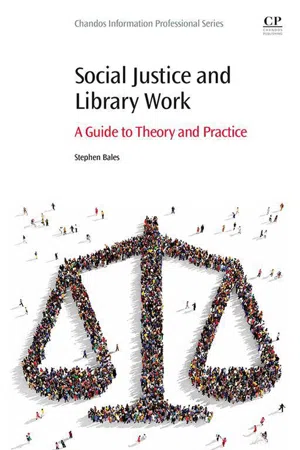
Although they may not have always been explicitly stated, library work has always had normative goals. Until recently, such goals have largely been abstract; they are things like knowledge creation, education, forwarding science, preserving history, supporting democracy, and safeguarding civilization. The modern spirit of social and cultural critique, however, has focused our attention on the concrete, material relationships that determine human potentiality and opportunity, and library workers are increasingly seeing the institution of the library, as well as library work, as embedded in a web of relations that extends beyond the library's traditional sphere of influence. In light of this critical consciousness, more and more library and information science professionals are coming to see themselves as change agents and front-line advocates of social justice issues. This book will serve as a guide for those library workers and related information professionals that disregard traditional ideas of "library neutrality" and static, idealized conceptions of Western culture. The book will work as an entry point for those just forming a consciousness oriented towards social justice work and will be also be of value to more experienced "transformative library workers" as an up-to-date supplement to their praxis.
- Justifies the use of a variety of theoretical and practical resources for effecting positive change
- Explores the role of the librarian as change agents
Information
Chapter 1
Introduction
Abstract
This chapter outlines the four basic objectives of this guide: (1) to orientate progressive and leftist librarians to the theoretical landscapes that comprise their work’s intersection with social justice; (2) to orientate transformative librarians to a collection of practical resources for transforming modern society; (3) to situate the theoretical and practical resources through a series of case studies; and (4) to present a profile of the transformative librarian. In addition, the introduction examines the basic concepts of social justice in relationship to library and information science (LIS) environments and research, followed by a summary of the remainder of the book.
Keywords
Social justice; libraries; transformative library work
1.1 A Preliminary Note Concerning Terminology
Whenever possible, I use the inclusive term “library work” to encompass all tasks, both physical and mental, that propel the library as a sociocultural institution, as well as to realize the library’s humanistic potential in modern society. I prefer to use the term “library worker” instead of “librarian” (unless the distinction is necessary) to identify all of those people that labor to realize the above tasks: professional librarians and related information professionals like archivists and museum curators, paraprofessional staff members, technical support staff, and volunteers. Ultimately, it is both artificial and counterproductive to restrict the domain of social justice activity by limiting the discourse surrounding such activity to only those people holding specific degrees and official titles. I consider everyone acting towards the realization of social justice and human rights through library or related work as equivalent. This postprofessional stance may be unpopular with some library and information science (LIS) practitioners, particularly when considering the continuing anxiety among librarians concerning their professional status. This posture, nonetheless, helps the library worker remain critical of her position within an institutional power structure and it helps justify her actions towards reforming both the institution and the society within which it operates. Finally, this guide aims at those library workers that sense the political nature of their work and either wish to explore this further or wish to inform an existing counterhegemonic praxis. I use the term “transformative library worker” to indicate those workers that have achieved some degree of critical consciousness concerning what they do and who have committed themselves to social justice action within environments directly associated with their work, as well as to social justice action within the larger society.
1.2 Introduction: Theory, Practice, Praxis, and Library Work
This book is a practical guide for the library worker who engages in, or wishes to start, a transformative professional praxis that aims at the goals ascribed to by social justice and its close relative human rights. The two operative words in the last sentence are transformative and praxis. What is a transformative praxis in the sense discussed in this book? Why is a transformative praxis important to the transformative library worker in order to effect any sort of lasting social justice change? How might one use this book to aid in the task of pursuing social justice through the library and related institutions?
To engage in professional praxis is to put theory into practice in a conscious, reflective way. There have been multiple variations on this basic understanding of the term. Paolo Freire, the great Brazilian philosopher of education—you will see his name many times in this book—developed a theory of praxis that is particularly germane to socially conscious library work. Freire’s praxis, as described in his Pedagogy of the Oppressed (1970), is a “transformation of the world. And as praxis it requires theory to illuminate it. Men’s activity is theory and action. It cannot, as [Freire] stressed in Chapter 2 [of Pedagogy of the Oppressed], be reduced to either verbalism or activism” (p. 119). If we adopt this vision of praxis, we cannot functionally separate theory from practice. With such a disconnection, theory becomes solipsistic bluster. Practice becomes, at best, a naïve activism, and at worst, a rote and robotic operation.
Freire’s praxis is communal, revolutionary, and social, a “dialogical” approach to change where “it is absolutely essential that the oppressed participate in the revolutionary process with an increasingly critical awareness of their role as Subjects of the transformation” (p. 121). This is the application of theory to and (importantly) by the community for the intent of positive change that benefits all of the community. Freire’s praxis is designed for the realization of social justice and human rights, ideas that turn on concepts like equity, freedom, community, cooperation, and consensus. These are also ideas that lead to the rejection of problematic social structures like hierarchy, exclusion, and authoritarianism.
Even though a library worker may not have thought deeply about the relation of social justice to her job, it is easy to see how she might identify with such ideas on a professional level. This inclusive praxis of action and transformation for social equity fits well, for instance, with the tenets put forth in the American Library Association’s (ALA) (2004) Core Values of Librarianship: (1) Democracy, (2) Diversity, (3) Education and Lifelong Learning, (4) Intellectual Freedom, (5) The Public Good, (6) Preservation, (7) Professionalism, (8) Service, and (9) Social Responsibility. However, without the productive dialogue of theory and practice, without the praxis, the ALA Core Values become nothing but abstract banalities. When library workers do make the connection between theory and action, they become aware of their roles; they acknowledge and consciously inhabit them. This consciousness does not necessarily happen in the politically partisan sense of some sort of conversion to a specific ideology or creed, but in the revelatory sense of coming to an understanding that their professional activities always serve the interests of some group, whether or not they want this to happen. Library work is a fundamentally political activity in that most workers operate in some capacity as information gatekeeper and agent of the state for an institution that supports the status quo. Such an epiphany can be unsettling, and the library loses some idealistic luster. Its social relations come into focus, many of which are hierarchical, patriarchal, and conservative. However, two things become apparent through critical consciousness: (1) libraries have vast potential as tools for societal transformation, and, in the face of these considerations, (2) the idle library worker is a bootless functionary. This guide approaches a critical, activist, social justice library praxis as an essentially stochastic endeavor applying that word’s original Greek sense: to assess a situation to take one’s best aim at a target. The information provided includes tools for assessing, directing, and transforming society, and doing so from the vantage point of the modern library and for the benefit of all.
1.3 Objectives of this Guide
To benefit a transformative praxis of library work, I have organized this book around the intrinsically related categories of theory and practice. I did this to provide insights, connections, and tools for informed action. The book has four objectives that hinge on these two categories. The first objective deals with theory. It is to introduce and orient transformative library workers to the current resources that join the pursuit of social justice and human rights with the library. The second objective concerns transformative library work in a more immediately material sense: to direct library activists to a collection of practical resources for transforming modern society. These practical resources are useful assets for both assimilating the core ideas of social justice qua library work and for actively engaging with important social justice and human rights issues as they relate to public, academic, special, school library media centers, and alternative information institutions.
Although sound theory and workable tools are necessary for effective social justice work in and through the library, it is these things’ application in the form of a robust professional praxis that matters the most to transformative library work and the greater good of society. In light of this necessity, the third objective of this guide is to situate contextually the categories of theory and practice in their codeterminate relations to give the reader insight into the workings of instantiations of praxis. While professional praxis remains a key element throughout the text of this guide, it figures extensively into the fourth chapter, which presents case studies of programs and initiatives that relate theory to practice in LIS and related settings. The fourth and final objective of this guide is to propose a potential profile of the transformative library worker herself. The book concludes with a brief presentation of my personal vision of the engaged library practitioner who consolidates critical thinking with progressive action for the purpose of social justice. The sketch is by no means conclusive or monolithic. Instead, it is a provisional model of three broad motifs for use in self-reflection and further investigation. I ask readers to consider it with an open mind, but also to challenge and modify it. Transformative change requires that we analyze objective idealisms and reject blind and simplistic abstractions. Both theorists and activists should make their ideas and actions open to critique.
The remainder of the present chapter is given over to establishing the landscape through which the transformative library worker navigates. It consists of a brief overview of relevant ideas by which the reader may establish their bearings before proceeding to the suggested resources. First, it examines definitions and concepts related to social justice. It then locates social justice and human rights work within the modern library. The chapter concludes with a call for inclusivity in social justice efforts and a brief outline describing the structure and content of the remainder of the text.
1.4 What is Social Justice?
Social justice thought and action weaves itself throughout world history, working as a counterpoint to humankind’s unfortunate propensities for greed, power, and physical and economic violence. The fundament of this thought and action has come out of philosophy, religion, and politics. It has also originated organically as a reaction to exploitation and oppression. Sometimes it is a combination of two or more of these factors. It never separates, however, from the context of history, cultural, and human social relations.
Social justice emerged in its modern conceptualizations out of the inequities heaped on the mid-nineteenth century European working class by the capitalist mode of production (Barry, 2005). From this miasma, Karl Marx developed his “principle of needs” (McCarthy, 1990, p. 94), i.e., the theory that “establishes the material framework for development of individual abilities and potentialities on an equal footing” (p. 95). Concepts of social justice and human rights continued to develop over the next century and a half in the face of unbridled industrialization, incessant wars, imperialism, colonialism, and globalization. This development did not result in any consensus on a technical definition, with differing and sometimes competing (or even blending) versions of social justice such as Marxist, feminist, Christian, anarchist, conservative, and liberal. As an idea, social justice remains ambiguous, and its theoretical and practical realization rests upon context: economics, cultural milieu, and the historical moment. This consideration, we shall see, has implications on implementations related to modern library work, which operates in a neoliberal, late capitalist environment.
The Oxford English Dictionary defines social justice broadly as “justice at the level of a society or state as regards the possession of wealth, commodities, opportunities, and privileges” (Social justice, 2016). Human rights is a closely related concept, albeit a more abstract one that often calls for the fulfillment of baseline requisites as opposed to parity of distribution. It is impossible to see the practical realization of the latter concept without the sufficient realization of the former (and vice versa). At least since the Age of Enlightenment, it has been possible to abstract most definitions of both social justice and human rights to the term “fairness.” If anything, this calculus of basic human equality is becoming even more widespread with the development and influence of the post-Marxian critiques of dominant social paradigms and power structures pioneered by critical theorists and activists in the post-WWII globalized environment.
The preeminent theoretician of fairness social justice was John Rawls, author of the seminal A Theory of Justice (1971/2005). Rawls’s thought centered on ideas of fair distribution and political freedom that hinge on the existence of basic freedoms and equality of opportunity. Despite its influence, his social justice is just one modern interpretation of the concept and has been the subject of criticism, including that it does not adequately account for or attempt to oppose the patriarchal and hierarchical society within which it sits (Noddings, 1989; Smiley, 2004). Other social justice theorists have proposed variations that come from radical egalitarian, welfare-based, libertarian, and desert-base...
Table of contents
- Cover image
- Title page
- Table of Contents
- Copyright
- Dedication
- Preface
- Chapter 1. Introduction
- Chapter 2. Theory: Intellectual Building-Blocks for Transformative Librarianship
- Chapter 3. Practice: Tools for Transformative Library Work
- Chapter 4. Praxis: Theory in Practice
- Chapter 5. Conclusion: The Transformative Library Worker
- Index
Trusted by 375,005 students
Access to over 1.5 million titles for a fair monthly price.
Study more efficiently using our study tools.
Frequently asked questions
Yes, you can cancel anytime from the Subscription tab in your account settings on the Perlego website. Your subscription will stay active until the end of your current billing period. Learn how to cancel your subscription
No, books cannot be downloaded as external files, such as PDFs, for use outside of Perlego. However, you can download books within the Perlego app for offline reading on mobile or tablet. Learn how to download books offline
Perlego offers two plans: Essential and Complete
- Essential is ideal for learners and professionals who enjoy exploring a wide range of subjects. Access the Essential Library with 800,000+ trusted titles and best-sellers across business, personal growth, and the humanities. Includes unlimited reading time and Standard Read Aloud voice.
- Complete: Perfect for advanced learners and researchers needing full, unrestricted access. Unlock 1.5M+ books across hundreds of subjects, including academic and specialized titles. The Complete Plan also includes advanced features like Premium Read Aloud and Research Assistant.
We are an online textbook subscription service, where you can get access to an entire online library for less than the price of a single book per month. With over 1.5 million books across 990+ topics, we’ve got you covered! Learn about our mission
Look out for the read-aloud symbol on your next book to see if you can listen to it. The read-aloud tool reads text aloud for you, highlighting the text as it is being read. You can pause it, speed it up and slow it down. Learn more about Read Aloud
Yes! You can use the Perlego app on both iOS and Android devices to read anytime, anywhere — even offline. Perfect for commutes or when you’re on the go.
Please note we cannot support devices running on iOS 13 and Android 7 or earlier. Learn more about using the app
Please note we cannot support devices running on iOS 13 and Android 7 or earlier. Learn more about using the app
Yes, you can access Social Justice and Library Work by Stephen Bales in PDF and/or ePUB format, as well as other popular books in Languages & Linguistics & Library & Information Science. We have over 1.5 million books available in our catalogue for you to explore.