eBook - ePub
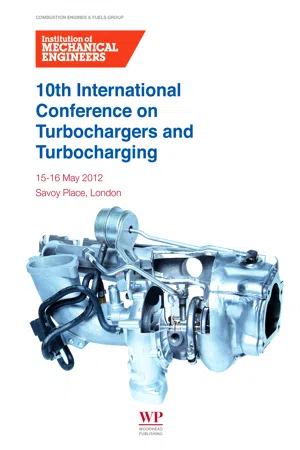
10th International Conference on Turbochargers and Turbocharging
- 456 pages
- English
- ePUB (mobile friendly)
- Available on iOS & Android
eBook - ePub
10th International Conference on Turbochargers and Turbocharging
About this book
This book presents the papers from the latest international conference, following on from the highly successful previous conferences in this series held regularly since 1978. Papers cover all current and novel aspects of turbocharging systems design for boosting solutions for engine downsizing. The focus of the papers is on the application of turbocharger and other pressure charging devices to spark ignition (SI) and compression ignition (CI) engines in the passenger car and commercial vehicles. Novel boosting solutions for diesel engines operating in the industrial and marine market sectors are also included.The current emission legislations and environmental trends for reducing CO2 and fuel consumption are the major market forces in the transport (land and marine) and industry sectors. In these market sectors the internal combustion engine is the key product where downsizing is the driver for development for both SI and CI engines in the passenger car and commercial vehicle applications. The more stringent future market forces and environmental considerations mean more stringent engine downsizing, thus, novel systems are required to provide boosting solutions including hybrid, electric-motor and exhaust waste energy recovery systems for high efficiency, response, reliability, durability and compactness etc. For large engines the big challenge is to enhance the high specific power and efficiency whilst reducing emission levels (Nox and Sox) with variable quality fuels. This will require turbocharging systems for very high boost pressure, efficiency and a high degree of system flexibility.
- Presents papers from all the latest international conference
- Papers cover all aspects of the turbocharging systems design for boosting solutions for engine downsizing
- The focus of the papers is on the application of turbocharger and other pressure charging devices to spark ignition (SI) and compression ignition (CI) engines in the passenger car and commercial vehicles
Information
Session 1
Novel Applications
HyBoost – An intelligently electrified optimised downsized gasoline engine concept
J. King, M. Heaney, E. Bower, N. Jackson and N. Owen, Ricardo, UK
J. Saward and A. Fraser, Ford Motor Company, UK
G. Morris and P. Bloore, Controlled Power Technologies, UK
T. Cheng, J. Borges-Alejo and M. Criddle, Valeo, France
ABSTRACT
The UK Technology Strategy Board (TSB) sponsored HyBoost project was a collaborative research programme to develop an ultra efficient optimised gasoline engine concept with "Intelligent Electrification". The basis of the concept was use of a highly downsized 1.0 L boosted engine in conjunction with relatively low cost synergistic '12 + X' Volt electrical management system and electrical supercharger technologies to deliver better value CO2 reduction than a full hybrid vehicle. Project targets of 99 g/km CO2 as measured over the European Drive Cycle (EDC) in a standard 2011 Ford Focus whilst maintaining the same performance and driveability attributes as a 2009 production 2.0 L version of the car were achieved, and a potential route through to < 85 g/km CO2 identified. Ricardo was supported by a consortium consisting of Ford, Controlled Power Technologies, Valeo, the European Advanced Lead Acid Battery Consortium, Imperial College London and the UK TSB.
1 INTRODUCTION
Mandation of road vehicle fuel economy is becoming a global phenomenon, with legislation or binding agreements for substantial improvements coming into force in Europe, the US, Canada, Australia, Japan and China. Passenger cars are a primary focus of this legislation, with future targets calling typically for continuing improvement of 3% per year as shown in Figure 1.

Figure 1 Future Passenger Car Fuel Economy Targets & Legislation (Source: Passenger Vehicle Greenhouse Gas and fuel Economy Standards: A Global Update – ICCT)
To put this change into context: in Europe, an average of 1.6% per year improvement has been achieved over the last decade, driven by the now superseded Voluntary Agreement. This is a world-leading pace of change, despite missing the VA targets. Future legislation in the major markets now requires that this pace of change must be doubled, for example in Europe a new car fleet average tailpipe CO2 emission of 130 g/km must be achieved, with phase-in from 2012-18, with even tougher targets currently set for 2020.
The mass-market advancement of Hybrid vehicles still requires significant reduction in product cost. Recent analysis by Ricardo (updating the 2003 DfT/DTI "Low Carbon Roadmap") indicates that current Hybrid cars only offer marginal Total Cost of Ownership savings unless these cost reductions are realised. This analysis also continues to indicate that deploying low cost technologies across a large number of vehicles remains more cost-effective than deploying costly technology to a few.
In the UK and Europe, the Diesel engine is currently established as the fuel-efficient solution for the majority of passenger cars sold. However, its significant incremental cost over a gasoline engine arising from the cost of precision fuel injection and exhaust after-treatment devices forms a higher proportion of the purchase price. Furthermore, rising demand for Diesel fuel rather than gasoline impairs the efficiency of the refinery (meaning that CO2 savings on a "well to wheel" basis are becoming less attractive) and pushes up the price of Diesel fuel. The aim of the HyBoost concept was to combine cost-effective hybridisation with synergistic gasoline engine downsizing technologies to offer a CO2/performance trade-off better than today's more costly full hybrids and high efficiency Diesels.
2 HYBOOST CONCEPT
HyBoost targets were to deliver a C-segment model year 2011 (MY2011) Ford Focus demonstrating a 30-40% reduction in CO2 emissions as measured over the EDC (to below 100 g/km) versus a baseline MY2009 2.0 L Naturally Aspirated (NA) gasoline engine version of the passenger car whilst maintaining the comparable vehicle performance and driveability attributes. Figure 2 shows a simple scheme of the concept with the 2.0 L NA engine replaced with a downsized DI gasoline engine equipped with a conventional fixed geometry turbocharger (FGT) delivering superior steady state power and torque levels. A Front End Accessory Drive (FEAD) mounted Belt Starter Generator (BSG) gave micro hybrid functionality of stop/start and more efficient motoring and generation enabled through the higher voltage "12 + X" (typically between 18 – 27 V) energy storage of an ultra capacitor system. Energy recovered during deceleration events could be deployed in a sophisticated boosting system combining a 12 + X electric supercharger "blowing through" the conventional turbocharger and/or the BSG torque assist system, using the electrical energy optimally to achieve good transient response or improved fuel consumption. The component systems have previously been demonstrated individually at 12 volts, but not brought together in this synergistic combination as a "12 + X" system.

Figure 2 Hyboost Concept Scheme
The project also included exploration of electric turbocompounding (shown in the scheme but not fitted to the HyBoost car) and a novel energy storage technology for further enhancements to efficiency and cost respectively, but these items are not covered in this paper.
3 RESULTS AND DISCUSSION
3.1 Hyboost Engine And Boost System
HyBoost uses a modified near production Ford 1.0 L 3 cylinder turbo GDI EcoBoost base engine. This gives 50% downsizing over the baseline engine. Figure 3 shows the steady state torque curves of the two engines, and the superior performance of the HyBoost engine can be clearly seen. The Ford 2.0 L Duratec engine produces peak power and torque levels of 107 kW at 6000 rpm and 185 Nm at 4000 rpm respectively. This compares to the HyBoost (with no electric supercharger assist) peak power and torque levels of 105 kW at 5500 rpm and 234 Nm at 2500 rpm respectively, which were achieved through re-optimisation of the boosting system, use of a new intake air path required to include the electric supercharger, and fitment of a new high efficiency Valeo Water Charge Air Cooler (WCAC) system. The WCAC system was specified with a very high (relative to engine size and performance) heat rejection capability of between 16 – 18 kW, and this was key to enabling excellent charge cooling to mitigate knocking and maintain lambda 1 operation through to full load, resulting in excellent Brake Specific Fuel Consumption (BSFC) across the entire operating map.

Figure 3 Ford 2.0 L Duratec Vs Hyboost Torque Curves Comparison
As the engine becomes more aggressively downsized several potential issues arise with regards to perceived performance. Firstly, the main issue is turbocharger lag, where the device itself takes time to build up boost pressure and the subsequent transient torque curve does not meet the steady state torque curve. Secondly, often there can be a big difference between the low engine speed "NA" torque (typically 8 – 11 bar BMEP), where the FGT is not able to deliver any significant boost pressure even during steady state conditions, and peak torque, which...
Table of contents
- Cover image
- Title page
- Table of Contents
- Copyright
- Your Global Technology Partner
- Session 1: Novel Applications
- Session 2A: High-Boost and Two-Stage Systems
- Session 2B: Turbine Fatigue and Structural
- Session 3A: Compressor Aero-Design Optimisation (CFD)
- Session 3B: Rotordynamics and Vibrations
- Session 4A: Advancing Simulation and Validation
- Session 4B: Turbine Development Trends
- Session 5: Systems and Transient Response
- Session 6: Compressor Development Trends
- Session 7: Novel Pressure Charging and High Efficiency Systems
- Session 8: Turbine Unsteady Flow
- Additional Papers Not Presented at the Conference
- Author Index
Trusted by 375,005 students
Access to over 1.5 million titles for a fair monthly price.
Study more efficiently using our study tools.
Frequently asked questions
Yes, you can cancel anytime from the Subscription tab in your account settings on the Perlego website. Your subscription will stay active until the end of your current billing period. Learn how to cancel your subscription
No, books cannot be downloaded as external files, such as PDFs, for use outside of Perlego. However, you can download books within the Perlego app for offline reading on mobile or tablet. Learn how to download books offline
Perlego offers two plans: Essential and Complete
- Essential is ideal for learners and professionals who enjoy exploring a wide range of subjects. Access the Essential Library with 800,000+ trusted titles and best-sellers across business, personal growth, and the humanities. Includes unlimited reading time and Standard Read Aloud voice.
- Complete: Perfect for advanced learners and researchers needing full, unrestricted access. Unlock 1.5M+ books across hundreds of subjects, including academic and specialized titles. The Complete Plan also includes advanced features like Premium Read Aloud and Research Assistant.
We are an online textbook subscription service, where you can get access to an entire online library for less than the price of a single book per month. With over 1.5 million books across 990+ topics, we’ve got you covered! Learn about our mission
Look out for the read-aloud symbol on your next book to see if you can listen to it. The read-aloud tool reads text aloud for you, highlighting the text as it is being read. You can pause it, speed it up and slow it down. Learn more about Read Aloud
Yes! You can use the Perlego app on both iOS and Android devices to read anytime, anywhere — even offline. Perfect for commutes or when you’re on the go.
Please note we cannot support devices running on iOS 13 and Android 7 or earlier. Learn more about using the app
Please note we cannot support devices running on iOS 13 and Android 7 or earlier. Learn more about using the app
Yes, you can access 10th International Conference on Turbochargers and Turbocharging by Institution of Mechanical Engineers in PDF and/or ePUB format, as well as other popular books in Technology & Engineering & Mechanical Engineering. We have over 1.5 million books available in our catalogue for you to explore.