eBook - ePub
Phase Transformations in Steels
Diffusionless Transformations, High Strength Steels, Modelling and Advanced Analytical Techniques
- 680 pages
- English
- ePUB (mobile friendly)
- Available on iOS & Android
eBook - ePub
Phase Transformations in Steels
Diffusionless Transformations, High Strength Steels, Modelling and Advanced Analytical Techniques
About this book
The processing-microstructure-property relationships in steels continue to present challenges to researchers because of the complexity of phase transformation reactions and the wide spectrum of microstructures and properties achievable. This major two-volume work summarises the current state of research on phase transformations in steels and its implications for the emergence of new steels with enhanced engineering properties.Volume 2 reviews current research on diffusionless transformations and phase transformations in high strength steels, as well as advances in modelling and analytical techniques which underpin this research. Chapters in part one discuss the crystallography and kinetics of martensite transformations, the morphology, substructure and tempering of martensite as well as shape memory in ferrous alloys. Part two summarises research on phase transformations in high strength low alloy (HSLA) steels, transformation induced plasticity (TRIP)-assisted multiphase steels, quenched and partitioned steels, advanced nanostructured bainitic steels, high manganese twinning induced plasticity (TWIP) and maraging steels. The final two parts of the book review advances in modelling and the use of advanced analytical techniques to improve our understanding of phase transformations in steels.With its distinguished editors and distinguished international team of contributors, the two volumes of Phase transformations in steels is a standard reference for all those researching the properties of steel and developing new steels in such areas as automotive engineering, oil and gas and energy production.
- Alongside its companion volume, this major two-volume work summarises the current state of research on phase transformations in steels
- Reviews research on diffusionless transformations and phase transformations in high strength steels
- Examines advances in modelling and the use of advanced analytical techniques to improve understanding of phase transformations in steels
Information
Part I
Diffusionless transformations
1
Crystallography of martensite transformations in steels
P.M. Kelly, The University of Queensland, Australia
Abstract:
This chapter describes the unique features of martensitic transformations in steels. It covers the characteristics that serve to distinguish and identify the different types of ferrous martensite and then moves on to tackle the most impressive, but often complex and mathematically inscrutable, theory of phase transformations ever produced – the phenomenological theory of martensite crystallography (the PTMC). The approach concentrates on what the mathematics attempts to achieve and not on the mathematics itself. A general comparison between theory and experiment is included as well as attempts to identify features that have proved difficult to explain and hence led to subsequent improvements in the theory. Finally, the chapter identifies the need for further work, either to provide critical experimental evidence to test the theories or to suggest fruitful areas for future research.
Key words
martensite
crystallography
habit plane
orientation relationship
shape strain
1.1 Introduction
As a solid state phase transformation, the formation of martensite in steels has some unique features. This chapter begins by describing these features and emphasising their importance in the crystallography of martensite. It deals briefly with some of the characteristics – the martensite plate habit plane in particular – that serve to distinguish and identify the different types of martensite found in steels. It then moves on to tackle the most impressive, but often complex and inscrutable, theory of phase transformations ever produced. The steps leading up to the development of the so-called phenomenological theory of martensite crystallography (the PTMC) are described and the various experimental and theoretical advances that provided critical ingredients for this theory are discussed.
The major portion of the chapter is then devoted to a description of the original versions of the PTMC and some of its progeny in the form of modifications or advanced variants. The biggest problem with describing the PTMC is its mathematics. The beautifully elegant matrix algebra employed in the PTMC is often sufficiently daunting and indigestible to permanently discourage the reader. Consequently the true value of this exceptional treatment of the crystallography of martensite is often never fully appreciated. In this chapter the emphasis is on describing what the mathematics attempts to achieve and not on the mathematics itself. Wherever possible, the approach will be descriptive and will avoid becoming submerged in what is often regarded as incomprehensible mathematics. Important concepts that are essential foundation stones for the PTMC will be explained. The various alternative theoretical treatments and modifications to the PTMC will be discussed and compared with the original theory. However, because of its unsurpassed success as a predictive theory, the PTMC will receive the lion’s share of attention and, in many cases, shown to be at least equivalent to the later models/theories.
The strength of any predictive theory rests on its ability to account for any experimental observations. Hence, the comparison between theory and experiment will be covered, but not in minute detail. There is an extensive amount of quite sophisticated experimental data on the crystallography of ferrous martensites in steels that has been collected over more than half a century, and it is impossible to cover all of this individual detail in a single chapter. Instead the emphasis will be on summaries that have appeared in textbooks or reviews and the reader is encouraged to go back to these sources for information on individual sets of observations. Wherever appropriate this comparison between theory and experiment will attempt to identify particular features that have proved difficult to explain via the PTMC. These examples have often led to developments/improvements in the theoretical treatment. Hence this theoretical/experimental comparison will serve not only to test the theories themselves, but also to provide a historical perspective on the development of our understanding of martensite crystallography in the last five decades. It is hoped it will also identify the need for further work, either to provide critical experimental evidence to test the theories or to suggest fruitful areas for future research.
Finally, the success of this chapter on the crystallography of martensite will depend on its ability to demonstrate the power of the PTMC and to encourage others to face the mathematical maelstrom of matrix algebra in the hope of appreciating its contribution to the understanding of a unique form of phase transformation in solids.
1.2 Martensite transformations in steels
1.2.1 The characteristics of martensite transformations
The martensite transformation in steels is probably one of the earliest recognised examples of a phase transformation in the solid state. The ability to harden ‘ignited iron’ by quenching was referred to more than 3000 years ago in Homer’s Odyssey (Homer, 900BC). The important characteristics of this form of transformation are that it leads to a change in crystal structure that occurs in an athermal, diffusionless fashion involving the simultaneous, co-operative movement of atoms over distances less than an atomic diameter and is accompanied by a macroscopic change of shape of the transformed volume (Bilby and Christian, 1955; Christian, 1965, 1975, 1990; Petty, 1970; Nishiyama, 1978; Cohen et al., 1979). While the co-operative atom movements may involve some small ‘shuffles’ (Christian, 1990), there is no need to ‘reconstruct’ the crystal structure of the matrix, as there is in a conventional diffusional transformation (Christian, 1975).
From the point of view of the crystallography of the transformation, the displacive character is particularly important. The shape change that results from this displacive component is relatively large and dominated by shear, as opposed to the relatively small changes in volume that accompany the transformation. In a surface polished prior to the transformation, the shape change associated with the formation of a martensite plate leads to surface tilts and the change in direction of surface scratches, as illustrated in Fig. 1.1. The shape change, its magnitude and direction, therefore constitute the most important and defining features associated with a martensitic transformation.
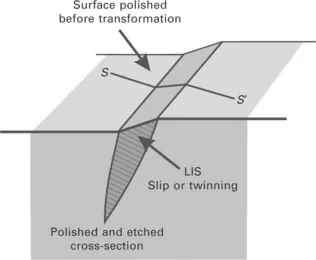
1.1 The experimentally observable effects associated with a martensite transformation in steels. The shape strain, which is an invariant plane strain, causes tilts in a pre-polished surface and changes in direction of the initially straight surface scratch SS′. The polished and etched cross-section approximately normal to the prepolished surface shows the lenticular martensite plate in section with possible evidence for the lattice invariant shear L in the form of slip or twinning, as well as the component of the tilt in the pre-polished surface. Adapted from fig. 2 of Zhang and Kelly (2009).
The other important crystallographic characteristics of martensite in steels are its morphology, the orientation relationship between the matrix and product martensite phases, the internal substructure of the martensite itself and the nature of the interface. These crystallographic features need to be referred to particular phases, such as the face centred cubic (fcc) parent phase austenite denoted by the subscript F, the body centred cubic (bcc) or tetragonal (bct) martensite phase denoted by the subscript B and the relatively rare hexagonal close-packed (hcp) epsilon (ε) martensite denoted by the subscript H.
Martensite in steels is often plate-like with a wel...
Table of contents
- Cover image
- Title page
- Table of Contents
- Copyright
- Contributor contact details
- Foreword
- Introduction
- Part I: Diffusionless transformations
- Part II: Phase transformations in high strength steels
- Part III: Modelling phase transformations
- Part IV: Advanced analytical techniques for studying phase transformations in steels
- Index
Trusted by 375,005 students
Access to over 1.5 million titles for a fair monthly price.
Study more efficiently using our study tools.
Frequently asked questions
Yes, you can cancel anytime from the Subscription tab in your account settings on the Perlego website. Your subscription will stay active until the end of your current billing period. Learn how to cancel your subscription
No, books cannot be downloaded as external files, such as PDFs, for use outside of Perlego. However, you can download books within the Perlego app for offline reading on mobile or tablet. Learn how to download books offline
Perlego offers two plans: Essential and Complete
- Essential is ideal for learners and professionals who enjoy exploring a wide range of subjects. Access the Essential Library with 800,000+ trusted titles and best-sellers across business, personal growth, and the humanities. Includes unlimited reading time and Standard Read Aloud voice.
- Complete: Perfect for advanced learners and researchers needing full, unrestricted access. Unlock 1.5M+ books across hundreds of subjects, including academic and specialized titles. The Complete Plan also includes advanced features like Premium Read Aloud and Research Assistant.
We are an online textbook subscription service, where you can get access to an entire online library for less than the price of a single book per month. With over 1.5 million books across 990+ topics, we’ve got you covered! Learn about our mission
Look out for the read-aloud symbol on your next book to see if you can listen to it. The read-aloud tool reads text aloud for you, highlighting the text as it is being read. You can pause it, speed it up and slow it down. Learn more about Read Aloud
Yes! You can use the Perlego app on both iOS and Android devices to read anytime, anywhere — even offline. Perfect for commutes or when you’re on the go.
Please note we cannot support devices running on iOS 13 and Android 7 or earlier. Learn more about using the app
Please note we cannot support devices running on iOS 13 and Android 7 or earlier. Learn more about using the app
Yes, you can access Phase Transformations in Steels by Elena Pereloma,David V Edmonds in PDF and/or ePUB format, as well as other popular books in Technology & Engineering & Mining Engineering. We have over 1.5 million books available in our catalogue for you to explore.