- 456 pages
- English
- ePUB (mobile friendly)
- Available on iOS & Android
eBook - ePub
Religion in Personality Theory
About this book
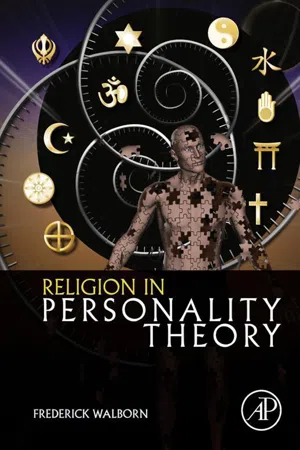
Religion in Personality Theory makes clear the link between theory and research and personality and religion. Presently, most personality texts have a limited discussion of religion and reference few theorists other than Freud and Maslow in relation to the subject. This book reviews the theory and the empirical literature on the writings of 14 theorists. Every chapter concludes with a summation of the current research on the theorist's proposals.
Reviews:
"Frederick Walborn has written an excellent text that explores the degree to which classical personality theorists were personally influenced by and focused upon religion in developing their personality theories. Each theorist is presented in sufficient detail so that their personal views of religion are seen to influence the theories they developed. In addition, the current status of the empirical evidence in the psychology of religion is explored in the context of the theorist and theory to which the data is most relevant. Current and up to date, this text is appropriate for either a course in Personality or as an introduction to the Psychology of Religion. The author's own comprehensive theory of religion and spirituality creatively integrates the positive contributions of the classical personality theorist to the contemporary psychology of religion."
-Ralph W. Hood Jr., Professor of Psychology, University of Tennessee at Chattanooga
"In this interesting and accessible book, Frederick Walborn thoughtfully probes the place of religion and spirituality in the writings of a broad range of classical psychological thinkers and offers an insightful critique of current empirical research on the complex relation of religion and spirituality to individual well-being."
-Michele Dillon, Ph.D., Professor and Chair, Department of Sociology, University of New Hampshire, Durham, New Hampshire
- Identifies what major personality theorists say about religion
- Investigates whether evidence supports or refutes predictions made by different theories
- Concludes with a comprehensive integrative theory on religion and spirituality
Information
Chapter 1
Introduction
Abstract
Historically, the classic personality theorists’ writings on religion and spirituality have been neglected in textbooks. Possible reasons for this disregard and the import of revitalizing their religious/spiritual writings are reviewed. To further accentuate this unnecessary neglect, some dark and positive moments from religion’s past are highlighted. Presently, there is an abundance of research to suggest that religious people tend to be healthier on a number of measures. The past and present movements toward, within, and away from religious practices are summarized. The chapter concludes with a number of provocative questions which will be answered in subsequent chapters. Finally, the reader is informed that an integrative/comprehensive theory on spirituality and religion concludes the book.
Keywords
religiosity; spirituality; religious attendance; spiritual endorsement; comprehensive theory
Contents
An Overview of the Psychology of Religion/Spirituality
Defining Religion and Spirituality
Reasons for Studying Religion/Spirituality and Personality Development
Religious/Spiritual People tend to be Healthier
Dark Moments from Religion’s Past
Some Dark Religious Behaviors from the Past
Some Dark Scriptures
Questioning Religion and Spirituality on a Personal Level
Some Bright Moments from Religion’s Past
Some Bright Religious Behaviors of the Past
Some Bright Scriptures
Praising Religion and Spirituality on a Personal Level
Movement Toward, Within, and Away from the Church
Statistics on Religion Survey (2010)
The Gallup Polls (2007 and 1948)
What to Expect from this Book
During the process of writing this book, many students, colleagues, friends, and acquaintances asked me about its content. When I replied that it was a book about the psychology of religion and spirituality, the majority of the people voiced strong opinions about their beliefs regarding the role of religion/spirituality in life. I have known many of these people for a number of years, and I had no idea how strong their beliefs, opinions, and/or attitudes were toward religion/spirituality. It did not matter whether a person was an atheist, agnostic, of a mainstream religion, or evangelical, people had very strong opinions about religion that they were eager to express. It was as if, before I could tell them anything about the book, there was going to be nothing that I could say or write that would change their opinion.
Some of the more honest people who had strong religious/spiritual beliefs questioned me on how psychology could have anything to do with religion. Some of these honest people were reflective of the religious camp that believed that psychology could have nothing to do with religion because their beliefs were based on faith and the mystical. Likewise, there were other honest people of the opposing camp, atheists and agnostics, who questioned what psychology had to do with religion/spirituality. They questioned why such an area of science, such as psychology, would want to study such an esoteric and immeasurable field as religion?
I didn’t try to convince my students, friends, or colleagues of a way for them to think about religion/spirituality. That is neither my purpose in life nor the purpose of this book. It is beyond my writing abilities, let alone my intellect, to understand God and to convey this understanding or lack of understanding to the reader. This book is not a persuasive book pro or con religion/spirituality. I will attempt to control my personal beliefs so that the reader may have as unbiased a presentation as possible of the various writings of the major theoretical psychologists, along with a review of the current empirical literature. I will attempt to maintain the role of a messenger to the best of my abilities. In the final chapter, I present a comprehensive theory on religion and spirituality which follows the various pathways both religious and nonreligious people might follow.
It is only fair, in such a hot-topic area, that the reader knows the author’s “biases.” I consider myself a religious/spiritual person, because I do believe that there is more to life than simply being rational, following our personal unconscious paths, and/or being a passive recipient of stimulus-response connections. I would also consider myself to be religious in that I have attended and been a member of numerous churches and organizations, all of the Protestant faith. The reason that I have attended churches of this particular denomination is because, like the majority of people, that is what I have known and what has been available. I know I need to reach out more, and become acquainted with the practices of other religions. But, I am still trying to discover the messages of the Protestant religion. I have been fortunate to have found other people that are receptive to an open interpretation of God and the importance that such faith can have in today’s hectic world. I do not interpret the Bible literally. I believe that all of the major religions are basically similar in their writings, because they prize the gift of moving from being self-focused to being other-focused. From such knowledge, we gain a true sense of love.
In this book, I will to keep my personal beliefs and biases at bay, but I fully acknowledge that this will not be totally possible. Even though some of my beliefs about religion/spirituality will emerge, I hope that the presentation will enlighten many readers on the writings of the major classical personality theorists and the current psychological research on religion/spirituality. Many readers will like what some of the theorists in the following chapters have written on religion/spirituality, and they will also find the writings of other theorists to be way off the mark. There is a good deal of variety between the various great theoretical psychologists on how they viewed the role of religion in life. The comprehensive theory, in the final chapter, is an integration of the theorists’ and empiricists’ writings.
Even with the above disclaimers, the reader is forewarned that the vast majority of theorists who wrote on religion/spirituality believed that religion and/or spirituality played a significant role in people’s personality development. Also, a general finding of recent research is that religious/spiritual people tend to be physically and psychologically more healthy than nonreligious/nonspiritual people. A section in this chapter summarizes the empirical studies. However, as the chapters progress, it will become apparent that the relationship between religion/spirituality and health is not so clear. Some theorists and research results conclude that certain religious/spiritual practices are unhealthy. Likewise, as will become evident by the conclusion of the book, there are also positive and negative secular trends.
The following sections of this chapter summarize the present status of the psychology of religion/spirituality, the definitions of the terms “religion” and “spirituality,” the importance of studying religion/spirituality, the dark and bright moments of religion, the recent waning and waxing of formal religion, and, finally, what to expect from this book.
An Overview of the Psychology of Religion/Spirituality
A summary of a recent survey conducted with psychologists concluded, “On the whole, psychologists remain quite nonreligious” (McMinn, Hathaway, Woods, & Snow, 2009, p. 10). On a five point Likert-type scale, 21% of the psychologists reported religion to be very important in their life (4 or 5 rating), 25% endorsed a midpoint rating of 3, and 54% of the psychologists endorsed a 1 or 2 rating (1 = not at all important). The results of this survey are similar to a previous survey of clinical psychologists conducted by Delaney, Miller, and Bisono (2007) and a survey conducted on psychiatrists and other mental health professionals (Shafranske, 2000). Overall, mental health practitioners and psychological scientists do not endorse religion as being an import facet of their lives.
Fifty-four percent of the psychologists in the previously mentioned survey considered themselves to be unaffiliated with a religious organization. In comparison, 16% of the general population of the United States considered themselves to be unaffiliated with a religious group (Statistics on Religion in America, 2010). This relative lack of endorsement of religion by psychologists is partially reflected by the neglect of theorists’ writings in personality theory textbooks. I reviewed ten personality textbooks, and only three had chapters in regard to religion. Of the three personality textbooks that did include significant information on religion, they all made reference to Eastern religions. However, in only one of the ten textbooks was there significant material on the role of Western religion in personality development (Ellis & Abrams, 2009).
Even though psychologists do not tend to endorse being religious, they do endorse being spiritual. Sixty-one percent of the psychologists surveyed rated spirituality as very important in their lives (4 or 5 on a 5-point scale), 21% as fairly important (3), and 18% as not at all important (1 or 2) (McMinn, Hathaway, Woods, and Snow, 2009). Thus, we are already introduced to a major schism in the field, the idea of people being religious and/or spiritual. In the following section, I review some of the current literature on these two divergent-yet-related terms.
One possible reason that current psychologists who write personality theory textbooks and other comprehensive books on psychological theory are not reviewing the literature on religion is because the authors of the textbooks are not religious, even though the majority of the general population do consider themselves religious. The authors of textbooks do not consider religion to be important in their personal lives, so they believe that religion does not actually play a significant role in the majority of peoples’ lives. I would like to believe that this is not the major reason for the neglect of the religious writings of various personality theorists because it would suggest blatant denial of other people’s experiential world and an overt projection of the textbook writer’s beliefs.
A second plausible reason for the lack of a review of the religious and spiritual writings of the theorists is that it is a touchy subject. As I mentioned at the opening of this chapter, people have strong opinions about religion and spirituality. Thus, for some authors of textbooks, it might feel uncomfortable to summarize the religious writings of prominent psychologists.
A third reason for not including religion and spirituality, as I have personally discovered, is that there is a lot of material that can be very confusing and difficult to summarize. The summary of personality theorists’ writings on religion/spirituality could easily be a class in and of itself. Further, reviewing the empirical literature on the different theorists’ vantages takes an inordinate amount of time.
A fourth reasonable reason for this general neglect in personality theory textbooks is that within the realm of scientific psychology there has been a waning of the psychoanalytic research and a waxing of the cognitive approach (Robins, Gosling, & Craik, 1999). Since the 1970s, there has been a tremendous growth of the cognitive perspective, and it has now achieved its prominence in the field. As the reader will discover, very few of the cognitive/behavioral theorists wrote on the role of religion/spirituality in personality development. However, the vast majority of the humanistic and psychodynamic theorists wrote on the role of religion.
Does this mean that the cognitive/behavioral camp will not be represented in this book? No. There will be a review of the major cognitive/behavioral theorists for this book; even though the theorists may have written nothing about religion, their perspective could add some new information...
Table of contents
- Cover image
- Title page
- Table of Contents
- Copyright
- Dedication
- Preface
- Acknowledgements
- Chapter 1. Introduction
- Chapter 2. Sigmund Freud
- Chapter 3. Carl Jung
- Chapter 4. Alfred Adler
- Chapter 5. Karen Horney
- Chapter 6. Erik Erikson
- Chapter 7. Eric Fromm
- Chapter 8. Burris Frederic Skinner
- Chapter 9. Albert Bandura
- Chapter 10. Walter Mischel
- Chapter 11. Raymond Cattell
- Chapter 12. Abraham Maslow
- Chapter 13. Victor Frankl
- Chapter 14. Gordon Allport
- Chapter 15. John Bowlby
- Chapter 16. A Comprehensive Theory of Spirituality and Religion
- References
- Index
Trusted by 375,005 students
Access to over 1.5 million titles for a fair monthly price.
Study more efficiently using our study tools.
Frequently asked questions
Yes, you can cancel anytime from the Subscription tab in your account settings on the Perlego website. Your subscription will stay active until the end of your current billing period. Learn how to cancel your subscription
No, books cannot be downloaded as external files, such as PDFs, for use outside of Perlego. However, you can download books within the Perlego app for offline reading on mobile or tablet. Learn how to download books offline
Perlego offers two plans: Essential and Complete
- Essential is ideal for learners and professionals who enjoy exploring a wide range of subjects. Access the Essential Library with 800,000+ trusted titles and best-sellers across business, personal growth, and the humanities. Includes unlimited reading time and Standard Read Aloud voice.
- Complete: Perfect for advanced learners and researchers needing full, unrestricted access. Unlock 1.5M+ books across hundreds of subjects, including academic and specialized titles. The Complete Plan also includes advanced features like Premium Read Aloud and Research Assistant.
We are an online textbook subscription service, where you can get access to an entire online library for less than the price of a single book per month. With over 1.5 million books across 990+ topics, we’ve got you covered! Learn about our mission
Look out for the read-aloud symbol on your next book to see if you can listen to it. The read-aloud tool reads text aloud for you, highlighting the text as it is being read. You can pause it, speed it up and slow it down. Learn more about Read Aloud
Yes! You can use the Perlego app on both iOS and Android devices to read anytime, anywhere — even offline. Perfect for commutes or when you’re on the go.
Please note we cannot support devices running on iOS 13 and Android 7 or earlier. Learn more about using the app
Please note we cannot support devices running on iOS 13 and Android 7 or earlier. Learn more about using the app
Yes, you can access Religion in Personality Theory by Frederick Walborn in PDF and/or ePUB format, as well as other popular books in Psychology & Personality in Psychology. We have over 1.5 million books available in our catalogue for you to explore.