- 252 pages
- English
- ePUB (mobile friendly)
- Available on iOS & Android
eBook - ePub
About this book
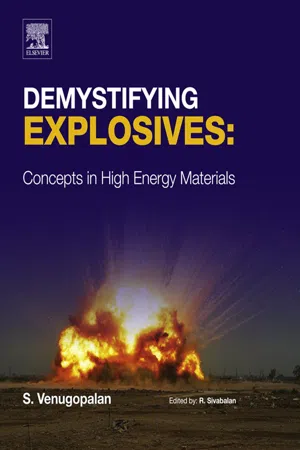
Demystifying Explosives: Concepts in High Energy Materials explains the basic concepts of and the science behind the entire spectrum of high energy materials (HEMs) and gives a broad perspective about all types of HEMs and their interrelationships. Demystifying Explosives covers topics ranging from explosives, deflagration, detonation, and pyrotechnics to safety and security aspects of HEMS, looking at their aspects, particularly their inter-relatedness with respect to properties and performance. The book explains concepts related to the molecular structure of HEMs, their properties, performance parameters, detonation and shock waves including explosives and propellants. The theory-based title also deals with important (safety and security) and interesting (constructive applications) aspects connected with HEMs and is of fundamental use to students in their introduction to these materials and applications.
- Explains the concept of high energy materials in simple language and down-to-earth examples
- Worked examples and problems are given wherever required
- Demystifies the concept of explosives
- Limited use of big and complex equations
- Questions and Suggested Reading are given at the end of each chapter
Information
Foreword 1
 | Condensed Systems Combustion Laboratory V.V. Voevodsky Institute of Chemical Kinetics and Combustion |

There are a large number of books and reports that give copious information on explosives, propellants, and pyrotechnics which are grouped as high energy materials (HEMs) or energetic materials. But, the book by S. Venugopalan is probably the first book of its kind intended to make the basic concepts of different HEMs clear and highlight the intricate relationship between them. The book also touches upon various aspects of HEMs like concerns of safety and security, instrumental characterization and performance evaluation of HEMs, future trends, and also their constructive applications. With the help of this book, the author wants to “demystify” the notion on explosives (a feared word!) and popularize the field of HEMs right from college curriculum to the beginners as well as veterans working in this field!
The author has a vast practical experience in the fields of propellants, explosives, and synthesis of HEMs and related materials, apart from close interaction with their manufacture, quality assurance, and safety. Therefore, he makes it interesting to read this book by reporting problems of practical interest and possible solutions. The Russians would refer this as obtaining information “from the first hands.” The author's style of presentation is amazingly simple and attractive. The book contains original statements/explanations regarding the definition and classification of HEMs and also their interrelationship in terms of energetics. The clearly illustrated pictures, worked examples, questions at the end of each chapter, and the suggested books for reading will be very useful to get a deeper understanding of the concepts.
The chapter on rocket propellants explains the fundamentals of internal ballistics of rockets and their bearing on the chemistry of formulation of the propellant as well as the challenges faced by the propellant chemist. There is a huge future for rocketry with many ambitious space programs in many countries and a youngster who dreams of choosing rocket propellants as his career will benefit from this chapter to get an introduction. While air-breathing engines like ramjets make use of the atmospheric oxygen for fuel combustion, the rockets that soar to outer space, where there is no oxygen, have to depend on compositions based on HEMs which provide an optimum combination of fuel and oxidizer.
The future of the rocketry can be fantastic when advanced HEMs like polynitrogen compounds can be used as propellant ingredients. Being highly endothermic compounds, these will release huge amounts of energy on decomposition resulting in very high values of specific impulse for the rockets, though many practical challenges may be encountered to use them, like safety, cost, and combustion stability.
I strongly believe that the information incorporated in the book will be quite useful to students, researchers, scientists, and technologists in understanding the basic and fundamental concepts of energetic materials. The contents and structure of the book are brilliant, and for the same reason, this will be an excellent material for teaching.

Vladimir Zarko received his PhD and DSc from the Institute of Hydrodynamics, Novosibirsk, in 1985 and became Professor in Novosibirsk Technical University in 1989. He got several medals of Russian Federation of Cosmonautics for applied research and students' education. He has published five books and more than 150 papers in the field of energetic materials and holds 11 patents. In 1993, he was elected Honorary Member of HEMSI, India, and in 1997, Associate Fellow, AIAA, USA. He was invited researcher in Illinois University in 1993–1994 and in California University in Berkeley in 1997. In 2012, he taught the combustion course in Technion (Israel Institute of Technology), Haifa, Israel.
Foreword 2
There are several books covering many different aspects of energetic materials, such as explosives, propellants, and pyrotechnics. Many of these examples go into great depth and detail. However, there are very few books available that cover, in a general way, the main concepts associated with high energy materials (HEMs). This book is one of the first that ties together many of the subjects important to understanding HEMs from a broad perspective.
This book covers topics at a conceptual level and help the reader obtain a good foundation. Examples of topics covered include: energetics of energetic materials, deflagration vs detonation, performance, propulsion, pyrotechnics, safety and security issues, characterization and evaluation, trends and challenges, and applications.
The book also provides many examples of problems that are solved in step-by-step detail to help the reader obtain a good understanding of subject matter being covered. Each chapter ends with a presentation of questions that cover the main concepts as well as references and suggested reading. The chapters are also written in a very clear manner and S. Venugopalan does an excellent job explaining the many diverse and difficult concepts associated with HEMs.
This book will be very beneficial to people who work in all different areas of energetic materials, and will be particularly useful for beginners in the field. The book will allow workers in energetic materials to understand how each HEM concept relates to one another. The book will be an excellent addition to not only the libraries meant for HEMs like propellants, explosives, and pyrotechnics, but also to universities and college libraries, so that a scientific awareness about HEMs can be spread among students with a chemistry background.
David Chavez received his BS with honor in chemistry from the California Institute of Technology and PhD from Harvard University. He was a National Science Foundation and Beinecke Memorial predoctoral fellow, a Frederick Reines Distinguished Fellow at Los Alamos National Laboratory, and is an invited Professor at the Ecole Normale Superieure, in Cachan, France. In 2011, he was awarded the prestigious E. O. Lawrence Award in the Atomic and Molecular Sciences category. He has published over 50 papers in the areas of organic chemistry and energetic materials synthesis (with over 1800 citations) and holds 10 patents in energetic materials and pyrotechnics.
Foreword 3
I feel privileged to write a foreword to this book, authored by S. Venugopalan who was my senior colleague in HEMRL for a number of years. I can recall that with his rich experience in the field of high energy materials (HEMs) and a strong background in fundamental and applied chemistry, many of the scientific officers and staff would approach him to clarify their doubts in this field, be it propellants or explosives or the synthetic organic chemistry related to HEMs. He was a popular teacher and invited speaker on various subjects, particularly on HEMs and there was a growing request from the scientific fraternity of the laboratory that he should write a popular book mainly focusing on the basic concepts governing HEMs, their development, and applications. This book is the result of such a request and hard work by the author.
The author gives a lucid elucidation of some basic terms such as explosives, HEMs, deflagration, detonation, etc., with examples and also the classification of HEMs. His explanation of the energetic aspects of HEMs based on thermochemistry, especially the significance of the heats of formation of HEMs is quite original and outstandingly clear. The network chart depicting the interrelationship between different parameters of HEMs, at the end of Chapter 2 excellently sums up the basic concepts of HEMs. As the author makes it clear in the preface, this book is meant mainly to create an interest in the field of HEMs among the beginners. A college student with a degree in chemistry can easily understand the intricacies related to explosives, propellants, and pyrotechnics and can be motivated to choose HEMs as his/her career. The book touches upon all the aspects concerning HEMs including safety and security concerns, instrumental analysis for their characterization and performance evaluation, future trends, and interestingly, the constructive applications of HEMs. The worked examples of numerical problems in quite a few chapters and the questions at the end of each chapter should be useful to the readers.
In light of my above comments, I strongly feel that this book should find a place not only with every scientist and technologist working in institutions handling HEMs but also in the libraries of colleges teaching chemistry to enhance the awareness about the importance and scope of HEMs. Apart from the beginners, even an experienced researcher in the field of HEMs will find this book an asset as he will understand the broader perspective of the entire gamut of HEMs that will help him in his work. I am confident that the book will be a unique popular science publication with the hope that HEMs chemistry may become a part of the chemistry curriculum in many universities and colleges, like other branches of chemistry, in the near future.
Dr Talawar was awarded PhD from Karnataka University, India, in 1994. He has been working in the indigenous development of advanced HEMs of defense interest for two decades. He has authored/coauthored nearly 150 research papers in the area of materials science in the peer-reviewed national and international journals of repute. He has presented several research papers in national and international seminars in the area of HEMs. He was a visiting scientist at Mendeleev University of Chemical Technology, Moscow, Russia, during 1998. Dr Talawar is also serving as an Editorial Board member for reputed journ...
Table of contents
- Cover image
- Title page
- Table of Contents
- A Journey Towards Higher Explosive Power
- Copyright
- Dedications
- About the Author and Editor
- Foreword 1
- Foreword 2
- Foreword 3
- Preface
- Acknowledgments
- Abbreviations
- Chapter 1. In Pursuit of Energy and Energetic Materials
- Chapter 2. Energetics of Energetic Materials
- Chapter 3. Two Faces of Explosion: Deflagration and Detonation
- Chapter 4. HEMs: The Facet of Explosive Performance
- Chapter 5. The Propulsive Facet of HEMs: I (Gun Propellants)
- Chapter 6. The Propulsive Facet of High Energy Materials—II (Rocket Propellants)
- Chapter 7. High Energy Materials in Pyrotechnics
- Chapter 8. HEMs: Concerns of Safety
- Chapter 9. HEMs: Concerns of Security
- Chapter 10. HEMs: Characterization and Evaluation
- Chapter 11. HEMs: Trends and Challenges
- Chapter 12. HEMs: Constructive Applications
- Index
Trusted by 375,005 students
Access to over 1.5 million titles for a fair monthly price.
Study more efficiently using our study tools.
Frequently asked questions
Yes, you can cancel anytime from the Subscription tab in your account settings on the Perlego website. Your subscription will stay active until the end of your current billing period. Learn how to cancel your subscription
No, books cannot be downloaded as external files, such as PDFs, for use outside of Perlego. However, you can download books within the Perlego app for offline reading on mobile or tablet. Learn how to download books offline
Perlego offers two plans: Essential and Complete
- Essential is ideal for learners and professionals who enjoy exploring a wide range of subjects. Access the Essential Library with 800,000+ trusted titles and best-sellers across business, personal growth, and the humanities. Includes unlimited reading time and Standard Read Aloud voice.
- Complete: Perfect for advanced learners and researchers needing full, unrestricted access. Unlock 1.5M+ books across hundreds of subjects, including academic and specialized titles. The Complete Plan also includes advanced features like Premium Read Aloud and Research Assistant.
We are an online textbook subscription service, where you can get access to an entire online library for less than the price of a single book per month. With over 1.5 million books across 990+ topics, we’ve got you covered! Learn about our mission
Look out for the read-aloud symbol on your next book to see if you can listen to it. The read-aloud tool reads text aloud for you, highlighting the text as it is being read. You can pause it, speed it up and slow it down. Learn more about Read Aloud
Yes! You can use the Perlego app on both iOS and Android devices to read anytime, anywhere — even offline. Perfect for commutes or when you’re on the go.
Please note we cannot support devices running on iOS 13 and Android 7 or earlier. Learn more about using the app
Please note we cannot support devices running on iOS 13 and Android 7 or earlier. Learn more about using the app
Yes, you can access Demystifying Explosives by Sethuramasharma Venugopalan in PDF and/or ePUB format, as well as other popular books in Technology & Engineering & Quantum Theory. We have over 1.5 million books available in our catalogue for you to explore.