eBook - ePub
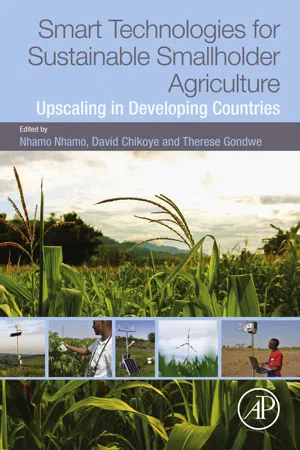
Smart Technologies for Sustainable Smallholder Agriculture
Upscaling in Developing Countries
- 330 pages
- English
- ePUB (mobile friendly)
- Available on iOS & Android
eBook - ePub
Smart Technologies for Sustainable Smallholder Agriculture
Upscaling in Developing Countries
About this book
Smart Technologies for Sustainable Smallholder Agriculture: Upscaling in Developing Countries defines integrated climate smart agricultural technologies (ICSAT) as a suite of interconnected techniques and practices that enhance quantity and quality of agricultural products with minimum impact on the environment. These ICSAT are centered on three main pillars, increased production and income, adaptation and resilience to climate change, and minimizing GHG emissions.
This book brings together technologies contributing to the three pillars, explains the context in which they can be scaled up, and identifies research and development gaps as areas requiring further investigation. It stresses the urgency in critically analyzing and recommending ICSAT and scaling out the efforts of both developing and disseminating these in an integrated manner.
The book discusses, synthesizes, and offers alternative solutions to agriculture production systems and socio-economic development. It brings together biophysical and socioeconomic disciplines in evaluating suitable ICSAT in an effort to help reduce poverty and food insecurity.
- Highlights the research gaps and opportunities on climate smart agricultural technologies and institutional arrangements
- Provides information on institutional engagements that are inclusive of value chain actors that support partnerships and the development of interactive platforms
- Elaborates some of the effects of climate extremes on production and socioeconomic development on small farms whose impact has potentially large impact
Information
Chapter 1
Smart Agriculture
Scope, Relevance, and Important Milestones to Date
Nhamo Nhamo, and David Chikoye International Institute of Tropical Agriculture (IITA), Southern Africa Research and Administration Hub (SARAH) Campus, Lusaka, Zambia
Abstract
Agricultural technologies are developed to increase production, resolve chemo-physical, biological, and socioeconomic constraints related to crop production systems. During the past three decades, there has been an increasing realization that technologies need to be tailored to the circumstances of farmers as well as to future sustainability goals including climate change projections. Climate projections from the Intergovernmental Panel on Climate Change have shown skewed future rainfall patterns with shortened growing seasons (leading to intermittent and terminal droughts) and extremes of temperature all of which threaten agriculture production. Current threats require advanced analysis of best-fit solutions in order for agricultural technologies to serve smallholder farmers' needs. Climate smart agriculture defined as agricultural practices that sustainably improve production, resilience of production systems, and reduce greenhouse gas emissions is required to overcome climate extremes and variability. Future food production systems will rely heavily on the successful integration of a range of technologies that are climate responsive and environmentally enhancing. Robust policies that will shape institutions to deliver more agricultural produce and financial gains in the long term are needed. Although there are clear extension messages for scaling up already, further research and refinement are still required for adaptation to climate extremes and mitigation of emissions.
Keywords
Farmer typologies; Smart technologies; Southern Africa; Target yield; Targeted investment
1.1. Introduction
Agricultural production has stagnated in the past three decades due to a range of challenges farmers face in producing crops and livestock (Alexandratos and Bruinsma, 2012; Bajželj et al., 2014; Pandey, 2007; Steinfeld et al., 2006). Key among the challenges to smallholder agriculture are climate extremes and weather variability. These have exacerbated the extent to which the abiotic (e.g., soil degradation leading to infertile soils) and biotic (weeds, disease, and pests) constraints affect production (Balasubramanian et al., 2007; Nhamo et al., 2014; Sanchez, 2010). Climate change threatens the gains made in agriculture since the introduction of improved technologies (Funk and Brown, 2009; Schlenker and Lobell, 2010; Wheeler and von Braun, 2013). Urgent deployment of agriculture technologies, which address the existing biotic and abiotic constraints, is required to harness the loss in agriculture production. Sanchez (2000) summarized the key global change scenarios relevant to developing countries and management of natural resource especially their direct effect on people, agriculture, carbon, water, nitrogen, and climate. The linkages between adaptation and mitigation to climate change leading to poverty reduction and improved natural resource management were elaborated. It is becoming clear that new investments and strategies for both underperforming and performing regions are required (Ray et al., 2012). Therefore, more focused research is needed to develop alternative options that will take agriculture production forward and provide food and nutrition to 9 billion people by year 2050. Furthermore, the scaling out of tried and tested technologies has to be priority for agricultural systems’ transformation under changing climate.
1.2. Scoping Climate Smart Agricultural Technologies
Future agriculture will rely heavily on the application of modern technologies, which have the capacity of increasing the scale, efficiency, and effectiveness of production and delivery in all aspects of the commodity value chains. Sustainable agricultural production systems have gained favor from both producer and technology developers; public and private sectors worldwide. Climate and climate change will be a major consideration in the design, scaling up, and adoption/adaptation of agricultural technologies in the future (Alley et al., 2003). This is because extreme events have begun to take a toll on agricultural output against a background of increased food demands in the developing world. In southern Africa, major shift in the (1) rainfall pattern and (2) temperature incidences are increasingly becoming common (IPCC, 2007). Rainfall, depending on the latitudinal position, often start around October and end around May with a growing season length averaging between 3 and 8 months. More recently, the crop growing season has shrunk to barely 2–3 months (period between December and February) with the effect of reducing the potential production due to water unavailability for the greater part of the year (SADC YearBook, 2013). Similarly, heat waves have begun to affect evapotranspiration rates and hence agricultural production. There is no better timing for climate smart technologies that can alleviate the impending loss in agricultural production to avert hunger (famine), malnutrition, and ill-health.
Three Pillars of Climate Smart Agriculture
Climate smart agriculture, defined as agricultural practices that sustainably improve agricultural production and incomes, adapt and contribute to systems resilience, and at the same time reduce or remove greenhouse gasses (FAO, 2013), holds a promise to improve the agricultural productivity in Southern Africa (SA). A number of technologies have been developed to further the objectives of the three components of climate smart agriculture in Africa. These can be grouped differently depending on context and application relevancy. For the purposes of this book we have approached climate smart agriculture (CSA) as follows:
Pillar 1: To sustainably improve agricultural production and incomes encompasses a range of practices that are an important input in agricultural transformation, and crop intensification here is referred to as smart technologies. Smart technologies are therefore a basket of improved agricultural technologies and interventions, which have the following characteristics: (a) enhance rain-water productivity, conserve water, reduce surface evapotranspiration, and lead to increased water-use efficiency; (b) increase the capacity of production systems to withstand extreme temperatures (in both cold and hot weather) conditions, enable utilization of intrinsic temperature moderation at animal/plant cell level, and increase energy conservation within individual species and across systems; (c) increase capture and utilization of CO2 for photosynthetic products. The majority of system agronomic practices fall in this category, e.g., integrated soil fertility management (ISFM), breeding for trait improvement, and conservation agriculture (CA).
Pillar 2: Mitiga...
Table of contents
- Cover image
- Title page
- Table of Contents
- Copyright
- List of Contributors
- Foreword
- Preface
- Introduction
- Chapter 1. Smart Agriculture: Scope, Relevance, and Important Milestones to Date
- Chapter 2. Climate Scenarios in Relation to Agricultural Patterns of Major Crops in Southern Africa
- Chapter 3. Advancing Key Technical Interventions Through Targeted Investment
- Chapter 4. Exploring Climatic Resilience Through Genetic Improvement for Food and Income Crops
- Chapter 5. Enhancing Gains From Beneficial Rhizomicrobial Symbiotic Communities in Smallholder Cropping Systems
- Chapter 6. Reducing Risk of Weed Infestation and Labor Burden of Weed Management in Cropping Systems
- Chapter 7. Opportunities for Smallholder Farmers to Benefit From Conservation Agricultural Practices
- Chapter 8. The Use of Integrated Research for Development in Promoting Climate Smart Technologies, the Process and Practice
- Chapter 9. Taking to Scale Adaptable Climate Smart Technologies
- Chapter 10. Food Processing Technologies and Value Addition for Improved Food Safety and Security
- Chapter 11. Models Supporting the Engagement of the Youth in Smart Agricultural Enterprises
- Chapter 12. Enabling Agricultural Transformation Through Climate Change Policy Engagement
- Chapter 13. Integrated Assessment of Crop–Livestock Production Systems Beyond Biophysical Methods: Role of Systems Simulation Models
- Chapter 14. Adaptive Livestock Production Models for Rural Livelihoods Transformation
- Chapter 15. Delivering Integrated Climate-Smart Agricultural Technologies for Wider Utilization in Southern Africa
- Index
Trusted by 375,005 students
Access to over 1.5 million titles for a fair monthly price.
Study more efficiently using our study tools.
Frequently asked questions
Yes, you can cancel anytime from the Subscription tab in your account settings on the Perlego website. Your subscription will stay active until the end of your current billing period. Learn how to cancel your subscription
No, books cannot be downloaded as external files, such as PDFs, for use outside of Perlego. However, you can download books within the Perlego app for offline reading on mobile or tablet. Learn how to download books offline
Perlego offers two plans: Essential and Complete
- Essential is ideal for learners and professionals who enjoy exploring a wide range of subjects. Access the Essential Library with 800,000+ trusted titles and best-sellers across business, personal growth, and the humanities. Includes unlimited reading time and Standard Read Aloud voice.
- Complete: Perfect for advanced learners and researchers needing full, unrestricted access. Unlock 1.5M+ books across hundreds of subjects, including academic and specialized titles. The Complete Plan also includes advanced features like Premium Read Aloud and Research Assistant.
We are an online textbook subscription service, where you can get access to an entire online library for less than the price of a single book per month. With over 1.5 million books across 990+ topics, we’ve got you covered! Learn about our mission
Look out for the read-aloud symbol on your next book to see if you can listen to it. The read-aloud tool reads text aloud for you, highlighting the text as it is being read. You can pause it, speed it up and slow it down. Learn more about Read Aloud
Yes! You can use the Perlego app on both iOS and Android devices to read anytime, anywhere — even offline. Perfect for commutes or when you’re on the go.
Please note we cannot support devices running on iOS 13 and Android 7 or earlier. Learn more about using the app
Please note we cannot support devices running on iOS 13 and Android 7 or earlier. Learn more about using the app
Yes, you can access Smart Technologies for Sustainable Smallholder Agriculture by David Chikoye,Therese Gondwe,Nhamo Nhamo in PDF and/or ePUB format, as well as other popular books in Technology & Engineering & Agriculture. We have over 1.5 million books available in our catalogue for you to explore.