- 440 pages
- English
- ePUB (mobile friendly)
- Available on iOS & Android
eBook - ePub
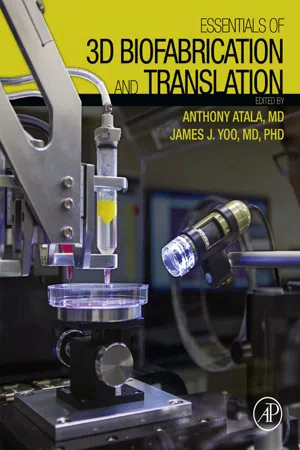
Essentials of 3D Biofabrication and Translation
About this book
Essentials of 3D Biofabrication and Translation discusses the techniques that are making bioprinting a viable alternative in regenerative medicine.
The book runs the gamut of topics related to the subject, including hydrogels and polymers, nanotechnology, toxicity testing, and drug screening platforms, also introducing current applications in the cardiac, skeletal, and nervous systems, and organ construction.
Leaders in clinical medicine and translational science provide a global perspective of the transformative nature of this field, including the use of cells, biomaterials, and macromolecules to create basic building blocks of tissues and organs, all of which are driving the field of biofabrication to transform regenerative medicine.
- Provides a new and versatile method to fabricating living tissue
- Discusses future applications for 3D bioprinting technologies, including use in the cardiac, skeletal, and nervous systems, and organ construction
- Describes current approaches and future challenges for translational science
- Runs the gamut of topics related to the subject, from hydrogels and polymers to nanotechnology, toxicity testing, and drug screening platforms
Information
Topic
Scienze biologicheSubtopic
BiotecnologiaChapter 1
Bioprinting Essentials of Cell and Protein Viability
Aleksander Skardal Wake Forest Institute for Regenerative Medicine, Wake Forest School of Medicine, Winston-Salem, NC, USA
Abstract
Bioprinting has emerged in recent years as an attractive method for engineering of 3D tissues and organs in the laboratory, which can subsequently be implemented in a number of regenerative medicine applications. Currently, the primary goals of bioprinting are to (1) create complete replacements for damaged tissues in patients and (2) rapidly fabricate small-sized human-based tissue models or organoids for high-throughput diagnostics, pathology modeling, and drug development. Regardless of which of these end applications are targeted, successful biofabrication using bioprinting technology relies on a set of four essential characteristics that must be optimized. In this chapter, we will discuss and evaluate integration of cell sourcing, biomaterial support, bioprinting device compatibility, and postfabrication tissue support, and how these characteristics are mandatory considerations for practical realization of viable and functional tissue engineered organ and organoid structures.
Keywords
bioprinting
biomaterials
biocompatibility
viability
biofabrication
stability
bioink
cells
hydrogel
1. An introduction to bioprinting
Bioprinting has emerged as a flexible tool in regenerative medicine with potential in a variety of applications. Bioprinting is a relatively new field within biotechnology that can be described as a robotic additive biofabrication that has the potential to build or pattern viable organ-like or tissue structures [1]. In general, bioprinting uses a computer-controlled 3D printing device to accurately deposit cells and biomaterials into precise geometries with the goal being the creation of anatomically correct biological structures. Generally, bioprinting devices have the ability to print cell aggregates, cells encapsulated in hydrogels or viscous fluids, or cell-seeded microcarriers – all of which can be referred to as “bioink” – as well...
Table of contents
- Cover
- Title page
- Table of Contents
- Copyright
- Dedication
- List of Contributors
- Preface
- Chapter 1: Bioprinting Essentials of Cell and Protein Viability
- Chapter 2: Software for Biofabrication
- Chapter 3: Design and Quality Control for Translating 3D-Printed Scaffolds
- Chapter 4: Inkjet Bioprinting
- Chapter 5: In Vivo and In Situ Biofabrication by Laser-Assisted Bioprinting
- Chapter 6: Stereolithographic 3D Bioprinting for Biomedical Applications
- Chapter 7: Extrusion Bioprinting
- Chapter 8: Indirect Rapid Prototyping for Tissue Engineering
- Chapter 9: Bioprinting Using Aqueous Two-Phase System
- Chapter 10: Bioprinting of Organs for Toxicology Testing
- Chapter 11: High Throughput Screening with Biofabrication Platforms
- Chapter 12: Biosensor and Bioprinting
- Chapter 13: Polymers for Bioprinting
- Chapter 14: Hydrogels for 3D Bioprinting Applications
- Chapter 15: Bioprinting of Organoids
- Chapter 16: Bioprinting of Three-Dimensional Tissues and Organ Constructs
- Chapter 17: Bioprinting of Bone
- Chapter 18: Bioprinting of Cartilage: Recent Progress on Bioprinting of Cartilage
- Chapter 19: Biofabrication of Vascular Networks
- Chapter 20: Bioprinting of Blood Vessels
- Chapter 21: Bioprinting of Cardiac Tissues
- Chapter 22: Bioprinting of Skin
- Chapter 23: Bioprinting of Nerve
- Chapter 24: Bioprinting: An Industrial Perspective
- Subject Index
Trusted by 375,005 students
Access to over 1.5 million titles for a fair monthly price.
Study more efficiently using our study tools.
Frequently asked questions
Yes, you can cancel anytime from the Subscription tab in your account settings on the Perlego website. Your subscription will stay active until the end of your current billing period. Learn how to cancel your subscription
No, books cannot be downloaded as external files, such as PDFs, for use outside of Perlego. However, you can download books within the Perlego app for offline reading on mobile or tablet. Learn how to download books offline
Perlego offers two plans: Essential and Complete
- Essential is ideal for learners and professionals who enjoy exploring a wide range of subjects. Access the Essential Library with 800,000+ trusted titles and best-sellers across business, personal growth, and the humanities. Includes unlimited reading time and Standard Read Aloud voice.
- Complete: Perfect for advanced learners and researchers needing full, unrestricted access. Unlock 1.5M+ books across hundreds of subjects, including academic and specialized titles. The Complete Plan also includes advanced features like Premium Read Aloud and Research Assistant.
We are an online textbook subscription service, where you can get access to an entire online library for less than the price of a single book per month. With over 1.5 million books across 990+ topics, we’ve got you covered! Learn about our mission
Look out for the read-aloud symbol on your next book to see if you can listen to it. The read-aloud tool reads text aloud for you, highlighting the text as it is being read. You can pause it, speed it up and slow it down. Learn more about Read Aloud
Yes! You can use the Perlego app on both iOS and Android devices to read anytime, anywhere — even offline. Perfect for commutes or when you’re on the go.
Please note we cannot support devices running on iOS 13 and Android 7 or earlier. Learn more about using the app
Please note we cannot support devices running on iOS 13 and Android 7 or earlier. Learn more about using the app
Yes, you can access Essentials of 3D Biofabrication and Translation by Anthony Atala,James J Yoo in PDF and/or ePUB format, as well as other popular books in Scienze biologiche & Biotecnologia. We have over 1.5 million books available in our catalogue for you to explore.