eBook - ePub
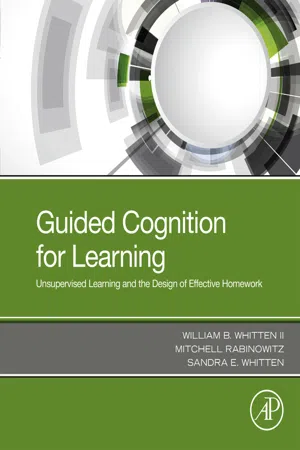
Guided Cognition for Learning
Unsupervised Learning and the Design of Effective Homework
- 218 pages
- English
- ePUB (mobile friendly)
- Available on iOS & Android
eBook - ePub
Guided Cognition for Learning
Unsupervised Learning and the Design of Effective Homework
About this book
Guided Cognition for Learning: Unsupervised Learning and the Design of Effective Homework details a new instructional design approach called Guided Cognition where homework tasks are designed to guide learners to engage in specific, observable cognitive events that are hypothesized to elicit underlying theoretical cognitive processes that result in learning. Outlining the results of twenty-six experiments completed over the course of eight years, the book tells a significant story about the generality of Guided Cognition instructional design to improve comprehension and recall by students of varying ages and ability levels.
- Explains why unsupervised learning is a major part of education
- Reviews the history of homework in American education
- Shows that quality of homework is more important than quantity
- Illustrates how Guided Cognition-designed homework improves learning for literature and mathematics
- Compares Guided Cognition to other types of instructional design
- Analyzes how the surface structure of Guided Cognition tasks relate to underlying psychological processes
- Discusses the effects of the internet on learning
- Presents applications that facilitate lifelong learning
- Includes an appendix of frames and guidelines for authoring Guided Cognition questions and tasks
Information
Topic
PsicologíaSubtopic
Psicología educativaChapter 1
The Importance of Unsupervised Individual Learning in Education
Abstract
This chapter introduces the key concepts of the book and provides context for the experimental work to be reported in later chapters. First, we discuss the importance of unsupervised individual learning in education and the importance of homework. A brief history of homework in American education, from the early 19th century to the present, is presented. The development of homework as a standard part of formal education is reviewed, and the recurring issues in favor of and against homework are discussed. The relationship of unsupervised individual learning to supervised group learning and the relationship of unsupervised individual learning to homework are discussed.
Keywords
History of homework; Homework; Supervised group learning; Supervised learning; Unsupervised individual learning; Unsupervised learning
When you think of education, it is likely that you think about formal school situations that you have experienced. Perhaps you recall your teachers, your classmates, the subject-matter categories, or discussions and other interactions in classes with teachers and with other students. Maybe you remember a group project that was interesting or fun or challenging. You may recall the physical arrangement of the school buildings, the processes of starting and ending the school day, or special events such as sports or music performances. It is less likely that the first thing that comes to mind is the independent studying that most likely absorbed many hours, especially in the later years of your education. This study time and effort, however, is typically a vitally important part of your education. There are, of course, a variety of ways to study, including team projects, study groups, and so forth. The dominant study situation, however, is unsupervised individual learning, usually referred to as homework.
The Importance of Homework
Homework serves many important functions for learning. It allows students to review new concepts, ideas, and terminology. It prescribes specific practice. It may allow for thoughtful complex thinking that can only be accomplished over more time than is available in classes. It provides the time necessary for mastery learning. And it can even be thought of as a rudimentary form of individualized instruction where a student can approach a topic at his or her own pace and in a preferred fashion.
Homework becomes increasingly important as students progress from elementary school, to middle school, to high school, and finally, to college. Some high school students may spend about 5 hours in classroom instruction (e.g., six or seven 45-minute classes), followed by 2–3 hours of evening homework. Thus, about one-third of all learning time may be spent doing homework. By college, this ratio is typically reversed, with at least two-thirds of all learning time spent outside the classroom. Beyond college, this trend continues. Some forms of adult learning, such as Internet-based “continuing education” and “lifelong learning,” may be almost entirely unsupervised individual study with characteristics similar to school-assigned homework. For these reasons, knowledge of how to design effective, efficient, interesting, and cost-effective homework should be of primary importance to educators.
A Brief History of Homework in American Education
During the first half of the 19th century, elementary school students had little or no homework, in part because of their teachers' heavy workload. In the 1830s, Chicago city classrooms might include as many as 100 students, with older students assigned to direct the instruction for small groups (Herrick, 1971; Kaestle, 1973). In rural one-room schools, one teacher taught all subjects to students who might range in age from 6 to 14 years (Fuller, 1982). Most students left school after fourth grade, but those who moved on to grammar school (grades 5–8) received 2–3 hours of homework each night during the week. The even smaller number of students who earned a high school diploma completed homework on weekends as well (Reese, 1995).
After the Civil War, public funding for schools increased, and students completed more years of school. As homework was assigned more frequently, conflicts arose between parents and schools (Kaestle, 1978). In 1880, the president of the Boston school board complained that his children's arithmetic homework was not useful for learning and interfered with their physical, mental, and emotional health. The school board responded by limiting the amount of arithmetic homework that teachers could assign (Burnham, 1905).
In the 1890s, anti-homework sentiments grew more prevalent and more extreme. Doctors warned that homework was damaging to children's eyesight and interfered with healthy outdoor exercise. Magazines and newspapers criticized homework for robbing children of the time they needed for play, for sleep, for chores, for church attendance, and for the moral influence of their parents. School officials felt that distractions at home actually interfered with children's learning, and many schools replaced homework in grades 4–6 with 15–30 minute in-school study periods (Annual Report of the Board of Education of Los Angeles, 1902). By 1901, a Massachusetts investigator reported that assigning homework was restricted in two-thirds of the city school districts surveyed (Gill & Schlossman, 1996).
During World War I, conflicts over homework quieted, but as the war ended, parents again became concerned about homework's negative effects on their children. The popular press resumed its criticisms, describing homework as a threat to children's health and as an unfair labor practice (Bassett, 1934). In 1919, the Progressive Education Association was founded to change education by making it an individualized process of discovery. The teacher's role was to provide experiences that would guide each child toward positive growth. Progressives believed that homework could interfere with engaging in real-life tasks and community activities (Graham, 1967; Westbrook, 1991).
By the 1940s, a majority of schools in the United States had adopted the progressive approach and had eliminated or stringently limited homework. But during this time, members of a “homework reform movement” suggested that a different kind of homework could support the goals of progressive education. They recommended a new focus on hands-on activities, projects, and home and community experiences. Parents could help children participate in music, art, sports and physical endeavors, cooking, helping with the family budget, interior decorating, and other pursuits that children would value and enjoy (Andersen, 1940; Eginton, 1931).
These ideas were surprisingly well received by a majority of parents (Gill & Schlossman, 2003a), and schools made more effort to individualize homework assignments to match the abilities and interests of each student. Nevertheless, many school districts instituted homework policies to limit the amount of time spent on homework, in accordance with a student's age and grade level. Generally, no homework was assigned for early elementary students. Junior high students could be assigned up to an hour of homework four nights a week, and high school students were limited to an hour and a half four nights per week (Strang, 1955). A number of schools chose not to assign homework on the weekend so students would have this time for personal activities and relief from the school work week (Olson, 1962). By 1948, a Purdue Opinion Poll reported that most high school students were doing less than an hour of homework per day (Gill & Schlossman, 2004).
The Russians' launch of Sputnik in 1957, however, caused many parents and educators to question the quality of American education. Russia's apparent superiority in science and mathematics education was contrasted with an American curriculum that was criticized for having too many courses focused on life skills and for failing to challenge gifted students (Herold, 1974). To help the United States compete with Russia, courses of study became more rigorous, and the amount of homework was increased.
During the late 1960s and early 1970s, homework was once again criticized as a danger to the health and wellbeing of young people, and some school districts responded accordingly (Vatterott, 2018). According to the Purdue Opinion Poll, the number of high school students doing more than 2 hours of daily homework fell from approximately 20% to 9% between 1967 and 1972 (Gill & Schlossman, 2003a). But with the publication of A Nation at Risk (United States National Commission on Excellence in Education, 1983) and What Works (United States Department of Educ...
Table of contents
- Cover image
- Title page
- Table of Contents
- Copyright
- Preface
- Acknowledgments
- Chapter 1. The Importance of Unsupervised Individual Learning in Education
- Chapter 2. Guided Cognition: A New Approach to Designing Effective Homework
- Chapter 3. Guided Cognition Effects in Learning Literature
- Chapter 4. Guided Cognition Effects in Learning Mathematics
- Chapter 5. Students' Perceptions and Preferences
- Chapter 6. Theoretical Considerations
- Chapter 7. Improving Unsupervised Individual Learning
- Chapter 8. Benefits and Applications of Guided Cognition Design
- Appendix I. Characteristics of the Participating Schools and Student Populations
- Appendix II. Experiments 3 and 4 Guided Cognition and Traditional Homework Questions from Part II of “The Secret Sharer”
- Appendix III. Experiments 10 and 11 Homework Materials for Conditions T, T + M, GC, and GC + M
- Appendix IV. Guidelines for Authoring Guided Cognition Homework
- References
- Index
Trusted by 375,005 students
Access to over 1.5 million titles for a fair monthly price.
Study more efficiently using our study tools.
Frequently asked questions
Yes, you can cancel anytime from the Subscription tab in your account settings on the Perlego website. Your subscription will stay active until the end of your current billing period. Learn how to cancel your subscription
No, books cannot be downloaded as external files, such as PDFs, for use outside of Perlego. However, you can download books within the Perlego app for offline reading on mobile or tablet. Learn how to download books offline
Perlego offers two plans: Essential and Complete
- Essential is ideal for learners and professionals who enjoy exploring a wide range of subjects. Access the Essential Library with 800,000+ trusted titles and best-sellers across business, personal growth, and the humanities. Includes unlimited reading time and Standard Read Aloud voice.
- Complete: Perfect for advanced learners and researchers needing full, unrestricted access. Unlock 1.5M+ books across hundreds of subjects, including academic and specialized titles. The Complete Plan also includes advanced features like Premium Read Aloud and Research Assistant.
We are an online textbook subscription service, where you can get access to an entire online library for less than the price of a single book per month. With over 1.5 million books across 990+ topics, we’ve got you covered! Learn about our mission
Look out for the read-aloud symbol on your next book to see if you can listen to it. The read-aloud tool reads text aloud for you, highlighting the text as it is being read. You can pause it, speed it up and slow it down. Learn more about Read Aloud
Yes! You can use the Perlego app on both iOS and Android devices to read anytime, anywhere — even offline. Perfect for commutes or when you’re on the go.
Please note we cannot support devices running on iOS 13 and Android 7 or earlier. Learn more about using the app
Please note we cannot support devices running on iOS 13 and Android 7 or earlier. Learn more about using the app
Yes, you can access Guided Cognition for Learning by William B. Whitten II,Mitchell Rabinowitz,Sandra E. Whitten in PDF and/or ePUB format, as well as other popular books in Psicología & Psicología educativa. We have over 1.5 million books available in our catalogue for you to explore.