- 538 pages
- English
- ePUB (mobile friendly)
- Available on iOS & Android
eBook - ePub
About this book
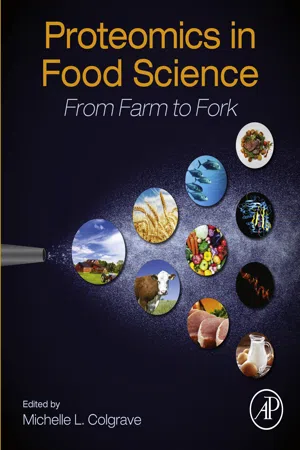
Proteomics in Food Science: From Farm to Fork is a solid reference providing concepts and practical applications of proteomics for those in various disciplines of food science. The book covers a range of methods for elucidating the identity or composition of specific proteins in foods or cells related to food science, from spoilage organisms, to edible components.
A variety of analytical platforms are described, ranging from the usage of simple electrophoresis, to more sophisticated mass spectrometry and bio-informatic platforms. The book is designed for food scientists, technologists, food industry workers, microbiologists, and public health workers, and can also be a valuable reference book for students.
- Includes a variety of analytical platforms, ranging from simple electrophoresis to more sophisticated mass spectrometry and bio-informatic platforms
- Presents analytical techniques for each food domain, including beverages, meats, dairy and eggs, fruit, fish/seafood, cereals, nuts, and grains that range from sample collection, proportion, and storage analysis
- Provides applications of proteomics in hot topics area of food safety, including food spoilage, pathogenic organisms, and allergens
- Covers major pathogens of concern e.g., Salmonella and applications to animal husbandry
Information
Subtopic
MicrobiologieSection 1
Application to Plants — Cereals, Nuts, Pulses, and Fruits
Chapter 1
Postharvest Proteomics of Perishables
Romina Pedreschi Pontificia Universidad Católica de Valparaíso, Quillota, Chile
Abstract
The shelf-life of perishables is largely determined by preharvest factors such as growing conditions and cultural practices. To extend their shelf-life, postharvest abiotic stresses such as cold, heat, modification of the atmosphere, and/or chemical treatments are applied. In this book chapter, an updated review of the main proteomics studies devoted to understanding the role of these postharvest treatments on the maintenance of desirable quality traits is carried out. The main proteome changes under different postharvest treatments as well as in different commodities (e.g., citrus, tomato, pear, grape, potato) are exposed. The importance of preharvest factors on initial quality is highlighted with the few available examples from the recent literature. Perspectives on the areas where proteomic studies complemented by other postgenomics approaches and complementary postharvest phenotyping techniques are emphasized.
Keywords
Abiotic; Fruits; Gel-based; LC-MS/MS; Stress; Vegetables
1.1. Introduction
Postharvest physiology and technology has been key to maintaining and extending the shelf-life of perishables and reducing food losses. However, postharvest losses are still significant and reduction of such losses would be the easiest, less costly, and most effective method instead of increasing food production (Pedreschi et al., 2013a).
Postharvest strategies or technological implementation, such as temperature reduction, modification of the atmosphere, or chemical treatments, are applied. These serve to reduce respiration rates, retard ripening, decrease ethylene production, and consequently retard senescence, prevent dehydration, and extend the shelf-life thus preserving produce quality. These strategies imply that produce are submitted to abiotic stresses and they need to activate different metabolic pathways to cope with these stresses and reach homeostasis to avoid undesirable quality traits that limit produce shelf-life (Pedreschi and Lurie, 2015).
Proteomics studies on fruits and vegetables have increased in recent years (Li et al., 2015; Buts et al., 2014). Proteins play key roles in fruit development, ripening, and senescence and are involved in key metabolic pathways and networks related to resistance to biotic and abiotic stresses. Numerous proteomics studies focused on understanding ripening, development, and senescence of different commodities such as tomato, grapes, citrus, strawberry, peach, papaya, mango, and banana are available and the reader is encouraged to review these papers to gain further insight (Rocco et al., 2006; Kok et al., 2008; Faurobert et al., 2007; Deytieux et al., 2007; Negri et al., 2008; Giribaldi et al., 2010; Katz et al., 2007, 2010; Bianco et al., 2009; Prinsi et al., 2011; Nogueira et al., 2012; Magalhaes Andrade et al., 2012; Torres-Toledo et al., 2012). Proteomic studies focused on microbial/fungal diseases and mechanisms during postharvest have been extensively reported. For example, Buron-Moles et al. (2015) studied the apple defense response to wounding, Penicillium expansum and Penicillium digitarum infection at the proteome and oxi-proteome (protein carbonyl) levels. The proteins Mal d 1.03A, Mal d 1.03E, and EF-Tu were specifically induced in response to P. digitarum infection. In addition, 27 oxidized proteins were identified as reactive oxygen species (ROS)-sensitive targets and were suggested to play a leading role in the response against biotic and abiotic stresses. Comparative proteomics and functional analysis have revealed that defense-related proteins, energy metabolism, and antioxidant-related proteins play key roles in fruits in response to storage conditions and elicitor treatments. For more studies on microbial/fungal diseases using proteomics approaches, the reader is referred to Gonzalez-Fernandez and Jorrin-Novo (2012), Shah et al. (2012), Chan (2013), and Taylor et al. (2008) and for a complete review of the mechanisms related to protein level changes in both the host and pathogen, the reader is referred to Chan (2013).
Numerous proteomics studies reported up to date have focused on understanding either desirable or undesirable postharvest quality traits (Urbany et al., 2011; Pedreschi et al., 2007; Nilo et al., 2010; Minas et al., 2016; Miyasaka et al., 2016) to find potential initial quality markers or early stage biomarkers of such quality traits. But these postharvest quality traits are strongly influenced by preharvest abiotic stresses (e.g., temperature, radiation, light exposure, dehydration) and enhanced or buffered by postharvest abiotic stresses. Thus, this book review focuses upon mainly commercially important fruits and vegetables with focus on how abiotic stresses (temperature, dehydration, atmosphere modification, light and chemical exposure, ozone treatments, etc.) influence certain produce quality traits or characteristics.
1.2. Factors Affecting Postharvest Quality
The type of stress and characteristics (severity, exposure, duration) and the characteristics of the different produce (genotype, maturity stage, organ type) will influence the response of the different produce to acclimate and withstand the different imposed abiotic stresses. It has been extensively reported that preharvest factors (e.g., growing conditions and crop management) and the stage of development influence the response of the different produce to abiotic stresses (Fig. 1.1) and thus on the postharvest phenotype obtained.
Some studies using other omics platforms have been reported on this topic but proteomics studies are still limited. Abdi et al. (2002) carried out a 2D-PAGE proteomics experiment for determining optimal harvest of stone fruits. Commercial harvest indices are skin color, firmness, soluble solids, and size. These parameters are affected not only by the cultivar but also by growing conditions and seasonal climatic factors. The authors proposed to use four allergenic proteins that were synthesized in the fruit a few days before the optimal harvest time in plums, peaches, and nectarines as a harvest index for stone fruits. Ye and Dilley (1992) and Dilley et al. (1995) by using a gel-based approach proposed 1-amino cyclopropane carboxylate-oxidase (ACO) as a biomarker for apple harvest. Other omics approaches employing transcriptomics and metabolomics have proposed potential initial quality markers for Hass avocado ripening heterogeneity and potatoes cold sweetening (Pedreschi et al., 2013b, 2014). Recently, Buts et al. (2016) studied at the proteome level using a gel-free approach, an apple browning disorder in the cultivar Braeburn related to preharvest application of calcium, potassium, and triazole as fertilizers. Calcium and potassium have been previously reported to reduce the incidence of this disorder while triazole displayed the opposite effect. Results from this study revealed that calcium and triazole application resulted in significant effects at the proteome level with 29 and 63 differentially expressed proteins after the treatment application. Key antioxidant enzymes were correlated with calcium fertilization and respiration and ethylene-related proteins were correlated with the triazole treatment. The authors, in addition, postulated that an early proteomics imprint (at harvest) could be used as an early decision tool of the postharvest performance of a batch to devel...
Table of contents
- Cover image
- Title page
- Table of Contents
- Copyright
- List of Contributors
- Preface
- Acknowledgments
- Section 1. Application to Plants — Cereals, Nuts, Pulses, and Fruits
- Section 2. Application to Farm Animals – Meats, Dairy, and Eggs
- Section 3. Application to Aquaculture
- Section 4. Processed Foods
- Section 5. Food Spoilage, Pathogenic Organisms and Allergens
- Index
Trusted by 375,005 students
Access to over 1.5 million titles for a fair monthly price.
Study more efficiently using our study tools.
Frequently asked questions
Yes, you can cancel anytime from the Subscription tab in your account settings on the Perlego website. Your subscription will stay active until the end of your current billing period. Learn how to cancel your subscription
No, books cannot be downloaded as external files, such as PDFs, for use outside of Perlego. However, you can download books within the Perlego app for offline reading on mobile or tablet. Learn how to download books offline
We are an online textbook subscription service, where you can get access to an entire online library for less than the price of a single book per month. With over 1.5 million books across 990+ topics, we’ve got you covered! Learn about our mission
Look out for the read-aloud symbol on your next book to see if you can listen to it. The read-aloud tool reads text aloud for you, highlighting the text as it is being read. You can pause it, speed it up and slow it down. Learn more about Read Aloud
Yes! You can use the Perlego app on both iOS and Android devices to read anytime, anywhere — even offline. Perfect for commutes or when you’re on the go.
Please note we cannot support devices running on iOS 13 and Android 7 or earlier. Learn more about using the app
Please note we cannot support devices running on iOS 13 and Android 7 or earlier. Learn more about using the app
Yes, you can access Proteomics in Food Science by Michelle Lisa Colgrave in PDF and/or ePUB format, as well as other popular books in Technologie et ingénierie & Microbiologie. We have over 1.5 million books available in our catalogue for you to explore.