- 236 pages
- English
- ePUB (mobile friendly)
- Available on iOS & Android
eBook - ePub
About this book
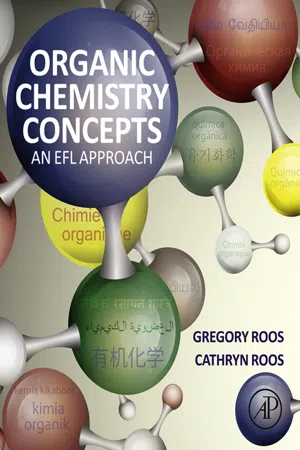
Organic Chemistry Concepts: An EFL Approach provides an introductory overview of the subject, to enable the reader to understand many critical, experimental facts. Designed to cover a single-semester course or a needed review on the principles of Organic Chemistry, the book is written and organized for readers whose first language is not English. Approximately 80% of the words used are drawn from the list of the 2,000 most common English words; the remaining 20% includes necessary technical words, common chemistry terms, and well-known academic words (per the Academic Word List). The book has been class-tested internationally as well as with native English speakers, and differs from other introductory textbooks in the subject both in its coverage and organization, with a particular focus on common problem areas.Focused on a limited number of functional classes, Organic Chemistry Concepts: An EFL Approach introduces those organic compounds early in the book. Once readers have a foundation of the concepts and language of organic chemistry, they can build from that knowledge and work with relatively complex molecules, such as some natural product types covered in a later chapter. The book describes basic level reaction mechanisms when instructive, and illustrations throughout to emphasize the 3D nature of organic chemistry. The book includes multiple pedagogical features, such as chapter questions and useful appendices, to support reader comprehension.
- Covers all primary concepts in accessible language and pedagogical features, worked examples, glossary, chapter questions, illustrations, and useful summaries
- Builds a foundation of key material through a structured framework from which readers can expand their understanding
- Contains class-tested content written in a straightforward and accessible manner for non-native English speakers
Information
Topic
Physical SciencesSubtopic
Organic ChemistryChapter 1
Organic Structures
Abstract
This chapter presents a short overview of organic chemistry as a major branch of chemistry. By building on the basics of general chemistry, the ability of carbon to produce a wide range of complex molecular types is highlighted. The purpose of the chapter is to introduce functional groups, structure drawing, molecular electronic effects, and the prediction of molecular shape. The relationship between physical properties and structure is also briefly considered.
Keywords
Carbon bonding; Compound class; Electronic effects; Functional group; Hybridization model: molecular shape; Inductive effect; Intermolecular forces; Polarity1.1. What Is Organic Chemistry?
Over the past 70 years, organic chemistry has become a very broad and complex subject. We see the results of this every day. There are new developments in food, pharmaceuticals, synthetic materials, and other petrochemical products. This progress is largely due to developments in modern instruments and theory. As a result, we can better understand the basic factors that control the behavior of organic compounds.
What is organic chemistry? New students usually answer: “The chemistry of carbon” or “The chemistry of life.” Both of these are good answers, but why exactly can carbon play this special role?
1.2. What Makes Carbon Special?
Table 1.1 shows that carbon is one of the primary elements of life. Only carbon is able to form molecules with enough complexity to support life.
How important is each element of life? It does not only depend on quantity. But it does depend on the role it plays. For example, Table 1.1 shows that the human body has only a small amount of iron. However, iron is necessary for the hemoglobin to carry oxygen in the blood. Iodine is needed for the thyroid to work properly. Cobalt is part of vitamin B12. Zinc, copper, and manganese are present in various enzymes. In each of these examples, there are many carbon, hydrogen, oxygen, and nitrogen atoms for each metal atom. However, without the trace element metals, it is impossible for these compounds to carry out their biological functions.
There are more than 30 million carbon-based compounds that are known so far. This number continues to grow every year. Why are carbon and its compounds such an important part of chemistry?
Table 1.1
Composition of the Human Body
| Element | % by weight | Element | % by weight |
| Oxygen | 65 | Sulfur | 0.2 |
| Carbon | 18 | Sodium | 0.1 |
| Hydrogen | 10 | Chlori... |
Table of contents
- Cover image
- Title page
- Table of Contents
- Copyright
- Preface
- How to Use This Book
- Self-Learning Programs
- Chapter 1. Organic Structures
- Chapter 2. Functional Classes I, Structure and Naming
- Chapter 3. Isomers and Stereochemistry
- Chapter 4. Resonance and Delocalization
- Chapter 5. Reactivity: How and Why
- Chapter 6. Acids and Bases
- Chapter 7. Functional Classes II, Reactions
- Chapter 8. Natural Product Biomolecules
- Appendices
- Solutions
- Glossary of Technical Definitions
- Index
Trusted by 375,005 students
Access to over 1.5 million titles for a fair monthly price.
Study more efficiently using our study tools.
Frequently asked questions
Yes, you can cancel anytime from the Subscription tab in your account settings on the Perlego website. Your subscription will stay active until the end of your current billing period. Learn how to cancel your subscription
No, books cannot be downloaded as external files, such as PDFs, for use outside of Perlego. However, you can download books within the Perlego app for offline reading on mobile or tablet. Learn how to download books offline
Perlego offers two plans: Essential and Complete
- Essential is ideal for learners and professionals who enjoy exploring a wide range of subjects. Access the Essential Library with 800,000+ trusted titles and best-sellers across business, personal growth, and the humanities. Includes unlimited reading time and Standard Read Aloud voice.
- Complete: Perfect for advanced learners and researchers needing full, unrestricted access. Unlock 1.5M+ books across hundreds of subjects, including academic and specialized titles. The Complete Plan also includes advanced features like Premium Read Aloud and Research Assistant.
We are an online textbook subscription service, where you can get access to an entire online library for less than the price of a single book per month. With over 1.5 million books across 990+ topics, we’ve got you covered! Learn about our mission
Look out for the read-aloud symbol on your next book to see if you can listen to it. The read-aloud tool reads text aloud for you, highlighting the text as it is being read. You can pause it, speed it up and slow it down. Learn more about Read Aloud
Yes! You can use the Perlego app on both iOS and Android devices to read anytime, anywhere — even offline. Perfect for commutes or when you’re on the go.
Please note we cannot support devices running on iOS 13 and Android 7 or earlier. Learn more about using the app
Please note we cannot support devices running on iOS 13 and Android 7 or earlier. Learn more about using the app
Yes, you can access Organic Chemistry Concepts by Gregory Roos,Cathryn Roos in PDF and/or ePUB format, as well as other popular books in Physical Sciences & Organic Chemistry. We have over 1.5 million books available in our catalogue for you to explore.