eBook - ePub
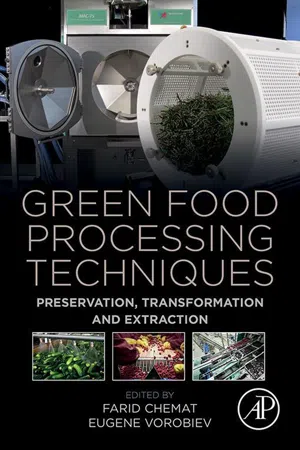
Green Food Processing Techniques
Preservation, Transformation and Extraction
- 586 pages
- English
- ePUB (mobile friendly)
- Available on iOS & Android
eBook - ePub
Green Food Processing Techniques
Preservation, Transformation and Extraction
About this book
Green Food Processing Techniques: Preservation, Transformation and Extraction advances the ethics and practical objectives of "Green Food Processing" by offering a critical mass of research on a series of methodological and technological tools in innovative food processing techniques, along with their role in promoting the sustainable food industry. These techniques (such as microwave, ultrasound, pulse electric field, instant controlled pressure drop, supercritical fluid processing, extrusion…) lie on the frontier of food processing, food chemistry, and food microbiology, and are thus presented with tools to make preservation, transformation and extraction greener.
The Food Industry constantly needs to reshape and innovate itself in order to achieve the social, financial and environmental demands of the 21st century. Green Food Processing can respond to these challenges by enhancing shelf life and the nutritional quality of food products, while at the same time reducing energy use and unit operations for processing, eliminating wastes and byproducts, reducing water use in harvesting, washing and processing, and using naturally derived ingredients.
- Introduces the strategic concept of Green Food Processing to meet the challenges of the future of the food industry
- Presents innovative techniques for green food processing that can be used in academia, and in industry in R&D and processing
- Brings a multidisciplinary approach, with significant contributions from eminent scientists who are actively working on Green Food Processing techniques
Trusted by 375,005 students
Access to over 1.5 million titles for a fair monthly price.
Study more efficiently using our study tools.
Information
Subtopic
Ciencia de los alimentos1
Green food processing: concepts, strategies, and tools
Francisco J. Barba1, Elena Roselló-Soto1, Krystian Marszałek2, Danijela Bursać Kovačević3, Anet Režek Jambrak3, Jose M. Lorenzo4, Farid Chemat5 and Predrag Putnik3, 1Nutrition and Food Science Area, Preventive Medicine and Public Health, Food Sciences, Toxicology and Forensic Medicine Department, Faculty of Pharmacy, University of Valencia, València, Spain, 2Prof. Wacław Dąbrowski Institute of Agricultural and Food Biotechnology, Department of Fruit and Vegetable Product Technology, Warsaw, Poland, 3Faculty of Food Technology and Biotechnology, University of Zagreb, Zagreb, Croatia, 4Meat Technology Center of Galicia, Parque Tecnológico de Galicia, San Cibrao das Viñas, Ourense, Spain, 5Avignon University, INRA, UMR408, GREEN Extraction Team, Avignon, France
Abstract
One of the developmental aspects of food science is testing and adapting advanced technologies for food production, which save resources and improve food quality. More often than not, this includes technologies operating at lower temperatures, shorter time, and resulting in better preservation of the thermolabile compounds in the foods, as compared to conventional technologies. Nutritionally rich but thermally sensitive raw materials such as fruit, vegetables, meats, and others can particularly benefit from the application of such advanced food technologies. Technologies with the most tested potential for industrial implementation include nonthermal plasma, pulsed electric field, high hydrostatic pressure, high-intensity ultrasound, etc. Even though such technologies have obstacles to wide industrial implementation, they can be applied in unit operations such as processing, pasteurization, and extraction. In addition, those technologies combined with exploitation of the economic and sustainable raw materials, such as industrial wastes from food production, are foundation for green and eco-friendly food production and processing. This chapter gives an overview of green food processing concepts, strategies, and tools.
Keywords
Green food processing; nonthermal; high-pressure processing; electrotechnologies; laser ablation; radiofrequency; solar energy; ultrasound; nutrients; bioactive compounds
1.1 Introduction
Food processing is among the different areas relevant to GREEN chemistry, particularly interesting for processes of preservation, transformation, bio-refining, and extraction (Putnik, Lorenzo, et al., 2018). GREEN concepts can be applied to various raw materials for food production, including fresh fruits (Lorenzo et al., 2018; Putnik, Bursać Kovačević, Herceg, Pavkov, et al., 2017), vegetables (Montesano, Rocchetti, Putnik, & Lucini, 2018), medicinal and aromatic plants (Vinceković et al., 2017), and food industrial by-products (Putnik, Bursać Kovačević, Režek Jambrak, et al., 2017).
Judging by the literature, this seems to be one of the most promising areas, from both academic and industrial point of view (Bursać Kovačević, Barba, et al., 2018; Putnik, Barba, Španić, et al., 2017). Food processing of fruits and vegetables (Putnik, Bursać Kovačević, Herceg, Roohinejad, et al., 2017; Repajić et al., 2015), fats and oils (Domínguez et al., 2018), sugar, dairies (Musina et al., 2017), meats (Domínguez et al., 2017), coffee and cocoa, meals, and flours affects a complex mixture of nutrients and bioactive compounds, such as carbohydrates, proteins, lipids, minerals, vitamins, and polyphenols. This also involves other compounds, such as fibers (Cukelj et al., 2016), aromas, pigments, antioxidants, and organic and mineral compounds which are involved with production. Before food products can be consumed, they have to be processed (even at minimal levels) and preserved to avoid microbial contamination and to ensure extended shelf life (Putnik, Bursać Kovačević, Herceg, & Levaj, 2017c). Moreover, it is of particular interest to reuse the wastes and by-products from agri-food industry, in order to obtain high-added value compounds (Fidelis et al., 2018). Later they can be used as potential food additives and/or nutraceuticals, among other applications (Putnik, Lorenzo, et al., 2018).
For instance, tremendous efforts have been made to develop and apply new sustainable “green and innovative” techniques in processing, pasteurization, and extraction (Barba et al., 2017). In comparison to conventional ones, they involve reduced processing time, less solvent and energy consumption, as well as reduced emissions of CO2 for diminishing the carbon footprint (Misra, Koubaa, et al., 2017).
Among the most common, innovative green and nonthermal technologies are high-pressure processing (HPP), supercritical carbon dioxide (SCCD), and electrotechnologies, for example, pulsed electric fields and high-voltage electrical discharges (HVED) (Bursać Kovačević, Maras, et al., 2018; Poojary et al., 2017). Solar food processing is another emerging technology providing good quality foods at low or no additional fuel costs (Eswara & Ramakrishnarao, 2012). Nonconventional energy sources, such as microwaves and ultrasound, have been also recognized as green processing intensification methods for various purposes in food processing (Djekic et al., 2018). Moreover, nanotechnology, laser ablation, and radiofrequency have been considered as attractive “green” alternatives, which can be successfully used in the food sector (Chellaram et al., 2014; Cheng et al., 2017; Salazar, Garcia, Lagunas-Solar, Pan, & Cullor, 2018; Singh et al., 2017).
1.2 High hydrostatic pressure
In this line, high hydrostatic pressure (HHP) also known as “high-pressure processing” consists of subjecting the materials to pressures as high as 1400 MPa, although 600 MPa is the maximum pressure used at industrial level. This environment-friendly technology has been identified as an alternative to thermal processing that could extend the shelf life and improve the safety of foods. Another advantage of HPP applications over thermal treatments implies minimal changes of fresh food characteristics like flavor, aroma, nutritional, and bioactive value (Huang, Wu, Lu, Shyu, & Wang, 2017).
Over the past few years, the number of industries that uses HPP to pasteurize liquid foods has grown considerably. Usually, employed pressures are between 300 and 600 MPa, exerted for 1–15 minutes at room temperature to achieve this process (Barba, Esteve, & Frígola, 2012). Nowadays, there are more than 300 sets of HPP equipment that have been operating for mass production worldwide but mostly in North America (54%), Europe (25%), and Asia (12%) (Huang et al., 2017).
Moreover, the use of HPP combined with high temperature to inactivate bacterial spores has been proposed by several authors (Borda, Bleoanca, & Turtoi, 2013). In addition, different applications for this technology are currently being investigated, such as reducing the allergenicity and contaminants in food products, inactivating enzymes present in fruits and/or vegetables, and valorizing food matrices (Barba, Terefe, Buckow, Knorr, & Orlien, 2015; Önür et al., 2018; Putnik, Bursać Kovačević, et al., 2018; Rastogi, Raghavarao, Balasubramaniam, Niranjan, & Knorr, 2007). In addition to that, HPP is useful even for engineering and manufacturing food-grade emulsions (Gharibzahedi et al., 2018). This technology is useful for both fresh products and food waste and by-products.
1.3 Supercritical carbon dioxide
SCCD, also known as high-pressure carbon dioxide or dense phase carbon dioxide, is a technique commonly used in food technology. It is mainly utilized for extraction (Fig. 1.1), microbial and enzyme inactivation, or even for drying. Batch and continuous systems are the two main SCCD options, which are already available. In batch system, often used for food preservation, samples are placed inside a thermostatted pressure chamber, while carbon dioxide is pumped at optimal pressure into the chamber for a specified time.

In continuous system, the carbon dioxide flows through the chamber at elevated pressure and temperature. This system is used for extraction and drying operations. From an economical point of view, recirculation of carbon dioxide as well as application of special moisture absorber for drying processes is required. SCCD is usually tested for preservation of liquid foods, such as fruit juices, beer, and milk (Damar & Balaban, 2006). Furthermore, in the food industry it is used for decaffeination of coffee, removal of alcohol from wine and beer, decreasing the amount of fat in meat, enrichment with lipid-soluble vitamins, and production of spice extracts by “green” extractions (Abd Hamid, Ismail, & Abd Rahman, 2018; Hashemi et al., 2018; Woźniak, Marszałek, Skąpska, & Jędrzejczak, 2017).
The first application of SCCD has been implemented in large scale for extraction processes. Carbon dioxide (above the critical point of 31.1°C and 7.38 MPa) is characterized by high diffusion coefficients and very low viscosity. From this point of view, rates of the extraction can be accelerated in comparison to traditional extraction with solvents. The density of carbon dioxide can be altered by the temperature and pressure changes. Many properties of carbon dioxide are correlated with the density; therefore the selectivity of extraction can be achieved by application of the proper process parameters (Woźniak, Marszałek, & Skąpska, 2016).
Food preservation under SCCD gives promising results which can be used in food industry (Ferrentino & Spilimbergo, 2011). The combined effect of pressure, heating with modification of product pH, is used for physical disruption of microbial cells, extraction of intracellular compounds, and structural...
Table of contents
- Cover image
- Title page
- Table of Contents
- Copyright
- List of Contributors
- Biography
- Preface
- 1. Green food processing: concepts, strategies, and tools
- 2. Ultrasound technology for food processing, preservation, and extraction
- 3. Supercritical fluid processing and extraction of food
- 4. High hydrostatic pressure processing of foods
- 5. High-pressure homogenization in food processing
- 6. Ohmic heating for preservation, transformation, and extraction
- 7. Pressure hot water processing of food and natural products
- 8. Instant controlled pressure drop as new intensification ways for vegetal oil extraction
- 9. Membrane separation in food processing
- 10. Extrusion
- 11. Gas-assisted oil expression from oilseeds
- 12. Encapsulation technologies for polyphenol-loaded microparticles in food industry
- 13. Essential oils for preserving foods
- 14. Pulsed light as a new treatment to maintain physical and nutritional quality of food
- 15. Pulsed electric field in green processing and preservation of food products
- 16. Cold plasma for sustainable food production and processing
- 17. Microwave technology for food applications
- 18. Solar as sustainable energy for processing, preservation, and extraction
- Author Index
- Subject Index
Frequently asked questions
Yes, you can cancel anytime from the Subscription tab in your account settings on the Perlego website. Your subscription will stay active until the end of your current billing period. Learn how to cancel your subscription
No, books cannot be downloaded as external files, such as PDFs, for use outside of Perlego. However, you can download books within the Perlego app for offline reading on mobile or tablet. Learn how to download books offline
Perlego offers two plans: Essential and Complete
- Essential is ideal for learners and professionals who enjoy exploring a wide range of subjects. Access the Essential Library with 800,000+ trusted titles and best-sellers across business, personal growth, and the humanities. Includes unlimited reading time and Standard Read Aloud voice.
- Complete: Perfect for advanced learners and researchers needing full, unrestricted access. Unlock 1.5M+ books across hundreds of subjects, including academic and specialized titles. The Complete Plan also includes advanced features like Premium Read Aloud and Research Assistant.
We are an online textbook subscription service, where you can get access to an entire online library for less than the price of a single book per month. With over 1.5 million books across 990+ topics, we’ve got you covered! Learn about our mission
Look out for the read-aloud symbol on your next book to see if you can listen to it. The read-aloud tool reads text aloud for you, highlighting the text as it is being read. You can pause it, speed it up and slow it down. Learn more about Read Aloud
Yes! You can use the Perlego app on both iOS and Android devices to read anytime, anywhere — even offline. Perfect for commutes or when you’re on the go.
Please note we cannot support devices running on iOS 13 and Android 7 or earlier. Learn more about using the app
Please note we cannot support devices running on iOS 13 and Android 7 or earlier. Learn more about using the app
Yes, you can access Green Food Processing Techniques by Farid Chemat,Eugene Vorobiev in PDF and/or ePUB format, as well as other popular books in Tecnología e ingeniería & Ciencia de los alimentos. We have over 1.5 million books available in our catalogue for you to explore.