- 351 pages
- English
- ePUB (mobile friendly)
- Available on iOS & Android
eBook - ePub
Computational Modelling of Nanoparticles
About this book
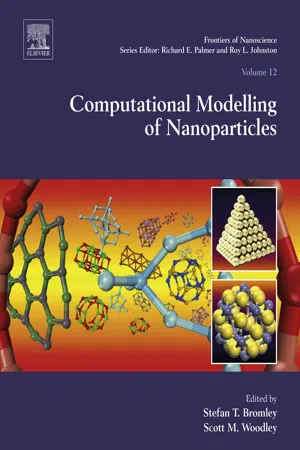
Computational Modelling of Nanoparticles highlights recent advances in the power and versatility of computational modelling, experimental techniques, and how new progress has opened the door to a more detailed and comprehensive understanding of the world of nanomaterials. Nanoparticles, having dimensions of 100 nanometers or less, are increasingly being used in applications in medicine, materials and manufacturing, and energy. Spanning the smallest sub-nanometer nanoclusters to nanocrystals with diameters of 10s of nanometers, this book provides a state-of-the-art overview on how computational modelling can provide, often otherwise unobtainable, insights into nanoparticulate structure and properties.
This comprehensive, single resource is ideal for researchers who want to start/improve their nanoparticle modelling efforts, learn what can be (and what cannot) achieved with computational modelling, and understand more clearly the value and details of computational modelling efforts in their area of research.
- Explores how computational modelling can be successfully applied at the nanoscale level
- Includes techniques for the computation modelling of different types of nanoclusters, including nanoalloy clusters, fullerines and Ligated and/or solvated nanoclusters
- Offers complete coverage of the use of computational modelling at the nanoscale, from characterization and processing, to applications
Information
Topic
Physical SciencesSubtopic
NanoscienceChapter 1
How to design models for ceria nanoparticles: Challenges and strategies for describing nanostructured reducible oxides
Albert Bruix*,1; Konstantin M. Neyman†,‡,1 * Chair for Theoretical Chemistry and Catalysis Research Center, Technische Universität München, Garching, Germany
† Departament de Ciència de Materials i Química Física & Institut de Química Teòrica i Computacional, Universitat de Barcelona, Barcelona, Spain
‡ Institució Catalana de Recerca i Estudis Avançats (ICREA), Barcelona, Spain
1 Corresponding authors: email address: [email protected], [email protected]
† Departament de Ciència de Materials i Química Física & Institut de Química Teòrica i Computacional, Universitat de Barcelona, Barcelona, Spain
‡ Institució Catalana de Recerca i Estudis Avançats (ICREA), Barcelona, Spain
1 Corresponding authors: email address: [email protected], [email protected]
Abstract
Cerium dioxide (ceria) is a versatile reducible oxide with a wide range of applications in catalysis. Nanostructured forms of ceria are used as noninert support materials for active metals and often participate directly in catalytic processes. The challenge of modeling ceria nanoparticles combines the complexity of nanostructured materials with the difficult description of strongly correlated Ce 4f electrons of reduced ceria. In this chapter, we introduce the reader to such challenges and describe the methods and tools used to design and optimize models of nanostructured ceria. Recent applications of these methods are reviewed, with a special focus on interdisciplinary studies combining theoretical modeling and experiments.
Keywords
Cerium dioxide; Ceria; DFT; Catalysis; Reducible oxides; Oxygen storage capacity; Modeling; Nanoparticles; Lanthanides; Rare earth oxides
1.1 Introduction
1.1.1 Cerium dioxide: Properties and applications
Cerium dioxide (CeO2, ceria) is a versatile compound used in a wide variety of technological applications including catalysis, oxygen sensors, synthetic membranes, and biomedicine [1]. A large amount of the annually consumed ceria is actually used in abrasive chemical–mechanical processes for polishing surfaces of optical and electronic materials [2]. However, most of the research devoted to ceria and ceria-based materials focuses on its applications in catalysis and other energy-related technologies such as solid oxide fuel cells [3–5]. Ceria has an important role in industrially and commercially relevant catalytic processes such as the three-way catalysis for conversion of automotive exhaust gases [6–8], the fluid catalytic cracking of petroleum crude oils [9], and the preferential oxidation of CO [10,11]. It is also actively investigated as key component of catalytic materials for the water–gas shift (WGS) reaction [12,13], alcohol reforming [14], and methanol synthesis [15], among others.
In many of these catalysts, ceria acts as an oxygen buffer, storing and releasing oxygen under O-rich and O-lean conditions, respectively. This ability is known as oxygen storage capacity (OSC) and arises from facile formation, migration, and healing of oxygen vacancies, promoting high oxygen transfer rates between ceria surfaces and reactants or other catalyst components [16]. Ceria thus belongs to the family of reducible oxides, which is characterized by the complex interplay between different metal oxidation states and oxide stoichiometry. For ceria, reduction and oxidation involve the reversible and facile transformation between Ce4 + and Ce3 + oxidation states, where electrons left behind upon the formation of neutral oxygen vacancies occupy 4f orbitals of Ce. The extraordinary OSC of ceria can actually be traced back to related quantum-mechanical effects involving the localization of Ce 4f electrons [17]. As we describe in more detail further, this makes the computational modeling of ceria-based materials particularly challenging.
1.1.2 Nanostructured ceria and its role in catalysis
Ceria's OSC is also highly structure sensitive and has been shown to depend on, for example, the surface termination [18–20] or the material's nanostructure [21–25]. In fact, nanostructured ceria often features properties that are markedly different from those of bulk ceria [1,4,26,27]. Corma and coworkers, for example, found that the CO oxidation rate on gold catalysts supported on nanoparticulate ceria is two orders of magnitude larger than when using bulk ceria as support [21]. This effect was attributed to the more facile reduction of ceria nanoparticles [28] and proved that the reducibility of cerium oxide, and thereby also its OSC, can be tuned by nanostructuring. Similar alterations to the OSC of ceria that facilitate oxygen removal can also be induced by doping with elements with different valences [29–34], the interaction with metal nanoparticles [16,35–37], or mixing with other oxides. It is also important to note that although ceria is often found supporting more active transition metal components in most catalytic applications [38], the catalytic function of ceria is not merely limited to accepting and providing O atoms. Surface sites of ceria (the basic O atoms, Ce3 +/4 + centers, or defects/vacancies) are active on its own for multiple reactions [39–42] and can therefore be combined with active metals in multifunctional catalytic materials.
The differences between properties of nanostructured and bulk ceria suggest that the theoretical modeling of ceria surfaces, which has provided a wealth of atomic-level understanding and mechanistic insight of ceria-based catalytic materials [43–45], are insufficient to address properties of nanostructured ceria catalysts. Instead, one needs to work with dedicated nanostructured models that explicitly account for the zero dimensionality of ceria nanoparticles as well as the presence of undercoordinated sites at their edges and corners. In fact, the structural differences between technical catalysts and the models (both experimental and theoretical) used to study them, known as the materials gap [46], seem to be even more significant for reducible oxides than for transition metal catalysts, for which reactivity differences between extended surfaces and nanoparticles are well documented [47].
1.1.3 Outline of the chapter
In this chapter, we summarize theoretical modeling efforts devoted to bridging the materials gap for nanostructured ceria-based catalysts. These have mostly relied on methods based on the density functional theory (DFT), which has become ubiquitous in materials modeling and represents the workhorse in theoretical heterogeneous catalysis research [48–51]. Using DFT-based methods with size-representative nanoparticle models involved until the mid-2000s a prohibitive computational cost due to the large number of atoms (and therefore also of their corresponding electrons) that need to be explicitly considered. However, the ever-increasing capacity o...
Table of contents
- Cover image
- Title page
- Table of Contents
- Copyright
- Contributors
- Introduction to modeling nanoclusters and nanoparticles
- Chapter 1: How to design models for ceria nanoparticles: Challenges and strategies for describing nanostructured reducible oxides
- Chapter 2: Simulating heterogeneous catalysis on metallic nanoparticles: From under-coordinated sites to extended facets
- Chapter 3: From nanoparticles to mesoporous materials
- Chapter 4: The DFT-genetic algorithm approach for global optimization of subnanometer bimetallic clusters
- Chapter 5: Clusters and nanoparticles: The experimental–computational connection to understanding
- Chapter 6: Stress-driven structural transitions in bimetallic nanoparticles
- Chapter 7: Modeling realistic titania nanoparticles
- Chapter 8: DFT modeling of metallic nanoparticles
- Chapter 9: Melting and structural transitions
- Index
Trusted by 375,005 students
Access to over 1.5 million titles for a fair monthly price.
Study more efficiently using our study tools.
Frequently asked questions
Yes, you can cancel anytime from the Subscription tab in your account settings on the Perlego website. Your subscription will stay active until the end of your current billing period. Learn how to cancel your subscription
No, books cannot be downloaded as external files, such as PDFs, for use outside of Perlego. However, you can download books within the Perlego app for offline reading on mobile or tablet. Learn how to download books offline
Perlego offers two plans: Essential and Complete
- Essential is ideal for learners and professionals who enjoy exploring a wide range of subjects. Access the Essential Library with 800,000+ trusted titles and best-sellers across business, personal growth, and the humanities. Includes unlimited reading time and Standard Read Aloud voice.
- Complete: Perfect for advanced learners and researchers needing full, unrestricted access. Unlock 1.5M+ books across hundreds of subjects, including academic and specialized titles. The Complete Plan also includes advanced features like Premium Read Aloud and Research Assistant.
We are an online textbook subscription service, where you can get access to an entire online library for less than the price of a single book per month. With over 1.5 million books across 990+ topics, we’ve got you covered! Learn about our mission
Look out for the read-aloud symbol on your next book to see if you can listen to it. The read-aloud tool reads text aloud for you, highlighting the text as it is being read. You can pause it, speed it up and slow it down. Learn more about Read Aloud
Yes! You can use the Perlego app on both iOS and Android devices to read anytime, anywhere — even offline. Perfect for commutes or when you’re on the go.
Please note we cannot support devices running on iOS 13 and Android 7 or earlier. Learn more about using the app
Please note we cannot support devices running on iOS 13 and Android 7 or earlier. Learn more about using the app
Yes, you can access Computational Modelling of Nanoparticles by Stefan T. Bromley,Scott M. Woodley in PDF and/or ePUB format, as well as other popular books in Physical Sciences & Nanoscience. We have over 1.5 million books available in our catalogue for you to explore.