eBook - ePub
Nasopharyngeal Carcinoma
From Etiology to Clinical Practice
- 394 pages
- English
- ePUB (mobile friendly)
- Available on iOS & Android
eBook - ePub
About this book
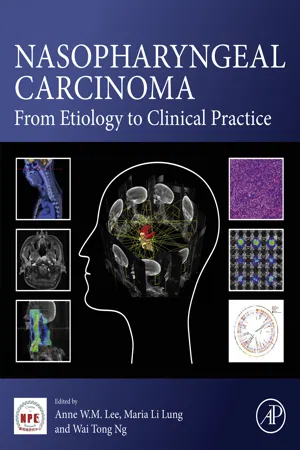
Nasopharyngeal Carcinoma: From Etiology to Clinical Practice discusses NPC from basic science, to clinical management through the perspective of members of the Centre for Nasopharyngeal Carcinoma Research in Hong Kong. It encompasses not only the most detailed information about multiple aspects of NPC, but also the modern day research model of scientist-clinician collaboration, focusing on bench-to-bedside approach. Basic science is covered, discussing genetics and genomics in NPC and its epidemiology and the role of Epstein-Barr Virus (EBV). Translational research is also covered, presenting topics such as animal models, plasma EBV DNA, molecular imaging and immunotherapy, amongst other topics.
This book is a valuable source for cancer researchers, oncologists, medical oncologists and several members of the biomedical field who are interested in learning more about NPC management from both clinical and research perspectives.
- Written by members of the Centre for Nasopharyngeal Carcinoma Research
- Extensively covers various aspects of NPC, including basic science and the clinical advances of both scientists and clinicians
- Discusses the molecular information gained through laboratory studies to stimulate research on new treatment strategies
Information
Chapter 1
Nasopharyngeal Carcinoma
A History
A.B. Rickinson 1 , and K.W. Lo 2 1 Institute of Immunology and Immunotherapy, Division of Cancer Sciences, University of Birmingham, Birmingham, United Kingdom 2 Department of Anatomical and Cellular Pathology and State Key Laboratory of Translational Oncology, Chinese University of Hong Kong, Hong Kong, China
Abstract
Here we describe the initial recognition of nasopharyngeal carcinoma (NPC) as a distinct clinical entity and, from that point, trace the timeline of NPC research as it has developed over the past 50 years. We show how the tumor's unique epidemiology revealed tumor risk to be influenced by both genetic and environmental cofactors, and describe how attempts to identify those cofactors have progressed alongside research on yet a third essential player in the disease process, the Epstein–Barr virus (EBV). We then describe how recent studies of genomic changes in NPC cells have helped to construct a model of the tumor's multifactorial disease pathogenesis, and discuss ways in which the EBV connection is opening up new possibilities for tumor diagnosis, treatment, and ultimately, prevention.
Keywords
Epidemiology; Future prospects; Genetics; History; Nasopharyngeal carcinoma; Pathogenesis; Treatment; Virology
Nasopharyngeal Carcinoma: An Introduction
Nasopharyngeal carcinoma (NPC) of undifferentiated type is a tumor whose unique pathogenesis, involving genetic, lifestyle, and viral cofactors, has made it an important platform for research on the multifactorial nature of oncogenesis. Here we follow the various strands of that research as they have grown over the past 50 years, diverging and reconnecting with one another to furnish our current understanding of NPC development. We describe the emergence over the same period of radiotherapy and chemoradiotherapy as standard treatment options, then consider how fundamental research is raising the prospect of novel therapies and even the possibility of tumor prevention. In each of these areas we highlight what we see as the most important findings to date, identify the challenges that remain, and, with an eye to the lessons of the past, discuss how best to meet those challenges in the future.
NPC arises from epithelial cells within the lymphocyte-rich nasopharyngeal mucosa, with an epicenter in the Fossa of Rosenmuller, a pharyngeal recess within the nasal cavity from which the tumor has multiple routes of spread. In particular, this location helps to explain why NPC so frequently presents as a lymph node metastasis in the neck rather than as a primary nasal lesion. Histologically the tumor is characterized by malignant epithelial cells that are of squamous origin but lack keratinization and are classified as either undifferentiated or poorly differentiated [Fig. 1.1]. Tumors with either of these two closely related histologies, originally designated NPC World Health Organization (WHO) types 2 and 3, are now considered as a single clinical entity, undifferentiated (nonkeratinizing) NPC. 1 One characteristic feature of this tumor's histology is the presence of a rich lymphocytic infiltrate whose content and biological significance is still poorly understood. Note that there is also a well-differentiated (keratinizing) nasopharyngeal tumor, originally designated NPC WHO type 1, which is not only histologically distinct from the undifferentiated carcinoma but has a quite different pathogenesis and epidemiology. Our focus here is on the undifferentiated (nonkeratinizing) form of NPC.

Recognition of the Tumor and Its Unique Epidemiology
The tumor's frequent presentation in metastatic form, as a swelling in the neck with superficial resemblance to an inflammatory tuberculous lesion, no doubt contributed to the lateness of its recognition as a malignancy of nasopharyngeal origin. As reviewed by van Hasselt and Gibb, 2 the first clinical description of an NPC in the Western literature has been attributed to Durand-Fardel in 1837. 3 However it was not until the early years of the 20th century that the nasopharyngeal origin of the tumor was first recognized, and NPC acquired textbook status as a rare but distinct entity. 4 Somewhat surprisingly, early Chinese medical records do not specifically mention the tumor, perhaps reflecting both the difficulty of clinical diagnosis and the fact that such records were largely drawn from central and northern regions of China where the disease was less prevalent than in the south. In 1921, Todd, working in Canton (now known as Guandong), was the first to describe a series of cases in Chinese patients, 5 followed in 1930 by a comprehensive report from Digby and colleagues of the tumor's clinical, anatomical, and histological features based on >100 cases in Hong Kong. 6
For many years the cellular origin of NPC remained in doubt and different interpretations of the tumor's histology led to its description as an endothelioma, a reticulo-endothelioma, or a carcinosarcoma. Subsequently the term “lymphoepithelioma” gained currency, reflecting the mixed cellular composition of the tumor mass and the uncertainty over which were the malignant cells. Indeed it was not until the first WHO classification in 1978 that a consensus was reached and the epithelial origin of the tumor was formally recognized. 7
By then, interest in NPC had grown considerably because of its distinct epidemiology. First, it had an unusual age profile, occurring throughout adult life but with a marked incidence peak in 45–60 year-olds, and a male predominance (M:F ratio 3:1). Second, and more important, incidence rates varied hugely between different ethnic groups, with Southeast Asian people particularly at risk. A recent International Agency for Research on Cancer (IARC) Globoscan profile of worldwide NPC incidence is shown in Fig. 1.2, although the homogenization of data from any one country tends to obscure important detail; for example, the very strong gradient of increased incidence as one moves from north to south within China. Already by the 1960s, 8 many studies had reported the high incidence of NPC (age-standardized rate in males of >15 per 100,000) among Southern Chinese, with an epicenter around Canton that extended down the Pearl River delta to include Hong Kong. Such rates are at least 30-fold greater than those seen in Caucasian populations. Migrants of Cantonese descent in Singapore have similarly high rates, as do first-generation Cantonese migrants to California. The tumor is also seen more generally throughout Southeast Asian populations, typically at intermediate incidence rates (age-standardized rate in males >4 per 100,000), but with hotspots of high incidence in certain minority ethnic groups in island nations of the Southeast Asian archipelago. Interestingly Wee and colleagues 9 have proposed that such groups, like Cantonese people themselves, are descendants of a high-risk aboriginal people who, at the end of the last Ice Age some 10,000 years ago, lived in the area of the South China Sea and were displaced in multiple directions by rising sea levels. The relevance of this hypothesis to foci of high NPC incidence beyond Southeast Asia remains conjectural. Interestingly, intermediate to high rates of NPC are seen in Inuit populations, 10 themselves of Asian descent, in Arctic regions, but NPC is also quite common in countries of the North African Maghreb and, reportedly, in certain communities in East Africa. 8

To what extent these differen...
Table of contents
- Cover image
- Title page
- Table of Contents
- Copyright
- List of Contributors
- Preface
- Acknowledgments
- Chapter 1. Nasopharyngeal Carcinoma: A History
- Chapter 2. Nasopharyngeal Carcinoma: Genetics and Genomics
- Chapter 3. Pathogenesis of Nasopharyngeal Carcinoma: Histogenesis, Epstein–Barr Virus Infection, and Tumor Microenvironment
- Chapter 4. Epidemiology and Population Screening
- Chapter 5. Establishment of Nasopharyngeal Carcinoma Cell Lines, Patient-Derived Xenografts, and Immortalized Nasopharyngeal Epithelial Cell Lines for Nasopharyngeal Carcinoma and Epstein–Barr Virus Infection Studies
- Chapter 6. Translational Studies: Drug Candidates and Preclinical Testing
- Chapter 7. Conventional and Novel Diagnostic Biomarkers and Approaches for Detection of Nasopharyngeal Carcinoma
- Chapter 8. Imaging of Nasopharyngeal Carcinoma
- Chapter 9. Staging of Nasopharyngeal Carcinoma Based on the 8th Edition of the AJCC/UICC Staging System
- Chapter 10. Standard of Care for Nasopharyngeal Carcinoma (2018–2020)
- Chapter 11. International Consensus on Delineation of Target Volumes and Organs at Risk
- Chapter 12. Advances in Radiotherapy
- Chapter 13. Salvage of Local Recurrence
- Chapter 14. Management of Metastatic Nasopharyngeal Carcinoma
- Chapter 15. Cancer Immunotherapy for Nasopharyngeal Carcinoma
- Chapter 16. Nasopharyngeal Carcinoma: Basic Science
- Chapter 17. Concluding Chapter: Nasopharyngeal Carcinoma—Clinical Aspects
- Index
Trusted by 375,005 students
Access to over 1.5 million titles for a fair monthly price.
Study more efficiently using our study tools.
Frequently asked questions
Yes, you can cancel anytime from the Subscription tab in your account settings on the Perlego website. Your subscription will stay active until the end of your current billing period. Learn how to cancel your subscription
No, books cannot be downloaded as external files, such as PDFs, for use outside of Perlego. However, you can download books within the Perlego app for offline reading on mobile or tablet. Learn how to download books offline
Perlego offers two plans: Essential and Complete
- Essential is ideal for learners and professionals who enjoy exploring a wide range of subjects. Access the Essential Library with 800,000+ trusted titles and best-sellers across business, personal growth, and the humanities. Includes unlimited reading time and Standard Read Aloud voice.
- Complete: Perfect for advanced learners and researchers needing full, unrestricted access. Unlock 1.5M+ books across hundreds of subjects, including academic and specialized titles. The Complete Plan also includes advanced features like Premium Read Aloud and Research Assistant.
We are an online textbook subscription service, where you can get access to an entire online library for less than the price of a single book per month. With over 1.5 million books across 990+ topics, we’ve got you covered! Learn about our mission
Look out for the read-aloud symbol on your next book to see if you can listen to it. The read-aloud tool reads text aloud for you, highlighting the text as it is being read. You can pause it, speed it up and slow it down. Learn more about Read Aloud
Yes! You can use the Perlego app on both iOS and Android devices to read anytime, anywhere — even offline. Perfect for commutes or when you’re on the go.
Please note we cannot support devices running on iOS 13 and Android 7 or earlier. Learn more about using the app
Please note we cannot support devices running on iOS 13 and Android 7 or earlier. Learn more about using the app
Yes, you can access Nasopharyngeal Carcinoma by Anne W.M. Lee,Maria Li Lung,Wai Tong Ng in PDF and/or ePUB format, as well as other popular books in Médecine & Industrie pharmaceutique, biotechnologique et de la santé. We have over 1.5 million books available in our catalogue for you to explore.