eBook - ePub
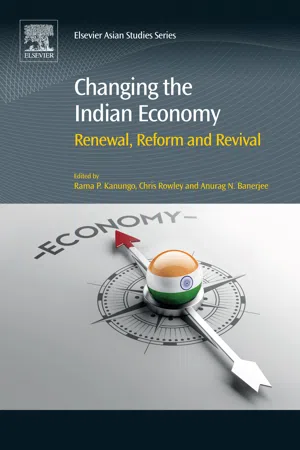
Changing the Indian Economy
Renewal, Reform and Revival
- 184 pages
- English
- ePUB (mobile friendly)
- Available on iOS & Android
eBook - ePub
Changing the Indian Economy
Renewal, Reform and Revival
About this book
Changing the Indian Economy: Renewal, Reform and Revival explores the fact that post-Modi India is witnessing unprecedented socioeconomic change, truly labeled as Modi's Mantra and his attempts to morph the Indian economic landscape. India is using an intelligent economic process for its renewal and growth, however, in a recent study by Nomura, 2016, The Japanese Financial Services firm, it is reported that there is downside risk to India's baseline forecast of 7.8 per cent GDP growth in 2016. Although the report suggests that there was a mid-cycle consolidation in mid-2014, the recovery seems to be losing momentum.
This book offers a novel, but inclusive outlook to the entire post-Modi economic overhaul.
- Offers a comprehensive narrative of the current economic scene in India
- Explores how the measures for reform are intelligent, while also considering their weaknesses
- Shows how India has a strong potential to grow amidst diversity of economic reforms and changing governance
- Includes a compilation of insightful articles on Indian economic reform and future prospects
Information
Chapter 1
Political Economy of Resources and Infrastructure in India
Anurag N. Banerjee*
Nilanjan Banik**
* University of Durham, Durham, United Kingdom
** Bennett University, India
* University of Durham, Durham, United Kingdom
** Bennett University, India
Abstract
This chapter examines the political dimensions of strategic resource challenges in India. Natural resource endowments (i.e. land, oil, gas and minerals) can serve as potent drivers of development. For better or worse energy, transport, mineral and land markets in India are shaped by national interest and do not behave as traditional goods markets, especially because of the lack of well-defined property rights. Therefore while markets are an essential part of any response to tighter resource supplies, governments also play a key role as a preeminent domain in this incomplete market setup. This has led to challenges concerning how local resource users are subject to exclusion and dispossession in the national interest of economic growth. For example, there has been an increase in the number of legal contests regarding land, water and mining rights which has increased inequality and local insecurities. Thus a ‘paradox of plenty’ exists in resource-rich countries such as India, where recent history has demonstrated that extractive endowments can disappoint if they are not well-managed. This chapter discusses the problems related to land acquisition and water resources and the possible solutions.
Keywords
economic development
farmers
government
infrastructure
judgement
land
water
1 Problems with land acquisition
Obtaining land for infrastructure or for the building industry is a real problem and can slow down growth. Table 1.1 shows that India lags behind other South Asian countries (with similar levels of economic development), not only in terms of per capita income but also with respect to other key development indicators such as electricity, water and sanitation. In India, obtaining land for infrastructure and the building industry remains a thorny issue.
Table 1.1
| Indicator | India | South Asia | Lower Middle Income Countries |
|---|---|---|---|
| GNI per capita, Atlas method (current USD) in 2016 | 1670 | 1611 | 2077.69 |
| Access to electricity (% of population) in 2014 | 79.16 | 80.05 | 79.53 |
| Access to improved water source (% of population) in 2015 | 94.1 | 92.37 | 89.18 |
| Access to improved sanitation facilities (% of population) in 2015 | 39.6 | 44.77 | 52.22 |
| Electricity Power Consumption (kWh per capita) in 2014 | 805.59 | 707.55 | 769.05 |

Source: World Development Indicators (2017), World Bank.
Analysis by TMP Systems found that out of 73,000 commercial projects across eight different countries, over 93% of projects were inhabited. When analysing 262 land tenure cases in 30 countries, the study found consistent material impacts of unclear land rights obstructing the building of new infrastructures, including dams, roads, ports and electricity supplies.a Therefore obtaining land with a clear title is an issue.
The story is no different in India. With limited government resources, there is a need for public–private partnerships (PPPs) to develop world-class infrastructure and service sector operations. The provision of hassle-free and cheap land to private companies for developing infrastructure is an essential component for this to happen. Investment risks posed by insecure and unclear land rights are responsible for holding back investment in infrastructure. At the other extreme, farmers and human rights activists complain that they are on the receiving end, with middlemen cornering the bulk of the profit.
2 Impact on industry
A study examining 1660 judgements delivered in the Punjab and Haryana High Court between 2009 and 2011 demonstrated how farmers are deprived (Singh, 2012). The study showed that the average government compensation was approximately one-fourth of the market value of the land. Moreover, most of the land procured for building infrastructure was used for commercial purposes [i.e. real estate and special economic zones (SEZs)]....
Table of contents
- Cover
- Title page
- Table of Contents
- Copyright
- List of Contributors
- Preface
- Chapter 1: Political Economy of Resources and Infrastructure in India
- Chapter 2: India’s Exports Through the Lens of Diversification
- Chapter 3: The Multiplier Effect of Developmental and Non-developmental Expenditure in India
- Chapter 4: Failing to Learn: India’s Schools and Teachers
- Chapter 5: Indian Industry: Performance, Problems and Prospects
- Chapter 6: Civil Society Matters: India in Continuity
- Chapter 7: Socioeconomic Reforms and Responsive Government: An Indian Perspective
- Chapter 8: Sectoral Approaches to Skills for Green Jobs in India
- Chapter 9: India’s New Bilateral Investment Treaty: Expansions, Inclusions and Exclusions
- Index
Trusted by 375,005 students
Access to over 1.5 million titles for a fair monthly price.
Study more efficiently using our study tools.
Frequently asked questions
Yes, you can cancel anytime from the Subscription tab in your account settings on the Perlego website. Your subscription will stay active until the end of your current billing period. Learn how to cancel your subscription
No, books cannot be downloaded as external files, such as PDFs, for use outside of Perlego. However, you can download books within the Perlego app for offline reading on mobile or tablet. Learn how to download books offline
Perlego offers two plans: Essential and Complete
- Essential is ideal for learners and professionals who enjoy exploring a wide range of subjects. Access the Essential Library with 800,000+ trusted titles and best-sellers across business, personal growth, and the humanities. Includes unlimited reading time and Standard Read Aloud voice.
- Complete: Perfect for advanced learners and researchers needing full, unrestricted access. Unlock 1.5M+ books across hundreds of subjects, including academic and specialized titles. The Complete Plan also includes advanced features like Premium Read Aloud and Research Assistant.
We are an online textbook subscription service, where you can get access to an entire online library for less than the price of a single book per month. With over 1.5 million books across 990+ topics, we’ve got you covered! Learn about our mission
Look out for the read-aloud symbol on your next book to see if you can listen to it. The read-aloud tool reads text aloud for you, highlighting the text as it is being read. You can pause it, speed it up and slow it down. Learn more about Read Aloud
Yes! You can use the Perlego app on both iOS and Android devices to read anytime, anywhere — even offline. Perfect for commutes or when you’re on the go.
Please note we cannot support devices running on iOS 13 and Android 7 or earlier. Learn more about using the app
Please note we cannot support devices running on iOS 13 and Android 7 or earlier. Learn more about using the app
Yes, you can access Changing the Indian Economy by Rama P. Kanungo,Chris Rowley,Anurag N. Banerjee in PDF and/or ePUB format, as well as other popular books in Business & Business General. We have over 1.5 million books available in our catalogue for you to explore.