- 318 pages
- English
- ePUB (mobile friendly)
- Available on iOS & Android
eBook - ePub
Management of Coking Coal Resources
About this book
Management of Coking Coal Resources provides a one-stop reference that focuses on sustainable mining practices using a four-point approach that includes the economical, governmental, societal, and environmental aspects of coal exploration, coking coal mining, and steelmaking applications.
This type of approach galvanizes the excavation, processing methods, and end uses of coal as an energy and steelmaking source, thus ensuring that the supply of coking coal meets the future demands of the rapidly expanding economies in India and other developing countries.
The book provides information on the strategic planning and revitalization of India's Jharia coalfield, addressing actionable plans for methods of extraction, master plans for mine fires, subsidence management, land use planning, and sustainable mining.
Users will find a multidisciplinary reference that presents the broad range of applications, techniques, and methodologies used in maintaining coking coal quality from exploration through extraction.
- Provides a one-stop reference that focuses on sustainable mining practices using a four-point approach
- Includes the economical, governmental, societal, and environmental aspects of coal exploration, coking coal mining, and steelmaking applications
- Presents information on the strategic planning and revitalization of India's Jharia coalfield
- Includes a broad range of the applications, techniques, and methodologies used in maintaining coking coal quality from exploration through extraction
Information
Chapter 1
Introduction
Abstract
The coking coal sector of the Indian coal-mining industry is riddled with a multiplicity of problems. This book examines the problem of the scarcity of coking coal resources and offers solutions through innovation in different areas. The book takes a holistic approach leading to technically feasible, and economically viable, solutions. Various mathematical models have been formulated to evaluate important process variables using a multidisciplinary approach. The book examines the management of the supply of coking coal within a framework that integrates production factors, quality factors, coke making, steel making, end products, recycling, transportation, and storage. The resurgence of the coal industry, its impact on the steel industry, and the changing landscape for policymakers has created opportunities for innovation within public–private partnerships, joint ventures, and foreign investments. The potentially dynamic growth of the Indian coal industry has been further probed through a triangular model linking attraction of investment, government policy, and focused investment.
Keywords
coking coal
steel making
supply chain
deregulation
public–private partnerships
joint ventures
foreign investments
vertical integration
outsourcing
1.1. Problems
The iron and steel industry is perhaps the most important element of a nation’s industrial economic infrastructure, and the consumption of steel per capita of population is an indicative index of industrialization and progress. Major European industrial powers of the nineteenth century, and the first half of the twentieth century, owed their position to domination of reserves of iron ore and coal. In fact, the industrial revolution in Europe started with coal mining in the United Kingdom, and the iron and steel industry prospered paralleling the growth of the coal industry; coking coal being an essential input to steel metallurgy. The superpowers of today, the USA, China, and Russia, have immense reserves of both iron ore and coal. Over 70% of global steel produced today from iron ore is largely dependent on coal.
In India the volume of good-quality iron ore is satisfactory, but metallurgical coal reserves are comparatively meager, necessitating the import of prime coking coal. The choicest Indian coking coals, which only occur in the Jharia coal belt of the state of Jharkhand, were wantonly wasted in steam production in both stationary boilers and steam engine boilers in the decades both before and after independence. A critical condition, therefore, prevails in India. Despite all the efforts to exploit coal reserves, with due regard being paid to conservation by India’s nationalized coal industry, it has not been possible to supply enough metallurgical coke, of the required grade, to meet the needs of India’s growing steel industry.
The government of India has raised concerns about the rapid depletion of the country’s coking coal reserves, and wide-ranging conservation programs have been undertaken as part of the exploration, exploitation, beneficiation, and end use of coking coal. These programs include detailed exploration for new and deeper deposits and other deposits hitherto considered lost; planning for maximizing extraction using advanced technology; blending lower grade coals with superior coals; improving coal beneficiation techniques; examining the possibility of replacing coking coal with noncoking coals; and improvement, or modification of, conventional steel metallurgy.
The inherent constraints faced by the Indian coal-mining industry include the close proximity of deposits; coal seam thicknesses that vary from 0.5 m to 30 m and are not always suitable for mechanized extraction; high inherent ash content within the coal and prevalence of bands of dirt in the seams; proneness to spontaneous heating of the coal; and prevalence of bord and pillar mining which results in subsidence, fire, and large reserves remaining inaccessible within the pillars.
Most recently, the technique of surface mining is showing growth. High-capacity mechanized mines are planned, which will extract coal from depths of about 480 m. These will replace the smaller scale, shallow-deposit quarries, which are labor intensive. Additionally, longwall mining has been successfully introduced, and is expected to greatly contribute to underground production in the future.
The Jharia coalfield, the main storehouse of prime coking coal in India, was haphazardly exploited for centuries by both selective and wasteful mining methods. A large amount of coal in this field remains inaccessible in pillars; almost 85 million tons of coal were lost due to fire, both surface and underground, during the last 70 years. A comprehensive scheme to combat and restrict fire is in place, and a master plan has been formulated for reconstruction of the entire coalfield including specific scientific exploitation programs designed to restructure the coalfield into large underground and surface mine blocks; remodeling the infrastructure; improvement in communication; reclamation of wasteland; and the redevelopment of commercial/residential areas.
The increasingly high ash content of Indian coals currently being mined, or planned for future mining, poses serious problems linked to beneficiation by conventional methods. In the steel sector a concomitant effort is being made to explore the possibilities of using newer technologies to develop the conservation of metallurgical grade coals.
1.2. The Objective of This Book
There is sufficient scope for an investigation into ways India might resolve the coking coal shortage in view of increasing demand from the growing steel industry. This book adopts a broad approach to examining the problems faced by the steel industry and its connection to India’s coal-mining industry. The various processes in vogue in Indian steel mills vis-à-vis the methods practiced abroad, and their merits and potential for use in India, are examined in detail. Statistical support is given in the book suggesting modifications required for steel making in India.
A critical appraisal of coking coal demand, in respect of the projected growth of the steel sector in India, has been attempted. This appraisal called for a detailed study of the supply/demand structure within the Indian steel industry, in relation to the coal industry both in the past and in the future, to identify caveats to such estimation techniques.
The analysis of coking coal resources is continuously updated by exploration agencies like the Geological Survey of India (GSI), the Mineral Exploration Corporation Ltd. (MECL), the Directorate of Geology and Mining (DGM), and the Central Mine Planning & Design Institute (CMPDI) of Coal India Ltd. (CIL), whose analysis is more detailed and goes to depths previously not attempted. Quantity and quality analysis is a continuous process. A review of the inventory for coking coal deposits in India, and the impact of technology on this in the future has been examined. The scarcity of resources has led to rising prices, which in turn has led to increased innovation. The model indicated in Figure 1.1 provides a framework for looking at the various possibilities for appreciation of resources through innovation.
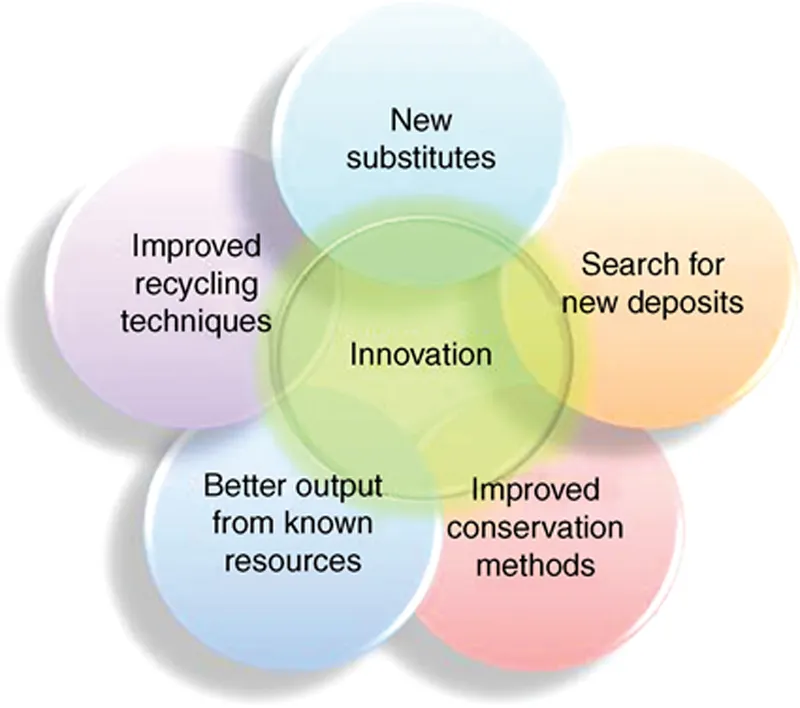
Figure 1.1 Appreciation of resources.
Innovation focuses on improvement, including taking inspiration from techniques and ideas unrelated to mining and metallurgy. It is important to be open to new ideas. Thinking “outside the box” is one of the key factors driving improvement and innovation. New information technology tools, and investment in research and development (R&D), may bring about technological breakthroughs in all areas of the coking coal sector, from mining processes and steel making to reengineering. A culture of innovation needs to be instilled throughout all the associated organizations, and this means developing new technical ideas and skills. The process of translation of a technology from inception to implementation is looked at in this book. As mining has become a global industry, India has to play its part by incorporating the latest developments and technologies into its mining industries. Global positioning system (GPS), airborne geophysics, and low-impact seismic methods are some examples of exploration innovation. Telemi...
Table of contents
- Cover
- Title page
- Table of Contents
- Copyright
- Dedication
- Preface
- Acknowledgments
- Chapter 1: Introduction
- Chapter 2: Latest Developments in the Iron and Steel Industry
- Chapter 3: Evaluation of Coking Coal Resources and Reserves
- Chapter 4: Rational Implementation of Mining Technology
- Chapter 5: Solutions to Transportation Problems
- Chapter 6: Societal Responsibility and Economic Viability
- Chapter 7: Conclusions
- Index
Trusted by 375,005 students
Access to over 1.5 million titles for a fair monthly price.
Study more efficiently using our study tools.
Frequently asked questions
Yes, you can cancel anytime from the Subscription tab in your account settings on the Perlego website. Your subscription will stay active until the end of your current billing period. Learn how to cancel your subscription
No, books cannot be downloaded as external files, such as PDFs, for use outside of Perlego. However, you can download books within the Perlego app for offline reading on mobile or tablet. Learn how to download books offline
Perlego offers two plans: Essential and Complete
- Essential is ideal for learners and professionals who enjoy exploring a wide range of subjects. Access the Essential Library with 800,000+ trusted titles and best-sellers across business, personal growth, and the humanities. Includes unlimited reading time and Standard Read Aloud voice.
- Complete: Perfect for advanced learners and researchers needing full, unrestricted access. Unlock 1.5M+ books across hundreds of subjects, including academic and specialized titles. The Complete Plan also includes advanced features like Premium Read Aloud and Research Assistant.
We are an online textbook subscription service, where you can get access to an entire online library for less than the price of a single book per month. With over 1.5 million books across 990+ topics, we’ve got you covered! Learn about our mission
Look out for the read-aloud symbol on your next book to see if you can listen to it. The read-aloud tool reads text aloud for you, highlighting the text as it is being read. You can pause it, speed it up and slow it down. Learn more about Read Aloud
Yes! You can use the Perlego app on both iOS and Android devices to read anytime, anywhere — even offline. Perfect for commutes or when you’re on the go.
Please note we cannot support devices running on iOS 13 and Android 7 or earlier. Learn more about using the app
Please note we cannot support devices running on iOS 13 and Android 7 or earlier. Learn more about using the app
Yes, you can access Management of Coking Coal Resources by Dilip Kumar,Deepak Kumar in PDF and/or ePUB format, as well as other popular books in Physical Sciences & Natural Resource Extraction Industry. We have over 1.5 million books available in our catalogue for you to explore.