- 242 pages
- English
- ePUB (mobile friendly)
- Available on iOS & Android
eBook - ePub
Materials for the Direct Restoration of Teeth
About this book
Materials for the Direct Restoration of Teeth focuses on the important role teeth play in our lives and how biomaterials scientists are ensuring that new dental materials are functional and esthetic.
As research in the field is shifting away from traditional materials like metal, and towards more advanced materials, such as resins and ceramics, this book on the subject of modern materials for the direct repair of teeth provides readers with a comprehensive reference.
The most pertinent modern dental materials and their properties and applications for the direct restoration of teeth are presented, along with case examples and guidance notes making this book an essential companion for materials scientists and clinicians.
- Provides comprehensive coverage of conventional and modern materials for direct restoration of teeth
- Includes guidance notes and case examples to support dental clinicians in decision-making
- Authored by a scientist and a clinician, the book provides a balanced and complete treatise of the subject
Information
Topic
MedicineSubtopic
Biotechnology in Medicine1
Clinical aspects of tooth repair
Abstract
This chapter covers the variety of assaults that can occur on natural teeth to impair their function. These are dental caries, trauma, abfraction, abrasion and erosion. All of these phenomena can cause serious damage and, in extreme cases, lead to loss of the tooth. Teeth can also be lost as a result of periodontal disease, and their pulps can lose vitality. In the latter case, endodontic treatment is required to prevent loss of the tooth. All of these conditions are described in this chapter. The aim is to set the scene for rest of the book by explaining why artificial materials are needed for tooth repair, and show something of the ways in which they provide acceptable clinical outcomes. All of the procedures that employ synthetic materials have as their objective the return of the tooth to its fully functioning condition. Preferably, too, they will retain the appearance of the natural dentition. Retention of teeth by such means is desirable because it contributes to the physical health of the patient, because it allows the consumption of a satisfying and healthy range of foods. Retention of the teeth also helps maintain a patient’s appearance, which is beneficial for psychological well-being.
Keywords
Teeth; Dental caries; Trauma; Abfraction; Abrasion; Erosion; Prophylaxis
1.1 Introduction
The teeth play an important part in human health, both physical and psychological [1,2]. At the physical level, they are essential in the mastication of food, with different teeth having different structures, which reflect their specialized purpose within the cycle of mastication of food. On the psychological level, the appearance of the teeth influences how individuals perceive themselves. People with missing or damaged teeth are typically self-conscious and may show lack of confidence or other signs of distress about their appearance [3].
Human teeth are small, calcified structures that are found in the mouth in distinctive positions relative to each other. Their location reflects their function, so that incisors are found at the front of the mouth and have sharp edges that fit them for the function of cutting food as it is taken into to the mouth. Molars are found towards the back of the mouth, and they have a flattened morphology that makes them suitable for crushing food immediately before swallowing and subsequent digestion [1,2].
In addition, there are canine teeth alongside the incisors, which share some of the functions of cutting and tearing food. Next to them come the pre-molars, which share some of the functions of crushing of the molars.
Teeth are typically long-lasting structures, capable of remaining functional in service for many years. In adults, there are 32 teeth and in children 20 teeth. These children’s teeth are lost around the age 7 onwards, and described as ‘deciduous’. The adult teeth, by contrast, are described as ‘permanent’.
The healthy tooth is covered with a thin layer of enamel (Fig. 1.1), the hardest substance in the human body [1,2]. It is highly mineralized, containing distinct crystalline phases of the calcium phosphate mineral hydroxyapatite Ca10(PO4)6(OH)2. It also contains traces of the protein collagen, which has important effects on the mechanical properties of the enamel. Specifically, the protein causes the enamel to be tougher than it would otherwise be, and hence more resistant to crack propagation through it [4]. It also reduces the permeability of the enamel, thus increasing its resistance to acid attack [4].
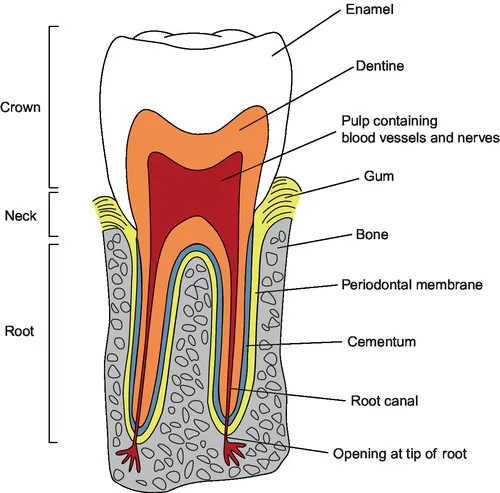
Fig. 1.1 Structure of a typical tooth.
Beneath the layer of enamel is a structure called dentine. It is a permeable pale yellow material that consists of approximately 70% hydroxyapatite, 20% organic matter (mainly collagen) and 10% water by mass.
Anatomically, the dentine has a tubular structure, with microscopic tubules radiating outwards from the central pulp cavity. These tubules range in diameter between 0.9 and 2.5 μm, with the diameter being widest near the pulp and becoming reduced as the tubule extends towards the dentino-enamel junction [2]. These tubules are filled with odontoblast processes.
The inner part of the tooth comprises a cavity, which contains soft connective tissue known as the dental pulp. It consists of blood vessels and nerve fibres and these enter the tooth via a small opening at the end of the tooth root called the apex. The outer layer of the pulp, adjacent to the dentine, contains dentine-producing cells known as odontoblasts. These cells produce dentine throughout the whole of life and are capable of providing a degree of repair to dentine that has been damaged by either trauma or bacterial activity. Also, in case of damage to the odontoblasts, in young patients, connective tissue cells from the pulp, the fibroblasts, can become transformed into odontoblasts, and these can then start the process of repairing the dentine. Because of these morphological and physiological connections between the dentine and the pulp, this tissue can be regarded as a single entity, the pulpo-dentinal complex.
The pulp contains sensitive cells which can be damaged by extensive mechanical trauma to the tooth, or by chemical assault from substances released from materials used to repair the tooth. The pulp can also become infected and transmit that infection to the rest of the body through the circulatory system. For this reason, the bacterially mediated disease of dental caries is potentially serious and should not be left untreated [5].
The tooth root is covered with a substance called cementum. This is a specialized tissue that shows some resemblance to bone [2] and has the approximate composition 455 hydroxyapatite, 33% protein (collagen) and 22% water by mass. Cementum occurs in two forms, acellular, which covers about two-thirds to the root, and cellular, which covers the remaining one-third closer to the tip of the tooth root. This form is more permeable than the acellular cementum.
The tooth is anchored within the bone of either the mandible or the maxilla by means of the periodontal ligament or membrane. The mechanical properties of this membrane are such that the tooth is supported during its use in mastication with a cushion of viscoelastic material and periodontal liquid within the more rigid supporting frame of alveolar bone [6]. This biomechanical structure thus contributes to the overall function of the tooth, while allowing a very small degree of movement within the tooth socket. This behaviour of the periodontal ligament can be attributed to its structure, which consists mainly on type 1 collagen fibres arranged in tight aligned bundles [7]. The periodontal ligament and the tooth are attached through the layer of cementum.
In service, teeth have to resistant a variety of assaults while maintaining their function. These include possible trauma, attack by acidic foodstuffs and beverages, biomechanical stresses of chewing and grinding and the effects of acidic metabolic products from the commonly occurring oral biofilm. Consequently, throughout life, teeth become damaged. The various types of damage are considered in the rest of this chapter. The remainder of the book is concerned with the materials available to the clinician to repair teeth that have been affected by these various damaging factors.
1.2 Dental caries
Tooth decay (dental caries) is one of the most common diseases in humans [8]. It has been defined as ‘a chronic, dietomicrobial, site-specific disease caused by a shift from protective factors favouring tooth remineralization to destructive factors leading to demineralization’ [9]. The specific factors leading to destruction of the mineral phase of the tooth are the presence of oral bacteria, mainly Streptococcus mutans [10], and the availability of fermentable carbohydrates from the diet. This combination leads to the production of organic acids as a result of the metabolic process of the bacteria, of which the main one is lactic acid, though other weak acids, such as ethanoic and propanoic can also occur [11]. These acids dissolve the mineral component of the tooth, leading to loss of structure.
The process of the disease of dental caries has been studied in depth for many years, and the details of its progress are now reasonably well understood [12]. The role of acidogenic bacteria in the mouth has long been known to be critical, and their ability to generate organic acids i...
Table of contents
- Cover image
- Title page
- Table of Contents
- Copyright
- Woodhead Publishing Series in Biomaterials
- 1: Clinical aspects of tooth repair
- 2: Classification of restorative materials and clinical indications
- 3: Composite resins
- 4: Polyacid-modified composite resins (compomers)
- 5: Dental adhesives
- 6: Conventional glass-ionomer cements
- 7: Resin-modified glass-ionomer cements
- 8: Modern glass-ionomer materials of enhanced properties
- 9: Materials for pulp capping
- 10: Materials for root canal filling
- Index
Trusted by 375,005 students
Access to over 1.5 million titles for a fair monthly price.
Study more efficiently using our study tools.
Frequently asked questions
Yes, you can cancel anytime from the Subscription tab in your account settings on the Perlego website. Your subscription will stay active until the end of your current billing period. Learn how to cancel your subscription
No, books cannot be downloaded as external files, such as PDFs, for use outside of Perlego. However, you can download books within the Perlego app for offline reading on mobile or tablet. Learn how to download books offline
Perlego offers two plans: Essential and Complete
- Essential is ideal for learners and professionals who enjoy exploring a wide range of subjects. Access the Essential Library with 800,000+ trusted titles and best-sellers across business, personal growth, and the humanities. Includes unlimited reading time and Standard Read Aloud voice.
- Complete: Perfect for advanced learners and researchers needing full, unrestricted access. Unlock 1.5M+ books across hundreds of subjects, including academic and specialized titles. The Complete Plan also includes advanced features like Premium Read Aloud and Research Assistant.
We are an online textbook subscription service, where you can get access to an entire online library for less than the price of a single book per month. With over 1.5 million books across 990+ topics, we’ve got you covered! Learn about our mission
Look out for the read-aloud symbol on your next book to see if you can listen to it. The read-aloud tool reads text aloud for you, highlighting the text as it is being read. You can pause it, speed it up and slow it down. Learn more about Read Aloud
Yes! You can use the Perlego app on both iOS and Android devices to read anytime, anywhere — even offline. Perfect for commutes or when you’re on the go.
Please note we cannot support devices running on iOS 13 and Android 7 or earlier. Learn more about using the app
Please note we cannot support devices running on iOS 13 and Android 7 or earlier. Learn more about using the app
Yes, you can access Materials for the Direct Restoration of Teeth by John Nicholson,Beata Czarnecka in PDF and/or ePUB format, as well as other popular books in Medicine & Biotechnology in Medicine. We have over 1.5 million books available in our catalogue for you to explore.