- 406 pages
- English
- ePUB (mobile friendly)
- Available on iOS & Android
eBook - ePub
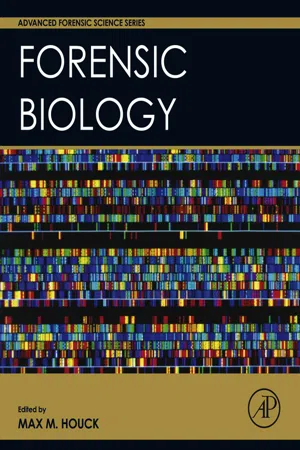
Forensic Biology
About this book
Forensic Biology provides coordinated expert content from world-renowned leading authorities in forensic biology. Covering the range of forensic biology, this volume in the Advanced Forensic Science Series provides up-to-date scientific learning on DNA analysis. Technical information, written with the degreed professional in mind, brings established methods together with newer approaches to build a comprehensive knowledge base for the student and practitioner alike.
LIke each volume in the Advanced Forensic Science Series, review and discussion questions allow the text to be used in classrooms, training programs, and numerous other applications. Sections on fundamentals of forensic science, history, safety, and professional issues provide context and consistency in support of the forensic enterprise. Forensic Biology sets a new standard for reference and learning texts in mondern forensic science.
- Advanced articles written by international forensic biology experts
- Covers the range of forensic biology, including methods and interpretation
- Includes entries on history, safety, and professional issues
- Useful as a professional reference, advanced textbook, or training review
Information
Section 1
Introduction
Introduction
The effect that DNA analysis, or profiling, has had on forensic science is almost incalculable. The last 30 years have been a blur of invention, application, argument, acceptance, and re-invention. DNA is readily accepted by the public and the courts now, but that was not always the case. The “DNA Wars” shoved forensic science into the spotlight only somewhat prepared for the controversies that resulted. It made forensic science better, if wary, and set the stage for many of the struggles to come, such as admissibility challenges to fingerprints, exonerations, and the wholesale quality culture that now envelopes the profession. In many ways, DNA remade forensic science without meaning to and opened up paths for the science and profession to follow that it never before considered.
Principles of Forensic Science
F. Crispino Université du Québec à Trois-Rivières, Trois-Rivières, QC, Canada
M.M. Houck Forensic & Intelligence Services, LLC, St. Petersburg, FL, USA
Abstract
Forensic science is grounded on two native principles (those of Locard and Kirk) and the admission of a few other non native ones. This framework is one definition of a paradigm for the discipline to be considered a basic science on its own merits. The science explores the relationships in legal and police matters through the analysis of traces of illegal or criminal activities. In this way, forensic science is seen as a historical science, interpreting evidence in context with its circumstances and originating processes (at source and activity levels).
Keywords
Epistemology; Forensic; Kirk; Locard; Paradigm; ScienceGlossary
Abduction
Syllogism in which one premise is certain whereas the other one is only probable, generally presented as the best explanation to the former. Hence, abduction is a type of reasoning in which we know the law and the effect, and we attempt to infer the cause.
Deduction
Process of reasoning that moves from the general to the specific and in which a conclusion follows necessarily from the stated premises. Hence, deduction is a type of reasoning in which, knowing the cause and the law, we infer the effect.
Forensic intelligence
Understanding on how traces can be collected from the scene, processed, and interpreted within a holistic intelligence-led policing strategy.
Heuristic
Process of reasoning by rules that are only loosely defined, generally by trial and error.
Holistic
Emphasizing the importance of the whole and the interdependence of its parts.
Induction
Process of deriving general principles from particular facts or instances (i.e., of reasoning that moves from the specific to the general). Hence, induction is a type of reasoning in which, knowing the cause and the effect (or a series of causes and effects), we attempt to infer the law by which the effects follow the cause.
Linkage blindness
Organizational or investigative failure to recognize a common pattern shared on different cases.
Science
The intellectual and practical activity encompassing the systematic study of the structure and behavior of the physical and natural world through observation and experiment. It is also defined as a systematically organized body of knowledge on a particular subject.
Given that it identifies and collects objects at crime scenes and then treats them as evidence, forensic science could appear at first glance to be only a pragmatic set of various disciplines, with practitioners adapting and developing tools and technologies to help the triers of fact (juries or judges) interpret information gained from the people, places, and things involved in a crime. The view could be—and has been—held that forensic science has no philosophic or fundamental unity and is merely the application of knowledge generated by other sciences. Indeed, many working forensic scientists regard themselves mainly as chemists, biologists, scientists, or technicians and rarely as practitioners of a homogeneous body of knowledge with common fundamental principles.
Even the 2009 National Academy of Sciences, National Research Council Report failed to recognize such a concept, certainly blurred by a semantic gap in the terminology itself of field practitioners, who confuse words such as “forensic science(s),” “criminalistic(s),” “criminology,” “technical police,” “scientific police,” and so on and generally restrict the scientific debate on analytical techniques and methods. An independent definition of forensic science, apart from its legal aspects, would support its scientific status and return the expert to his domain as scientist and interpreter of his analyses and results to assist the lay person.
What Is Forensic Science?
In its broadest sense, forensic science describes the utility of the sciences as they pertain to legal matters to include many disciplines, such as chemistry, biology, pathology, anthropology, toxicology, and engineering, among others. (“Forensic” comes from the Latin root forum, the central place of the city where disputes and debates were made public to be solved—hence defining the law of the city. Forensic generally means of or applied to the law.) The word “criminalistics” was adopted to describe the discipline directed toward the “recognition, identification, individualization, and evaluation of physical evidence by application of the natural sciences to law-science matters.” (“Kriminalistik” was coined in the late nineteenth century by Hans Gross, a researcher in criminal law and procedure to define his methodology of classifying investigative, tactical, and evidential information to be learned by magistrates at law schools to solve crimes and help convict criminals.) In the scheme as it currently stands, criminalistics is part of forensic science; the word is a regionalism and is not universally applied as defined. Difficulties in differentiating the concepts certainly invited the definition of criminalistics as the “science of individualization,” isolating this specific epistemologically problematic core from the other scientific disciplines. Individualization, the concept of determining the sole source of an item, enthroned a linear process—identification or classification on to individualization—losing sight of the holistic, variable contribution of all types of evidence. Assessing the circumstances surrounding a crime, in which the challenge is to integrate and organize the data in order to reconstruct a case or propose alternative propositions for events under examination, requires multiple types of evidence, some of which may be quite nuanced in their interpretation. This is also true in the use of so-called forensic intelligence, which feeds investigative, police, or security needs, in which one of the main reasons for failures is linkage blindness. Nevertheless, it seems that the essence of the forensic daily practice is hardly captured within the present definitions of both terms.
In the broadest sense, forensic science reconstructs past criminal events through the analysis of the physical remnants of those activities (evidence); the results of those analyses and their expert interpretation establish relationships among people, places, and objects relevant to those events. It produces these results and interpretations through logical inferences, induction, abduction, and deduction, all of which frame the hypothetico-deductive method; investigative heuristics also play a role. Translating scientific information into legal information is a particular domain of forensic science; other sciences must (or at least should) communicate their findings to the public, but forensic science is often required by law to communicate their findings to public courts. Indeed, as the Daubert hearing stated, “[s]cientific conclusions are subject to perpetual revision as law must resolve disputes finally and quickly.” This doubly difficult requirement of communicating to the public and to the law necessitates that forensic scientists should be better communicators of their work and their results. Scientific inferences are not necessarily legal proofs, and the forensic scientist must recognize that legal decisions based, in part, on their scientific work may not accord with their expert knowledge. Moreover, scientists must think in probabilities to explain evidence given possible causes whereas jurists must deal in terms of belief beyond reasonable doubt. As Inman and Rudin state, “Because we [the scientists] provide results and information to parties who lack the expertise to independently understand their meaning and implications, it is up to us to furnish an accurate and complete interpretation of our results. If we do not do this, our conclusions are at best incomplete, at worst potentially misleading.”
The Trace as the Basic Unit of Forensic Science
The basic unit of forensic science is the trace, the physical remnant of the past criminal activity. Traces are, by their very nature, semiotic: They represent something more than merely themselves; they are signifiers or signs for the items or events that are its source. A fiber is not the sweater it came from, a fingerprint is not the fingertip, soot in the trachea is not the victim choking from a fire, and blood droplets are not the violence against ...
Table of contents
- Cover image
- Title page
- Table of Contents
- Copyright
- Editor: Biography
- List of Contributors
- Foreword
- Preface
- Overview
- Section 1. Introduction
- Section 2. Methods
- Section 3. Analysis
- Section 4. Interpretation
- Section 5. Professional Issues
- Section 6. Additional Topics
- Index
Trusted by 375,005 students
Access to over 1.5 million titles for a fair monthly price.
Study more efficiently using our study tools.
Frequently asked questions
Yes, you can cancel anytime from the Subscription tab in your account settings on the Perlego website. Your subscription will stay active until the end of your current billing period. Learn how to cancel your subscription
No, books cannot be downloaded as external files, such as PDFs, for use outside of Perlego. However, you can download books within the Perlego app for offline reading on mobile or tablet. Learn how to download books offline
Perlego offers two plans: Essential and Complete
- Essential is ideal for learners and professionals who enjoy exploring a wide range of subjects. Access the Essential Library with 800,000+ trusted titles and best-sellers across business, personal growth, and the humanities. Includes unlimited reading time and Standard Read Aloud voice.
- Complete: Perfect for advanced learners and researchers needing full, unrestricted access. Unlock 1.5M+ books across hundreds of subjects, including academic and specialized titles. The Complete Plan also includes advanced features like Premium Read Aloud and Research Assistant.
We are an online textbook subscription service, where you can get access to an entire online library for less than the price of a single book per month. With over 1.5 million books across 990+ topics, we’ve got you covered! Learn about our mission
Look out for the read-aloud symbol on your next book to see if you can listen to it. The read-aloud tool reads text aloud for you, highlighting the text as it is being read. You can pause it, speed it up and slow it down. Learn more about Read Aloud
Yes! You can use the Perlego app on both iOS and Android devices to read anytime, anywhere — even offline. Perfect for commutes or when you’re on the go.
Please note we cannot support devices running on iOS 13 and Android 7 or earlier. Learn more about using the app
Please note we cannot support devices running on iOS 13 and Android 7 or earlier. Learn more about using the app
Yes, you can access Forensic Biology by Max M. Houck in PDF and/or ePUB format, as well as other popular books in Law & Forensic Science. We have over 1.5 million books available in our catalogue for you to explore.