- 424 pages
- English
- ePUB (mobile friendly)
- Available on iOS & Android
eBook - ePub
About this book
The addition of polymers to bitumen allows the modification of certain physical properties, such as softening point, brittleness and ductility, of the bitumen. Polymer modified bitumen: Properties and characterisation provides a valuable and in-depth coverage of the science and technology of polymer modified bitumen.After an initial introduction to bitumen and polymer modified bitumen, the book is divided into two parts. Chapters in part one focus on the preparation and properties of a range of polymer modified bitumen, including polymer bitumen emulsions, modification of bitumen with poly (urethanes), waste rubber and plastic and polypropylene fibres. Part two addresses the characterisation and properties of polymer modified bitumen. Chapter topics covered include rheology, simulated and actual long term ageing studies; the solubility of bituminous binders in fuels and the use of Fourier transform infrared spectroscopy to study ageing/oxidation of polymer modified bitumen.Polymer modified bitumen is an essential reference for scientists and engineers, from both academia and the civil engineering and transport industries, interested in the properties and characterisation of polymer modified bitumen.
- Provides a comprehensive and in-depth coverage of the science and technology of polymer modified bitumen
- Focuses on the preparation and properties of a range of polymer modified bitumen, including emulsions, modification of bitumen with poly(urethanes), waste rubber and plastic as well as polypropylene fibres
- Addresses the characterization and properties of polymer modified bitumen, including rheology, simulated and actual long term ageing studies, and the solubility of bituminous binders in fuels
Information
Part I
Types of polymer modified bitumen
1
Introduction to polymer modified bitumen (PmB)
T. McNally, Queen’s University Belfast, UK
Abstract:
Bitumen is a by-product of the fractional distillation of crude oil, but is also found in natural deposits. It has a unique combination of excellent water-proofing and adhesive properties which have been used effectively for more than 5000 years. Bitumen is a low-cost thermoplastic material which is widely used in roofing, road and pavement applications. However, it is brittle in cold environments and softens readily in warm environments. One of the many methods employed to toughen bitumen is to blend it with polymers, either virgin or scrap, to produce polymer modified bitumen (PmB). In this chapter, an introduction to bitumen structure and properties, and a short review of the published literature on PmB is provided. Finally, an outline of the focus and content of each chapter in the book is described.
Key words
bitumen
asphaltenes
aromatics
resins
paraffins
colloid
Iatroscan
polymer modified bitumen
binder
microstructure
rheology
viscoelastic properties
bitumen ageing
1.1 Bitumen
British Standard 3690, Part 1: 1989 defines bitumen as ‘A viscous liquid, or solid, consisting essentially of hydrocarbons and their derivatives, which is soluble in trichloroethylene and is substantially non-volatile and softens gradually when heated. It is black or brown in colour and possesses waterproofing and adhesive properties. It is obtained by refinery processes from petroleum, and is also found as a natural deposit or as a component of naturally occurring asphalt, in which it is associated with mineral matter’.
Man has made use of bitumen and bituminous binders for thousands of years. There are many references to bitumen in the Bible. In Genesis it refers to Noah’s waterproofing of the ark which was ‘pitched within and without with pitch’. Pitch is the Latin equivalent of ‘gwitu-men’ which was subsequently shortened to ‘bitumen’, then passing via French into English. Also, in the description of the building of the Tower of Babel, ‘they used bricks for stone and bitumen for mortar’ (Whiteoak, 1990). For over 5000 years bitumen has been used as a waterproofing and/or bonding agent (Abraham, 1945). The earliest recorded use was by the Sumerians around 3800 BC and the Egyptians used it in their mummification processes (Volke, 1993; Chirife et al., 1991).
Bitumen occurs naturally, as mentioned above, and also remains after crude oil has been refined. Since the turn of the twentieth century demand for bitumen has far outweighed that available from naturally occurring sources. ‘Natural’ bitumen is found in the vicinity of subterranean crude oil deposits where surface seepages may occur at geological faults. The amount and nature of this naturally occurring material depend on a number of natural processes which modify the properties of this material. This product is often accompanied by mineral matter, the amount and nature of which depend on the circumstances which caused such an admixture to occur (Whiteoak, 1990).
Crude oil originates from the remains of marine organisms and vegetable matter deposited with mud and fragments of rock on the ocean bed. Over millions of years organic matter and mud accumulate into layers hundreds of metres thick, the immense weight of the upper layers compressing the lower layers into sedimentary rock. Conversion of organisms and vegetable matter into hydrocarbons of crude oil is thought to be the result of the effect of heat from the earth’s crust and of pressure applied by the upper sedimentary layers, possibly aided by the effects of bacterial action and radioactive bombardment. As further layers of sediment were deposited on the sedimentary rock where the oil had formed, the additional pressure squeezed the oil sideways and upwards through porous rock. Porous rock extends to the earth’s surface, allowing oil to seep through, resulting in surface seepages (Whiteoak, 1990).
In general, there are four main oil producing regions in the world: the USA, Russia, the Middle East and the countries around the Caribbean. Bitumen is obtained by the fractional distillation of the crude oil at 300–350°C. Figure 1.1 shows a schematic diagram of the distillation process.
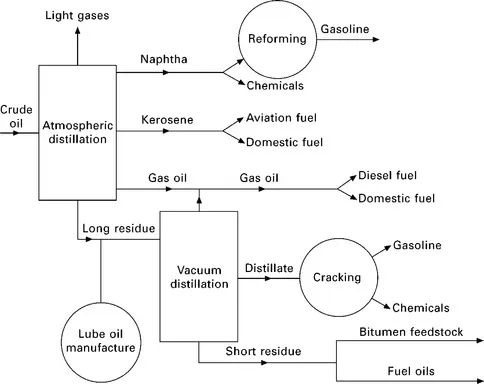
1.1 Schematic diagram of the fractional distillation of crude oil to yield bitumen feedstock. (Whiteoak, 1990)
The lighter fractions (e.g. propane and butane) come off first, followed by naphtha, kerosene and gas oil, distillates and short residue. It is this short residue which is the feedstock used in the manufacture of many different grades of bitumen. Oxygen is blown through the short residue and, depending on the temperatures and pressures used, and how much oxygen is added, different grades of bitumen are obtained. In the UK bitumen is generally classified into four grades:
1. Penetration grades: specified by penetration (British Standard 2000, Part 49: 1983) and softening point (British Standard 2000, Part 58: 1983), tests.
2. Cutback grades (to which kerosene has been added): specified by viscosity.
3. Hard grades: specified by penetration test and softening point range.
4. Oxidised grades: specified by penetration and softening point tests and also by solubility criteria.
Bitumen is considered to be a complex mixture of high molecular weight hydrocarbons and non-hydrocarbons which can be separated into fractions consisting of asphaltenes, resins, aromatics and paraffins (Traxler, 1936). Three types of hydrocarbons are present in bitumen; paraffinic, naphthenic and aromatic. Non-hydrocarbons in bitumen have heterocyclic atoms consisting of sulphur, nitrogen and oxygen. Elemental analysis of bitumen manufactured from a variety of crude oils shows that most bitumens contain:
• Carbon 82–85%
• Hydrogen 8–11%
• Sulphur 0–6%
• Oxygen 0–1.5%
• Nitrogen 0–1%.
Trace quantities of metals such as nickel, iron, vanadium, calcium, magnesium and chromium are also found in bitumen (Atherton et al., 1987).
Chemically, asphaltenes are multilayer systems containing a great variety of building blocks. Initially, Nellensteyn in 1933 proposed that asphaltenes contained a microcrystalline graphitic-type nucleus (Nellensteyn, 1933), but in 1940 Pfeiffer and Saal suggested that asphaltenes were high molecular weight hydrocarbons of an aromatic character (Pfeiffer and Saal, 1940). Exhaustive studies by Yen and co-workers (Yen et al., 1961, 1962; Yen and Erdman, 1962, 1963; Yen and Dickie, 1968), Strausz and co-workers (Ignasiak et al., 1977; Rubenstein and Strausz, 1979; Payzant et al., 1979, 1992; Rubenstein et al., 1979) and others have identified many different chemical structures in asphaltenes. The average asphaltene molecule contains a flat sheet of condensed aromatic systems which may be interconnected by sulphur, ether, aliphatic chains or naphthenic ring linkages. Gaps and holes in th...
Table of contents
- Cover image
- Title page
- Table of Contents
- Copyright
- Contributor contact details
- Part I: Types of polymer modified bitumen
- Part II: Characterisation and properties
- Index
Trusted by 375,005 students
Access to over 1.5 million titles for a fair monthly price.
Study more efficiently using our study tools.
Frequently asked questions
Yes, you can cancel anytime from the Subscription tab in your account settings on the Perlego website. Your subscription will stay active until the end of your current billing period. Learn how to cancel your subscription
No, books cannot be downloaded as external files, such as PDFs, for use outside of Perlego. However, you can download books within the Perlego app for offline reading on mobile or tablet. Learn how to download books offline
Perlego offers two plans: Essential and Complete
- Essential is ideal for learners and professionals who enjoy exploring a wide range of subjects. Access the Essential Library with 800,000+ trusted titles and best-sellers across business, personal growth, and the humanities. Includes unlimited reading time and Standard Read Aloud voice.
- Complete: Perfect for advanced learners and researchers needing full, unrestricted access. Unlock 1.5M+ books across hundreds of subjects, including academic and specialized titles. The Complete Plan also includes advanced features like Premium Read Aloud and Research Assistant.
We are an online textbook subscription service, where you can get access to an entire online library for less than the price of a single book per month. With over 1.5 million books across 990+ topics, we’ve got you covered! Learn about our mission
Look out for the read-aloud symbol on your next book to see if you can listen to it. The read-aloud tool reads text aloud for you, highlighting the text as it is being read. You can pause it, speed it up and slow it down. Learn more about Read Aloud
Yes! You can use the Perlego app on both iOS and Android devices to read anytime, anywhere — even offline. Perfect for commutes or when you’re on the go.
Please note we cannot support devices running on iOS 13 and Android 7 or earlier. Learn more about using the app
Please note we cannot support devices running on iOS 13 and Android 7 or earlier. Learn more about using the app
Yes, you can access Polymer Modified Bitumen by Tony McNally in PDF and/or ePUB format, as well as other popular books in Technology & Engineering & Industrial & Technical Chemistry. We have over 1.5 million books available in our catalogue for you to explore.