eBook - ePub
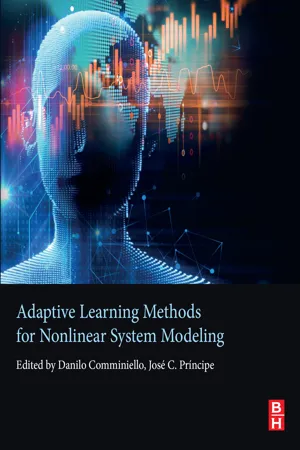
Adaptive Learning Methods for Nonlinear System Modeling
- 388 pages
- English
- ePUB (mobile friendly)
- Available on iOS & Android
eBook - ePub
Adaptive Learning Methods for Nonlinear System Modeling
About this book
Adaptive Learning Methods for Nonlinear System Modeling presents some of the recent advances on adaptive algorithms and machine learning methods designed for nonlinear system modeling and identification. Real-life problems always entail a certain degree of nonlinearity, which makes linear models a non-optimal choice. This book mainly focuses on those methodologies for nonlinear modeling that involve any adaptive learning approaches to process data coming from an unknown nonlinear system. By learning from available data, such methods aim at estimating the nonlinearity introduced by the unknown system. In particular, the methods presented in this book are based on online learning approaches, which process the data example-by-example and allow to model even complex nonlinearities, e.g., showing time-varying and dynamic behaviors. Possible fields of applications of such algorithms includes distributed sensor networks, wireless communications, channel identification, predictive maintenance, wind prediction, network security, vehicular networks, active noise control, information forensics and security, tracking control in mobile robots, power systems, and nonlinear modeling in big data, among many others.
This book serves as a crucial resource for researchers, PhD and post-graduate students working in the areas of machine learning, signal processing, adaptive filtering, nonlinear control, system identification, cooperative systems, computational intelligence. This book may be also of interest to the industry market and practitioners working with a wide variety of nonlinear systems.
- Presents the key trends and future perspectives in the field of nonlinear signal processing and adaptive learning.
- Introduces novel solutions and improvements over the state-of-the-art methods in the very exciting area of online and adaptive nonlinear identification.
- Helps readers understand important methods that are effective in nonlinear system modelling, suggesting the right methodology to address particular issues.
Information
Table of contents
- Cover image
- Title page
- Table of Contents
- Copyright
- Contributors
- Preface
- Acknowledgments
- Chapter 1: Introduction
- Part 1: Linear-in-the-Parameters Nonlinear Filters
- Chapter 2: Orthogonal LIP Nonlinear Filters
- Chapter 3: Spline Adaptive Filters
- Chapter 4: Recent Advances on LIP Nonlinear Filters and Their Applications
- Part 2: Adaptive Algorithms in the Reproducing Kernel Hilbert Space
- Chapter 5: Maximum Correntropy Criterion–Based Kernel Adaptive Filters
- Chapter 6: Kernel Subspace Learning for Pattern Classification
- Chapter 7: A Random Fourier Features Perspective of KAFs With Application to Distributed Learning Over Networks
- Chapter 8: Kernel-Based Inference of Functions Over Graphs
- Part 3: Nonlinear Modeling With Multiple Learning Machines
- Chapter 9: Online Nonlinear Modeling via Self-Organizing Trees
- Chapter 10: Adaptation and Learning Over Networks for Nonlinear System Modeling
- Chapter 11: Combined Filtering Architectures for Complex Nonlinear Systems
- Part 4: Nonlinear Modeling by Neural Systems
- Chapter 12: Echo State Networks for Multidimensional Data: Exploiting Noncircularity and Widely Linear Models
- Chapter 13: Identification of Short-Term and Long-Term Functional Synaptic Plasticity From Spiking Activities
- Chapter 14: Adaptive H∞ Tracking Control of Nonlinear Systems Using Reinforcement Learning
- Chapter 15: Adaptive Dynamic Programming for Optimal Control of Nonlinear Distributed Parameter Systems
- Index
Trusted by 375,005 students
Access to over 1.5 million titles for a fair monthly price.
Study more efficiently using our study tools.
Frequently asked questions
Yes, you can cancel anytime from the Subscription tab in your account settings on the Perlego website. Your subscription will stay active until the end of your current billing period. Learn how to cancel your subscription
No, books cannot be downloaded as external files, such as PDFs, for use outside of Perlego. However, you can download books within the Perlego app for offline reading on mobile or tablet. Learn how to download books offline
Perlego offers two plans: Essential and Complete
- Essential is ideal for learners and professionals who enjoy exploring a wide range of subjects. Access the Essential Library with 800,000+ trusted titles and best-sellers across business, personal growth, and the humanities. Includes unlimited reading time and Standard Read Aloud voice.
- Complete: Perfect for advanced learners and researchers needing full, unrestricted access. Unlock 1.5M+ books across hundreds of subjects, including academic and specialized titles. The Complete Plan also includes advanced features like Premium Read Aloud and Research Assistant.
We are an online textbook subscription service, where you can get access to an entire online library for less than the price of a single book per month. With over 1.5 million books across 990+ topics, we’ve got you covered! Learn about our mission
Look out for the read-aloud symbol on your next book to see if you can listen to it. The read-aloud tool reads text aloud for you, highlighting the text as it is being read. You can pause it, speed it up and slow it down. Learn more about Read Aloud
Yes! You can use the Perlego app on both iOS and Android devices to read anytime, anywhere — even offline. Perfect for commutes or when you’re on the go.
Please note we cannot support devices running on iOS 13 and Android 7 or earlier. Learn more about using the app
Please note we cannot support devices running on iOS 13 and Android 7 or earlier. Learn more about using the app
Yes, you can access Adaptive Learning Methods for Nonlinear System Modeling by Danilo Comminiello,Jose C. Principe in PDF and/or ePUB format, as well as other popular books in Technology & Engineering & Automation in Engineering. We have over 1.5 million books available in our catalogue for you to explore.