- 608 pages
- English
- ePUB (mobile friendly)
- Available on iOS & Android
eBook - ePub
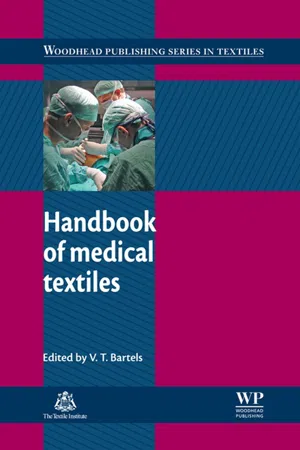
Handbook of Medical Textiles
About this book
With a rising population and the increasing range of textiles for medical products, the need to understand and improve medical textiles is gaining in importance. The Handbook of medical textiles provides an overview of the different types of medical textiles currently available as well as specific information on more specialised topics and applications.In part one, the types and properties of medical textiles are discussed, with chapters covering topics including reusable textiles, textiles for implants and textiles with cosmetic effects. Part two focuses on the interaction of textiles with the skin, examining key issues such as contact sensations, allergies and mechanical irritation. Chapters in part three provide information on the latest developments in textiles for hygiene and infection control, while part four provides a range of applications and case studies, including improvements in medical occupational clothing, medical filters and superabsorbent fibres.With its expert editor and contributions from some of the world's leading authorities, the Handbook of medical textiles is a standard reference for designers and manufacturers of medical textile products, as well as for biomaterials scientists and medical professionals.
- Explores the different types of medical textiles currently available as well as specific information on more specialised areas and applications
- Chapters cover topics such as reusable textiles, textiles for implants and interaction of textiles with the skin
- Is a standard reference for designers and manufacturers of medical textile products, as well as for biomaterials scientists and medical professionals
Information
Part I
Types and properties of medical textiles
1
Modern textiles and biomaterials for healthcare
S. Petrulyte and D. Petrulis, Kaunas University of Technology, Lithuania
Abstract:
The chapter provides the latest information on sources and main properties of medical textiles and biomaterials. It first reviews the role of textile structures and biomaterials in healthcare then describes types and key properties of textile structures and biomaterials used for medical sector. The main features of advanced examples and innovative applications of products are given. At the end of this chapter, the future of medical textile materials is discussed.
Key words
advanced products of medical textiles
biomaterials
polymers
properties of medical textiles
textile structures
1.1 Introduction
Because of innovative applications in today’s healthcare environment, the medical textile industry and research are developing at an incredible rate, with achievements in such fields as infection control, barrier materials, wound care products and medical devices. For example, some decades ago only a few kinds of nontraditional wound dressing (as opposed to traditional ones like cotton, lint, and gauzes) were available on the healthcare product market. Nowadays, the explosion in product variety, market size and segments can be observed around the world, and virtually new products are appearing on the market. Also at the centre of current research are well known and widely used cotton and other natural fibres, such as silk, flax, and hemp. These natural fibres can be given significantly improved properties using enzymatic and other advanced biotechnological procedures as well as new methods of processing and modification of usual fibres, with the aim of overcoming their drawbacks.
Many modern medical textile products are made from polymer fibre components and their modified structures. The word ‘biomaterials’ is a combination of the Greek word ‘bios’ (everything to do with life) and ‘materials’ (including substances or components with certain properties which are used as input in production or manufacturing). Biomaterials can be defined simply as natural or manufactured (man-made) materials that comprise all or part of a living structure or biomedical device. So, biomaterials are essentially used and adapted for medical applications.
A biopolymer is any organic polymer. Well-known biopolymers such as starch, proteins, peptides, etc. make up much of living structures as well as the majority of the biosphere. Biopolymers tend to have a well-defined structure and exhibit similar functions to natural material, and are built using a template-directed process. Biomaterials are the outcome of interdisciplinary subjects that involve the integration of natural and engineering sciences. Major applications of biomaterials include: sutures, joint replacements, artificial ligaments, tendons, wound dressings, blood vessels, heart valves, artificial skin, scaffolds enabling the tissue regeneration, protective structures, biomonitoring systems, etc.
The area of advanced medical textiles is significantly developing because of the major expansion in various fields such as implantable devices, medical devices, bandaging and pressure garments, wound healing, infection control and barrier materials, controlled release, hygiene products, the development of new intelligent textile products and textronis. The latest innovations in the field of medical textiles confirm the importance of modern techniques such as tissue engineering and nanoapplications and their great impact on advanced wound care structures.
Human beings are always in a dynamic state. Furthermore, the present day society is undergoing changes such as ageing of the population and increase in the life span of individuals, especially in Europe and the US. Various situations and hazards of human activity and civilisation also include transport accidents, effects of chemical materials, temperature, and other factors. So, these factors stimulate rapid movement of the medical and healthcare product market with the requirements for novel techniques and technologies for developing modern textile materials and polymers. Research in biomaterials and textile systems is oriented technically and technologically as well as functionally and effectively because of regular scientific inquiry into many new interdisciplinary aspects and novel developments. Virtually new products are regularly being approved following development by researchers. Using biotechnology it is possible to develop modern textile products, opening new markets and speeding up production. Besides, white biotechnologies are preventative, focussing on cleaner production processes.
1.2 The role of textile structures and biomaterials in healthcare
New generation medical textiles are an important and growing field. The importance of medical textiles is determined by their excellent physical, geometrical, and mechanical qualities, such as strength, extensibility, flexibility, air, vapour and liquid permeability, availability in two- or three-dimensional structures, variety in fibre length, fineness, cross-sectional shape, etc. Nowadays, textile products are able to combine traditional textile characteristics with modern multifunctionality and this role is constantly evolving.
Medical textiles should provide many specific functions depending on the scenario (healthcare monitoring or healing), application peculiarity, individuality of the patient and so on. Specialised materials with determined functions can be included in medical textiles, extending into multifunctional systems made from natural or/and manufactured (man-made) materials.
The role of medical textiles and biomaterials is determined by their leading features, depending on the final application. Such materials could be bacteriostatic, anti-viral, non-toxic, fungistatic, highly absorbent, non-allergic, breathable, haemostatic, biocompatible and incorporating medications, and can also be designed to provide reasonable mechanical properties and comfort. A wide variety of textile structures can be used for medicine and healthcare: fibre (or filament), sliver, yarn, woven, nonwoven, knitted, crochet, braided, embroidered, composite materials, etc. Medical textiles also use materials like hydrogels, matrix (tissue engineering), films, hydrocolloids, and foams. The advantage is that the materials can be used as gels, films, sponges, foams, beads, fibres, support matrices and in blends or combinations as well. Specialised additives with special functions can be introduced in advanced products with the aim of absorbing odours, providing strong antibacterial properties, reducing pain and relieving irritation. Nanofibres are used due to their unique properties such as high surface area to volume ratio, film thinness, nanoscale fibre diameter, porosity, and light weight (Petrulyte, 2008).
1.3 Types of textiles and biomaterials for medical applications
Textiles for healthcare include fibres, filaments, yarns, woven, knitted, nonwoven materials, and articles made from natural and manufactured materials as well as products utilising such raw materials. In textile products, the fibres are the main conventional structural elements. Table 1.1 shows the classification of fibres generally used for medical textiles manufacturing. The most important natural fibres for healthcare are cotton, silk and flax. These fibres are the oldest textile structures used in medical products. Meanwhile, manufactured fibres can be defined as distinct from the fibres made of natural materials. The manufactured fibres, which are applied in the healthcare sector, may be subdivided into organic and inorganic fibres. Organic fibres can be divided into two large groups based on natural and synthetic polymers. The entire spectrum of manufactured fibres from such polymers as polyester (PES), polyamide (PA), polypropylene (PP), viscose (CV) and polytetrafluoroethylene (PTFE) has found increasing application during the last decades. Polyethylene terephthalate (PET) as the most common fibre-forming PES is also used. Besides these fibres, a variety of fibrous medical materials have been derived from natural polymers, such as alginate (ALG), polylactic acid (PLA), distinct types of collagen, etc.
Table 1.1
Classification o...
Table of contents
- Cover image
- Title page
- Table of Contents
- Copyright
- Contributor contact details
- Woodhead Publishing Series in Textiles
- Preface
- Part I: Types and properties of medical textiles
- Part II: Textiles and the skin
- Part III: Textiles for hygiene
- Part IV: Medical textile case studies and applications
- Index
Trusted by 375,005 students
Access to over 1.5 million titles for a fair monthly price.
Study more efficiently using our study tools.
Frequently asked questions
Yes, you can cancel anytime from the Subscription tab in your account settings on the Perlego website. Your subscription will stay active until the end of your current billing period. Learn how to cancel your subscription
No, books cannot be downloaded as external files, such as PDFs, for use outside of Perlego. However, you can download books within the Perlego app for offline reading on mobile or tablet. Learn how to download books offline
Perlego offers two plans: Essential and Complete
- Essential is ideal for learners and professionals who enjoy exploring a wide range of subjects. Access the Essential Library with 800,000+ trusted titles and best-sellers across business, personal growth, and the humanities. Includes unlimited reading time and Standard Read Aloud voice.
- Complete: Perfect for advanced learners and researchers needing full, unrestricted access. Unlock 1.5M+ books across hundreds of subjects, including academic and specialized titles. The Complete Plan also includes advanced features like Premium Read Aloud and Research Assistant.
We are an online textbook subscription service, where you can get access to an entire online library for less than the price of a single book per month. With over 1.5 million books across 990+ topics, we’ve got you covered! Learn about our mission
Look out for the read-aloud symbol on your next book to see if you can listen to it. The read-aloud tool reads text aloud for you, highlighting the text as it is being read. You can pause it, speed it up and slow it down. Learn more about Read Aloud
Yes! You can use the Perlego app on both iOS and Android devices to read anytime, anywhere — even offline. Perfect for commutes or when you’re on the go.
Please note we cannot support devices running on iOS 13 and Android 7 or earlier. Learn more about using the app
Please note we cannot support devices running on iOS 13 and Android 7 or earlier. Learn more about using the app
Yes, you can access Handbook of Medical Textiles by V Bartels in PDF and/or ePUB format, as well as other popular books in Technology & Engineering & Medical Technology & Supplies. We have over 1.5 million books available in our catalogue for you to explore.