eBook - ePub
Energy, Resources and Environment
Papers Presented at the First U.S.-China Conference on Energy, Resources and Environment, 7-12 November 1982, Beijing, China
- 624 pages
- English
- ePUB (mobile friendly)
- Available on iOS & Android
eBook - ePub
Energy, Resources and Environment
Papers Presented at the First U.S.-China Conference on Energy, Resources and Environment, 7-12 November 1982, Beijing, China
About this book
Energy, Resources and Environment documents the first U.S.-China Conference and discusses the concerns about the world's energy situation, such as its resource, environmental effects, and possible alternative sources. The book is comprised of 72 chapters including the keynote address, five lecture papers, and 66 technical papers that are organized according to its contents, specifically the type of energy it discusses. The text begins with the keynote address, and then discusses the plenary and technical papers. The plenary papers discuss the importance of energy, resources, environment, and future development. The technical papers cover the technological advancement of alternative energy source and their application. The conference covers the following theme: chemical fuels, coal energy, electric power systems, energy conservation, geothermal and other natural energy, hydropower, ice storage for cooling, solar energy, wind energy, economic aspect of energy utilization, and impact of energy on the environment. The book will be of great interest to individuals concerned with the development of alternative energy sources. Researchers whose work involves alternative energy will be able to make use of this book as a reference material.
Trusted by 375,005 students
Access to over 1.5 million titles for a fair monthly price.
Study more efficiently using our study tools.
Information
IV
COAL ENERGY
Outline
Chapter 12: ADVANCED OPTICAL TECHNIQUES FOR DIAGNOSTICS, CONTROL AND SAFETY IN FOSSIL ENERGY CONVERSIONS
Chapter 13: AQCS FOR COAL FIRED PLANTS IN THE PEOPLE’S REPUBLIC OF CHINA (PRC)
Chapter 14: THE COAL INDUSTRY AND THE COMPREHENSIVE UTILIZATION OP COAL IN CHINA
Chapter 15: CONCEPTUAL DESIGN OF AN ADVANCED PULVERIZED-COAL POWER PLANT
Chapter 16: ENGINEERING AND COSTING COAL SLURRY PIPELINE FOR ELECTRIC UTILITIES AND PORT DELIVERY
Chapter 17: HEATING AND BURNING CHARACTERISTICS OF SINGLE COAL-WATER SLURRY DROPLET USED AS A NEW FORM OF FUEL
Chapter 18: HIGH SPEED THREE-DIMENSIONAL DIAGNOSTICS IN COMBUSTION
Chapter 19: THE PROSPECTS OF THE APPLICATION OF NEW TECHNIQUES IN THE UTILIZATION OF COAL AND OIL SHALE IN CHINA
Chapter 20: TECHNICAL ADVANCES IN COAL UTILIZATION
ADVANCED OPTICAL TECHNIQUES FOR DIAGNOSTICS, CONTROL AND SAFETY IN FOSSIL ENERGY CONVERSIONS
David L. Murphree
Director Edward J. Beiting, Project Scientist, Robert E. Stickel, Project Scientist and Rangaswami Arun Kumar, Research Associate, MHD Energy Center, Mississippi State University, Mississippi State, MS 39762
T.K. Lau
Project Manager
, Office of Coal Utilization & Extraction, Fossil Energy, U.S. Department of Energy ABSTRACT
Microprocessor-controlled, optical diagnostic instrumentation systems are being developed at Mississippi State University for the U.S. Department of Energy’s (DOE) magnetohydrodynamic (MHD) program and other fossil energy technologies. Three of these instrumentation techniques are described. The sensitivity of the temperature gradient of the combustion flame to a change in stoichiometry indicates a possible optical stoichiometric control technique. A microprocessor-controlled, packaged optical instrument for non-intrusive measurement of nitric oxide (NO) concentration in a combustion gas is described. Experimental results are presented using coherent anti-Stokes Raman spectroscopy (CARS) for spatially and temporally resolved temperature measurements in a simulated coal-fired envi ronment.
KEYWORDS
Microprocessor-controlled
optical combustion diagnostics
stoichiometric control
non-intrusive nitric oxide measurement
CARS
INTRODUCTION
On-line or in-situ techniques offer the only means to characterize a combustion process such that basic data can be obtained for modeling of the process. State-of-the-art instrumentation and techniques do not currently have the capability of measurement at process conditions to supply the information needed because of high temperature and pressure requirements.
U.S. Department of Energy (DOE) investigations are being conducted at Mississippi State University into non-intrusive optical techniques for advanced fossil energy processes to determine temporal and spatial resolution of combustion stoichiometry, nitric oxide concentration, molecular composition of gases, and combustion temperature.
This work is being conducted to remove major deficiencies existing in the diagnostics and control of these parameters, which are critical to the success of advanced fossil energy processes such as coal gasification, liquefaction, fluidized-bed combustion, magnetohydrodynamics and oil shale retorting.
OPTICAL STOICHIOMETRIC CONTROL
Experiments performed on the Mississippi State University combustion test stand have shown it is possible to determine the air/fuel stoichiometry in similar oil-fired combustion systems by making fast, relatively accurate measurements of the flame temperature gradient.
The combustion of hydrocarbons can be described in terms of three sequential and macroscopic events (Hautman and colleagues, 1981). The hydrocarbon is first transformed into smaller intermediate hydrocarbon species, then oxidized to carbon monoxide, and finally oxidized to carbon dioxide. The last two steps are the exothermic stages responsible for the release of energy during hydrocarbon oxidation. In the case of fuel-rich combustion a lesser amount of carbon monoxide is completely oxidized to carbon dioxide, and the oxidation of the hydrocarbon fragments to carbon monoxide is the main source of heat. This results in a shorter distance from the fuel injection site to the peak temperature location, compared to cases where a stoichiometric or an excess amount of air is used to burn the fuel. The peak temperature of the fuel-rich mixture is also lower than that obtained with a stoichiometric amount of air. This earlier (and lower) peak temperature for fuel-rich combustion results in lower post-combustion temperatures at downstream locations.
Combustion at the stoichiometric amount or an excess amount of air produces peak temperatures at about the same location, further downstream than the site of the peak temperature for fuel-rich combustion. Air-rich combustion produces a lower peak temperature and lower post-combustion temperatures at downstream locations than combustion with a stoichiometric amount of air.
In summary, fuel-rich flames peak further upstream than air-rich flames and both fuel-rich and air-rich combustion produce lower peak temperatures than combustion using the stoichiometric amount of air. Figure 1 shows gas temperature measurements at three locations on the combustion test stand when burning various quantities of oil (No. 1 diesel fuel oil) with a fixed flow-rate of preheated air. These measurements were made with two microprocessor-controlled, packaged sodium line reversal emission/absorption systems equipped with fiber optics, on the Mississippi State University combustion test stand.
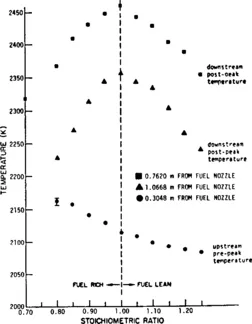
Fig. 1 The effect of stoichiometric ratio (air/fuel) on the gas stream temperature
The lowest curve shows the temperature upstream from the peak temperature location and indicates the early peaking of the gas temperatures for fuel-rich combustion. The upper two bell-shaped curves are for gas temperatures at sites downstream from the peak temperature location. The gas temperatures are lower on the fuel-rich side of the curve because of the early peaking of the gas temperature. The excess air causes the air-rich combustion temperatures to be lower than those obtained with the stoichiometric amount of air.
These tests demonstrate that the combustion stoichiometry can be determined by measuring the gas temperature at two different sites, with one site upstream and one site downstream of the general region where the peak temperature is obtained for all air/fuel ratios. The downstream post-peak temperature will be an indication of how far the stoichiometric ratio is from a value of 1.00. The upstream pre-peak temperature will be an indication that the combustion is either fuel-rich or air-rich. For every air flow-rate there will be a unique set of two gas temperatures that will indicate stoichiomietric ratio.
The key for successfully using this technique is taking fast, accurate temperature measurements. The non-intrusive sodium line reversal instruments developed at Mississippi State University are capable of the precise measurements and f...
Table of contents
- Cover image
- Title page
- Table of Contents
- Inside Front Cover
- Copyright
- ACKNOWLEDGEMENT
- CONFERENCE COMMITTEES
- INVITED AND CONTRIBUTED AUTHORS
- PREFACE
- I: KEYNOTE ADDRESS
- II: PLENARY LECTURES
- III: CHEMICAL FUELS
- IV: COAL ENERGY
- V: ELECTRIC POWER SYSTEMS
- VI: ENERGY CONSERVATION
- VII: GEOTHERMAL AND OTHER NATURAL ENERGY
- VIII: HYDROPOWER
- IX: ICE STORAGE FOR COOLING
- X: SOLAR ENERGY
- XI: WIND ENERGY
- XII: ECONOMIC ASPECT OF ENERGY UTILIZATION
- XIII: IMPACT OF ENERGY ON THE ENVIRONMENT
Frequently asked questions
Yes, you can cancel anytime from the Subscription tab in your account settings on the Perlego website. Your subscription will stay active until the end of your current billing period. Learn how to cancel your subscription
No, books cannot be downloaded as external files, such as PDFs, for use outside of Perlego. However, you can download books within the Perlego app for offline reading on mobile or tablet. Learn how to download books offline
Perlego offers two plans: Essential and Complete
- Essential is ideal for learners and professionals who enjoy exploring a wide range of subjects. Access the Essential Library with 800,000+ trusted titles and best-sellers across business, personal growth, and the humanities. Includes unlimited reading time and Standard Read Aloud voice.
- Complete: Perfect for advanced learners and researchers needing full, unrestricted access. Unlock 1.5M+ books across hundreds of subjects, including academic and specialized titles. The Complete Plan also includes advanced features like Premium Read Aloud and Research Assistant.
We are an online textbook subscription service, where you can get access to an entire online library for less than the price of a single book per month. With over 1.5 million books across 990+ topics, we’ve got you covered! Learn about our mission
Look out for the read-aloud symbol on your next book to see if you can listen to it. The read-aloud tool reads text aloud for you, highlighting the text as it is being read. You can pause it, speed it up and slow it down. Learn more about Read Aloud
Yes! You can use the Perlego app on both iOS and Android devices to read anytime, anywhere — even offline. Perfect for commutes or when you’re on the go.
Please note we cannot support devices running on iOS 13 and Android 7 or earlier. Learn more about using the app
Please note we cannot support devices running on iOS 13 and Android 7 or earlier. Learn more about using the app
Yes, you can access Energy, Resources and Environment by S.W. Yuan in PDF and/or ePUB format, as well as other popular books in Social Sciences & Social Science Research & Methodology. We have over 1.5 million books available in our catalogue for you to explore.