- 310 pages
- English
- ePUB (mobile friendly)
- Available on iOS & Android
eBook - ePub
Contextual Inquiry for Medical Device Design
About this book
Contextual Inquiry for Medical Device Design helps users understand the everyday use of medical devices and the way their usage supports the development of better products and increased market acceptance.
The text explains the concept of contextual inquiry using real-life examples to illustrate its application. Case studies provide a frame of reference on how contextual inquiry is successfully used during product design, ultimately producing safer, improved medical devices.
- Presents the ways contextual inquiry can be used to inform the evaluation and business case of technology
- Helps users understand the everyday use of medical devices and the way their usage supports the development of better products
- Includes case studies that provide a frame of reference on how contextual inquiry is successfully used during the product design process
Information
Chapter 1
Introduction to Contextual Inquiry
Mary Beth Privitera, University of Cincinnati and Know Why Design, LLC, Cincinnati, Ohio, USA
Contextual inquiry (CI) is a systematic study of people, tasks, procedures, and environments in their work places. It is a commonly used method in user-centered design as the basis for product design decisions and strategy. The method was originally described in the work of Beyer and Holzblatt. The CI research approach is seemingly casual to the study participants, but when done properly for medical device development, it involves rigorous data analysis and robust determination of the social and physical environments of the workplace through the use of tools that dissect individual task and user behaviors. For the purposes of medical device development (MDD), CI is used to create a body of information about the habits, devices, constraints, and/or systems delivery of care. The accumulated body of information can be used to determine product strategies and to assess how current devices are actually used in the field highlighting specific use patterns and behaviors. Additionally, it can be used for the purposes of optimizing existing devices, training, and a means of collaborating with users. The majority of literature available on CI methods focuses on user interaction design intended for the design of software systems.
Keywords
Contextual inquiry; medical device development; ethnography; ethnomethodology; clinical trial
1.1 Background and Introduction
Contextual inquiry (CI) is a systematic study of people, tasks, procedures, and environments in their work places. It is a commonly used method in user-centered design as the basis for product design decisions and strategy. The method was originally described in the work of Beyer and Holzblatt (1999). The CI research approach is seemingly casual to the study participants, but when done properly, it involves rigorous data analysis and robust determination of the social and physical environments of the workplace through the use of tools that dissect individual task and user behaviors. For the purposes of medical device development (MDD), CI is used to create a body of information about the habits, devices, constraints, and/or systems in the delivery of care. The accumulated body of information can be used to determine product strategies and to assess how current devices are actually used in the field highlighting specific use patterns and behaviors. Additionally, it can be used for the purposes of optimizing existing devices, training, and a means of collaborating with users. The majority of literature available on CI methods focuses on user interaction design intended for the design of software systems.
The work of Beyer and Holzblatt has provided a basic framework for CI, with a specific focus on human–computer interface, and has led to a host of research in specific fields highlighting unique user challenges through the process of observation and interview. This book builds on their initial work and is focused on using CI for the purposes of designing and developing medical devices. It describes the processes of conducting CI in various health care environments, including guidance on how to navigate typical challenges with data collection. It further explains, when in the medical device design process it is appropriate to implement this research in order to both achieve optimal design and address new compliance requirements. Case studies are used to illustrate potential processes and applications of CI highlighting research methodologies that integrate observation and interview techniques commonly used in the healthcare environment; these methodologies are consistent with the Association for the Advancement of Medical Instrumentation Technical Information Report #51 on Contextual Inquiry.
The processes presented represent experiences from the author with additional case study contributions from experienced colleagues with full recognition that the methods presented here may not be exhaustive. The fundamental elements of a CI study are that they are flexible and adaptable, therefore evolving. A CI study is rarely completed exactly the same a second time, as those who would be study participants are likely to change and the agenda of discovery has advanced. The breadth of medical device demands for CI is stark; the device spectrum runs the gamut of simple sutures to complex robots, while study goals extend from seeking radical procedure shifts through confirmation of product graphics as a risk mitigation. Additionally, as a general rule variability in CI studies can be high; this is especially true in the practice of medicine as each patient can represent a separate set of challenges. Comparisons can be challenging. The methods presented here are a combination and integration of qualitative research techniques, contextual design, and creativity for the purposes of product design.
1.1.1 CI or Ethnography?
CI and ethnography are terms often used as synonyms. Schuler presents the commonality with ethnography in that “CI is an adaptation of ethnographic research methods to fit the time and resource constraints of engineering” (Schuler and Namioka, 1993). CI is rooted in the importance of analyzing interactions among devices, people, and their workplace. This technique is also a real-time observation of interactions in the real work environment and captures design-informing behaviors and intentions that are not easily gleamed from interviews, surveys, or reports of adverse events alone (Spinuzzi, 2000, 2005).
The design industry started to hire ethnographers in the 1970s (Koshinen et al., 2011). For the purposes of design, ethnography is used to understand the “micro-cultures” or user behaviors relevant to a specific product design within their use context. In the 1990s, when computers moved into the workplace, design began to adopt ethnographic methods for conducting user research (Crabtree et al., 2012). As these methods developed, design teams gained greater appreciation of the real work extended by users as well as the real-time character of each work step within an organization of activities (Crabtree, 1998). Major companies hired several anthropologists in the 1990s, including Apple (1994) and Intel (1996). Design firms, such as IDEO and Fitch, also began to adopt ethnographic field research methods for their clients (Koshinen et al., 2011). With the continuous advent of emerging technologies in the medical field, user research has similarly become more crucial for developing medical products. MDD ethnographic research or CI entails studying the behaviors of specific medical device users in their work environments. Ethnography informs designers who might otherwise design based on their own opinions and assumptions, which they impose their worldview of users (Spinuzzi, 2000).
The practice of ethnography for design requires a technique where the user is observed and interviewed in order to inform design. It is a form of applied social science that draws from sociology, anthropology, and ethnomethodology (Steen, 2011) and leverages an immersive approach that requires analytic assessment. It is not just about going out and observing; an ethnographic research team must have data collection methods, clear objectives, and analytical perspective to assure a methodical process that yields actionable data. Ethnography goes beyond the method of task analysis, wherein the specific tasks and tool uses are discovered. This includes the uncovering of social and environmental factors that affect how someone does their work. In the practice of ethnography, social scientists may dwell for long periods with their study participants. Their immersive data collection period may take years. In contrast, a CI study is a more focused study for the purposes of product development albeit software or hardware. It uncovers practical action and practical reasoning, and provides empirical topics that can be analyzed while seeking to answer “What do users do and what kind of reasoning is involved in doing it?”(Crabtree et al., 2012). CI is typically a one-way communication from the user to the researcher. In this method, researchers and designers observe users and their actions embedded in social and cultural contexts, while seeking their opinions. The study participant is the mentor, and the researcher, the mentee. The practice of CI is intended to not only inform design but also provide a richness of information to assist in the negotiation of design elements. Of note, there are limitations to this technique as it only describes current practices and may not capture future dreams and perceptions unless specifically queried. For true ethnographic researchers, CI is often considered a less rigorous approach as it is often very qualitative and relies on the researcher to make inferences about the situation.
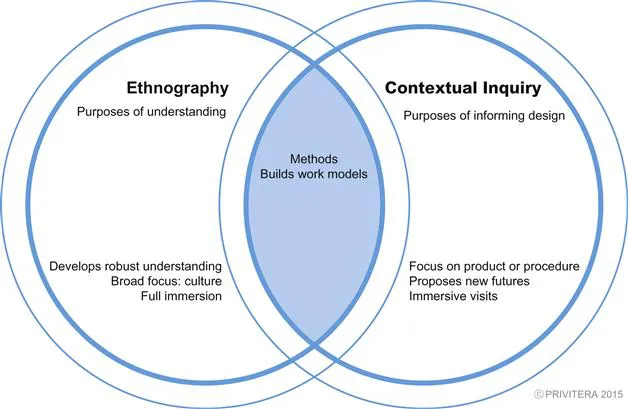
CI is a form of ethnography. Ethnography is a broader methodology that encompasses more investigative techniques than interviewing and studying user in their work environment. Figure 1.1 illustrates that both research techniques use the same methods and build models; however, their purposes are different. Ethnography has a more broad approach, whereas CI is focused on informing design. CI is like ethnography in that the methods include observations and interviews of a particular work group and break down their steps, behaviors, and opinions in a methodical manner, then develops various models to develop an understanding of the user. However, unlike ethnography, once those work models are understood and diagrammed, they are redesigned with a new perspective (Spinuzzi, 2000, 2005). Thus envisioning a new future. In MDD, this new perspective is product opportunity and definition.
CI methods involve part observation and part interview in the users’ workplace, while they complete a task: note the similarity to the description of ethnography. It goes beyond observation to making inquiries regarding specific tools or procedures, while the user is interacting in their workplace. Spinuzzi deduces CI is explicitly structured as a field method oriented toward design. It involves short, targeted observations, and conversational interviews c...
Table of contents
- Cover image
- Title page
- Table of Contents
- Copyright
- List of Contributors
- Foreword by Thomas Fogarty
- Foreword by Peter Curry
- Foreword by William S. Ball
- Foreword by Arthur Pancioli
- Preface
- Acknowledgments
- Chapter 1. Introduction to Contextual Inquiry
- Chapter 2. Planning a CI Study for Medical Device Development
- Chapter 3. Contextual Inquiry Methods
- Chapter 4. Executing and Documenting a CI Study
- Chapter 5. Data Analysis
- Chapter 6. Developing Insights
- Chapter 7. Data Visualization and Communication
- Case Study Introduction
- Chapter 8. A CI Study in Cerebral Angiography for Product Development Strategy and Clinical Training
- Chapter 9. BioMarker Strategies SnapPath® Case Study: Design Research Program to Integrate a Breakthrough Diagnostic System into the Clinical Environment
- Chapter 10. Contextual Inquiry as a Tool for Medical-Device Development: The Case of Harmonic Focus
- Chapter 11. Using CI to Inform Design Development of an Incision and Drain Packing Device for Use in Emergency Medicine
- Chapter 12. Quick Reference and FAQ
- Index
Trusted by 375,005 students
Access to over 1.5 million titles for a fair monthly price.
Study more efficiently using our study tools.
Frequently asked questions
Yes, you can cancel anytime from the Subscription tab in your account settings on the Perlego website. Your subscription will stay active until the end of your current billing period. Learn how to cancel your subscription
No, books cannot be downloaded as external files, such as PDFs, for use outside of Perlego. However, you can download books within the Perlego app for offline reading on mobile or tablet. Learn how to download books offline
Perlego offers two plans: Essential and Complete
- Essential is ideal for learners and professionals who enjoy exploring a wide range of subjects. Access the Essential Library with 800,000+ trusted titles and best-sellers across business, personal growth, and the humanities. Includes unlimited reading time and Standard Read Aloud voice.
- Complete: Perfect for advanced learners and researchers needing full, unrestricted access. Unlock 1.5M+ books across hundreds of subjects, including academic and specialized titles. The Complete Plan also includes advanced features like Premium Read Aloud and Research Assistant.
We are an online textbook subscription service, where you can get access to an entire online library for less than the price of a single book per month. With over 1.5 million books across 990+ topics, we’ve got you covered! Learn about our mission
Look out for the read-aloud symbol on your next book to see if you can listen to it. The read-aloud tool reads text aloud for you, highlighting the text as it is being read. You can pause it, speed it up and slow it down. Learn more about Read Aloud
Yes! You can use the Perlego app on both iOS and Android devices to read anytime, anywhere — even offline. Perfect for commutes or when you’re on the go.
Please note we cannot support devices running on iOS 13 and Android 7 or earlier. Learn more about using the app
Please note we cannot support devices running on iOS 13 and Android 7 or earlier. Learn more about using the app
Yes, you can access Contextual Inquiry for Medical Device Design by Mary Beth Privitera in PDF and/or ePUB format, as well as other popular books in Technology & Engineering & Biomedical Science. We have over 1.5 million books available in our catalogue for you to explore.