eBook - ePub
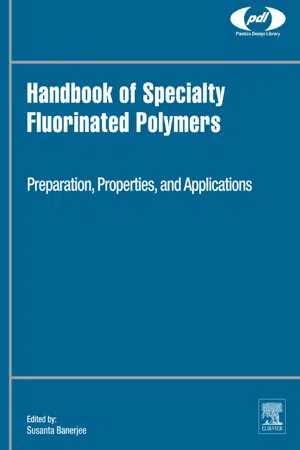
Handbook of Specialty Fluorinated Polymers
Preparation, Properties, and Applications
- 340 pages
- English
- ePUB (mobile friendly)
- Available on iOS & Android
eBook - ePub
Handbook of Specialty Fluorinated Polymers
Preparation, Properties, and Applications
About this book
Fluoropolymers are used in applications demanding service at enhanced temperature while maintaining their structural integrity and have excellent combination of chemical, physical and mechanical properties. Advancements in materials and processing technology mean that a huge amount of research is currently taking place into new, high performance applications for specialty fluorinated polymers.
This book is a complete review of the current research in synthesizing new fluorinated high performance polymers and their application in the field of low dielectric constant materials, membrane based separation (gas and liquid) and proton exchange membranes. Special emphasis is given to the preparation of soluble high performance polymers by incorporating fluorine and different structural elements so as to use these classes of polymers in different membrane based applications, including low dielectric constant materials, gas separation, pervaporation, proton exchange membranes in fuel cells, and more.
The coverage of processing properties and commercial aspects - as well as a practical assessment of the advantages and disadvantages of specialty fluoropolymers compared to other materials - enables engineers and product designers to apply the latest scientific developments in this area in a practical setting.
- Thorough coverage of modern applications for specialty fluorinated polymers, including membranes and coatings – giving insight into recent research and the future direction of this technology
- Brings researchers and engineers up to date with the latest developments in specialty fluoropolymers, to assist in future materials research and part design
- Includes detailed assessment of the advantages and shortcomings of specialty fluorinated polymers, for ease of comparison with alternative materials
Information
1
Introduction to Semifluorinated High-Performance Polymers
Susanta Banerjee Materials Science Centre, Indian Institute of Technology, Kharagpur, West Bengal, India
Abstract
High-performance polymers are the class of polymers known for their outstanding thermal and mechanical performance, better weather and chemical resistance, and many other properties. The major problem with this class of polymers is its poor processability. Incorporation of fluorine in these polymers rendered many important changes in their properties, including processability. This chapter discusses a few important properties of fluorine that make it different from other elements and impart many unique properties once incorporated in high-performance polymers.
Keywords
High-performance polymers; Role of fluorine in polymers; Structure and bonding; Uniqueness of fluorine1.1. General Introduction to High-Performance Polymers
Tremendous activity regarding the synthesis and development of high-performance and high-temperature polymers has occurred over the past 50 years [1–6]. Development of this class of polymers arose mainly from the demand for newer materials that required a diverse range of applications, including the aerospace, automotive, and microelectronic industries. High-performance polymers are used in many applications that demand service at a high temperature while maintaining structural integrity. In addition, the materials required in these applications need to have a combination of chemical, physical, and mechanical properties, e.g., high glass transition temperatures, toughness, good adhesion, oxidative and thermal stability, and low dielectric constant. A large number of polymers have been developed and their suitability has been evaluated for these robust applications. Some important classes of polymers in this respect are poly(arylene ether)s and aromatic polyimides, polyamides, and polybenzazoles. The major drawback of these classes of polymers is their processing difficulty. These classes of polymers are mostly infusible and insoluble in common organic solvents, which restricts processability from their melt or solution. Because of their poor solubility in common organic solvents and high softening temperature, use of these polymers in industrial applications is limited. The presence of a rigid backbone in the polymer structure (inherent macromolecular rigidity or semicrystallinity) and strong inter-chain forces were the main reasons for poor processability. Thus, a great amount of work has been directed through macromolecular engineering toward making these polymers more tractable, soluble, and processable without sacrificing their high-performance characteristics. The important approaches that have been adopted to obtain soluble or tractable polymers are the introduction of flexible linkage, bulky substituents, and bulky units within the polymer backbone, non-coplanar or alicyclic monomers, or disrupting the symmetry of the polymer chain via co-polymerization. Introduction of these structural elements in polymers reduced several types of polymer inter-chain interactions, chain packing, and charge transfer electronic polarization interactions, and thus promoted both solubility and flowability. An important commercial example in which all of these concepts have been used is Ultem® 1000, developed by General Electric company. This polymer exhibits reasonable thermal stability, good mechanical properties, and excellent moldability.
One of the approaches to make organo-soluble polymer is the preparation of semifluorinated polymers. Over the past 30 years or more there has been spectacular growth in research in the field of fluorinated polymers [7–9]. It has been observed that incorporation of fluorine in the form of trifluoromethyl (–CF3) or hexafluoroisopropylidene [-C(CF3)2-] (6F) groups into the polymer chain increases solubility, thermal stability, flame resistance, glass transition temperature, oxidation resistance, optical transparency, and environmental stability while decreasing crystallinity, dielectric constant, water absorption, and color. This has led to the preparation of several classes of fluorine-containing polymers. Retention of high thermal stability in polymer containing the fluoro group is attributed to the strong C–F bond. The decrease in color results from disturbed conjugation by 6F groups when placed between the aromatic rings, interrupting the extended π-system. The bulky 6F groups also serve to increase the fractional free volume of the polymer, thus improving its electrical insulating characteristics.
1.2. Uniqueness of Fluorine
Fluorine is represented by the symbol F and its atomic number is 9, with an electronic configuration of 1s2 2s2 2p5. It exists as a pale yellow diatomic gas and is the lightest element in the halogen family. It usually forms F− because it is extremely electronegative and a strong oxidizing agent. Gaseous F2 absorbs the highest energy light (violet light) and it appears p...
Table of contents
- Cover image
- Title page
- Table of Contents
- Series Editor
- Copyright
- Contributors
- 1. Introduction to Semifluorinated High-Performance Polymers
- 2. Fluorinated Poly(Arylene Ether)s: Synthesis, Properties, and Applications
- 3. Fluorinated Polyimides: Synthesis, Properties, and Applications
- 4. Fluorinated Polyamides: Synthesis, Properties, and Applications
- 5. Fluorinated Polyazoles: Synthesis, Properties, and Applications
- 6. Fluorosilicones and Other Fluoropolymers: Synthesis, Properties, and Applications
- Index
Trusted by 375,005 students
Access to over 1.5 million titles for a fair monthly price.
Study more efficiently using our study tools.
Frequently asked questions
Yes, you can cancel anytime from the Subscription tab in your account settings on the Perlego website. Your subscription will stay active until the end of your current billing period. Learn how to cancel your subscription
No, books cannot be downloaded as external files, such as PDFs, for use outside of Perlego. However, you can download books within the Perlego app for offline reading on mobile or tablet. Learn how to download books offline
Perlego offers two plans: Essential and Complete
- Essential is ideal for learners and professionals who enjoy exploring a wide range of subjects. Access the Essential Library with 800,000+ trusted titles and best-sellers across business, personal growth, and the humanities. Includes unlimited reading time and Standard Read Aloud voice.
- Complete: Perfect for advanced learners and researchers needing full, unrestricted access. Unlock 1.5M+ books across hundreds of subjects, including academic and specialized titles. The Complete Plan also includes advanced features like Premium Read Aloud and Research Assistant.
We are an online textbook subscription service, where you can get access to an entire online library for less than the price of a single book per month. With over 1.5 million books across 990+ topics, we’ve got you covered! Learn about our mission
Look out for the read-aloud symbol on your next book to see if you can listen to it. The read-aloud tool reads text aloud for you, highlighting the text as it is being read. You can pause it, speed it up and slow it down. Learn more about Read Aloud
Yes! You can use the Perlego app on both iOS and Android devices to read anytime, anywhere — even offline. Perfect for commutes or when you’re on the go.
Please note we cannot support devices running on iOS 13 and Android 7 or earlier. Learn more about using the app
Please note we cannot support devices running on iOS 13 and Android 7 or earlier. Learn more about using the app
Yes, you can access Handbook of Specialty Fluorinated Polymers by Susanta Banerjee in PDF and/or ePUB format, as well as other popular books in Technology & Engineering & Materials Science. We have over 1.5 million books available in our catalogue for you to explore.