- 642 pages
- English
- ePUB (mobile friendly)
- Available on iOS & Android
eBook - ePub
Microbial Biodegradation and Bioremediation
About this book
Microbial Biodegradation and Bioremediation brings together experts in relevant fields to describe the successful application of microbes and their derivatives for bioremediation of potentially toxic and relatively novel compounds. This single-source reference encompasses all categories of pollutants and their applications in a convenient, comprehensive package.
Our natural biodiversity and environment is in danger due to the release of continuously emerging potential pollutants by anthropogenic activities. Though many attempts have been made to eradicate and remediate these noxious elements, every day thousands of xenobiotics of relatively new entities emerge, thus worsening the situation. Primitive microorganisms are highly adaptable to toxic environments, and can reduce the load of toxic elements by their successful transformation and remediation.
- Describes many novel approaches of microbial bioremediation including genetic engineering, metagenomics, microbial fuel cell technology, biosurfactants and biofilm-based bioremediation
- Introduces relatively new hazardous elements and their bioremediation practices including oil spills, military waste water, greenhouse gases, polythene wastes, and more
- Provides the most advanced techniques in the field of bioremediation, including insilico approach, microbes as pollution indicators, use of bioreactors, techniques of pollution monitoring, and more
Information
Topic
Physical SciencesSubtopic
Environmental Science1
Microbial Bioremediation
A Potential Tool for Restoration of Contaminated Areas
Surajit Das and Hirak R. Dash, Laboratory of Environmental Microbiology and Ecology (LEnME), Department of Life Science, National Institute of Technology, Rourkela, Odisha, India
Due to rapid industrialization and large-scale anthropogenic activities, the pollution level is increasing at a rapid rate, which is a major concern. Though many remediation techniques are available, the use of microorganisms has many advantages like cost effectiveness, few or no by-products, reusability, and more. Microorganisms are readily available, rapidly characterized, highly diverse, omnipresent, and can use many noxious elements as their nutrient source. They can be applied in both in situ and ex situ conditions; in addition, many extreme environmental conditions can be cleaned by such entities. Most countries do not restrict industrialization in spite of increased pollution levels; however, these can be minimized using suitable remedial measures, particularly where microorganisms provide a useful tool for a better alternative. In this chapter, the role of microbes in bioremediation, their superiority over other mechanisms, and the implications of such tiny organisms for cleaning the environment will be discussed.
Keywords
Bioremediation; bacteria; genetic manipulation; extreme environment
1.1 Introduction
More than 1 billion people around the world cannot get healthy air to breathe; 3 million die annually due to air pollution (WHO, 2006). This century has witnessed the warmest quarter in recorded history (from September 2003 to November 2003). Globally, over 1 million seabirds and thousands of sea mammals are killed by pollution every year. Each year 1.2 trillion gallons of untreated sewage and industrial waste are dumped into waterways by the United States alone. More than 3 million children under the age of 5 die annually from various environmental pollutions (EPA, 2000). These statistics not only give us a clear understanding of the precarious conditions at present, but warn us to think today about a better tomorrow. An unprecedented increase in population, anthropogenic activities, and urbanization in the name of modernization have increased pollutants to critical levels. In day-to-day life, we use more than 60,000 chemicals in the form of fuels, consumer products, industrial solvents, drugs, pesticides, fertilizers, and food additives. Though industrialization is essential for the faster growth of the developing nations, its concomitant pollution level should not come without sustainable management. Hence, proper management policy, suitable remedial strategies, and sustainable utilization of resources without altering the natural ecosystem should be the prime aim of all researchers and decision-making bodies.
In this context, microorganisms play an important role in the maintenance and sustainability of any ecosystem as they are more capable of rapid adjustment towards environmental changes and deterioration. Microorganisms are considered to be the first life forms to have evolved; they are versatile and adaptive to various challenging environmental conditions. Microorganisms are omnipresent, and they impact the entire biosphere. They play a major role in regulating biogeochemical cycles, from extreme environmental conditions like frozen environments, acidic lakes, hydrothermal vents, bottoms of deep oceans, to the small intestines of animals (Seigle-Murandi et al., 1996). Microorganisms are responsible for carbon fixation, nitrogen fixation, methane metabolism, and sulfur metabolism, thus controlling the global biogeochemical cycling (Das et al., 2006). They produce diverse metabolic enzymes that can be employed for the safe removal of contaminants, which can be achieved either by direct destruction of the chemical or through transformation of the contaminants to a safer or lesser toxic intermediate (Dash and Das, 2012). Due to their versatility, microorganisms have provided a useful platform to be used for an enhanced model of bioremediation of heavy metals, hydrocarbons, polythenes, food wastes, greenhouse gases, etc. as discussed in the subsequent chapters.
1.2 Pollution: A Major Global Problem
The pollution crisis is a major problem all around the globe. It adversely affects millions of people every year, causing many health disorders and deaths. Although urban areas are usually more polluted than the countryside, pollution can also spread to remote places; for example, pesticides and other chemicals have been found in the Antarctic ice sheet. In the middle of the northern Pacific Ocean, a large collection of microscopic plastic particles are found in what is known as the Great Pacific Garbage Patch. Pollutants can be moved from one place to another through land, water, and the atmosphere, worsening the situation day by day (Figure 1.1). Air and water currents carry pollution, ocean currents and migrating fish carry marine pollutants far and wide, and the wind can pick up and scatter radioactive material accidentally released from a nuclear reactor or smoke from a factory from one country into another (Doney et al., 2012). Thus, pollution does not believe in the limitations of geographical boundaries.
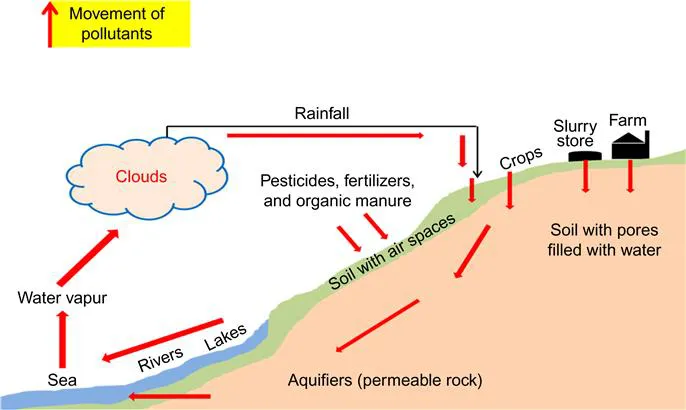
There are many major pollution-causing agents found around the globe, i.e., oil spills, fertilizers, garbage, sewage disposals, toxic chemicals. All of them contribute to global pollution in the form of soil, air, water, and marine environmental pollution. Fifty-three chemicals have been identified by United States Environmental Protection Agency as persistent, bioaccumulative, and toxic among 87,000 commercial chemicals (USEPA, 2000). Contamination may be defined as the presence of elevated concentrations of substances in the environment which may or may not be harmful for society. However, pollution is the deliberate introduction of the noxious elements by human beings into the environment, resulting in a toxic effect. These contaminants may be produced due to various natural as well as anthropogenic activities like the large-scale manufacturing of chemicals as well as their processing and handling. The pollution level has increased at a rapid pace throughout the globe and is a major concern for developed as well as developing nations. A comparative detail of air pollution in terms of CO2 emission and generation of municipal waste has been given in Table 1.1.
Table 1.1
A Comparative Account of CO2 Emission and Generation of Municipal Waste Throughou...
Table of contents
- Cover image
- Title page
- Table of Contents
- Copyright
- Preface
- Biography
- List of Contributors
- 1. Microbial Bioremediation: A Potential Tool for Restoration of Contaminated Areas
- 2. Heavy Metals and Hydrocarbons: Adverse Effects and Mechanism of Toxicity
- 3. Nanotoxicity: Aspects and Concerns in Biological Systems
- 4. Application of Molecular Techniques for the Assessment of Microbial Communities in Contaminated Sites
- 5. Microbial Indicators for Monitoring Pollution and Bioremediation
- 6. Mercury Pollution and Bioremediation—A Case Study on Biosorption by a Mercury-Resistant Marine Bacterium
- 7. Biosurfactant-Based Bioremediation of Toxic Metals
- 8. Biofilm-Mediated Bioremediation of Polycyclic Aromatic Hydrocarbons
- 9. Nanoremediation: A New and Emerging Technology for the Removal of Toxic Contaminant from Environment
- 10. Bioremediation Using Extremophiles
- 11. Role of Actinobacteria in Bioremediation
- 12. Biology, Genetic Aspects, and Oxidative Stress Response of Streptomyces and Strategies for Bioremediation of Toxic Metals
- 13. Bacterial and Fungal Bioremediation Strategies
- 14. Microbial Bioremediation of Industrial Effluents
- 15. Phycoremediation Coupled with Generation of Value-Added Products
- 16. Feasibility of Using Bioelectrochemical Systems for Bioremediation
- 17. Microbial Bioremediation: A Metagenomic Approach
- 18. In Silico Approach in Bioremediation
- 19. Microalgae in Bioremediation: Sequestration of Greenhouse Gases, Clearout of Fugitive Nutrient Minerals, and Subtraction of Toxic Elements from Waters
- 20. Bioreactor and Enzymatic Reactions in Bioremediation
- 21. Microbiological Metabolism Under Chemical Stress
- 22. Bioremediation of Pesticides: A Case Study
- 23. Microalgae in Removal of Heavy Metal and Organic Pollutants from Soil
- 24. Bioremediation of Aquaculture Effluents
- 25. Aquifer Microbiology at Different Geogenic Settings for Environmental Biogeotechnology
- 26. Exploring Prospects of Monooxygenase-Based Biocatalysts in Xenobiotics
Trusted by 375,005 students
Access to over 1.5 million titles for a fair monthly price.
Study more efficiently using our study tools.
Frequently asked questions
Yes, you can cancel anytime from the Subscription tab in your account settings on the Perlego website. Your subscription will stay active until the end of your current billing period. Learn how to cancel your subscription
No, books cannot be downloaded as external files, such as PDFs, for use outside of Perlego. However, you can download books within the Perlego app for offline reading on mobile or tablet. Learn how to download books offline
Perlego offers two plans: Essential and Complete
- Essential is ideal for learners and professionals who enjoy exploring a wide range of subjects. Access the Essential Library with 800,000+ trusted titles and best-sellers across business, personal growth, and the humanities. Includes unlimited reading time and Standard Read Aloud voice.
- Complete: Perfect for advanced learners and researchers needing full, unrestricted access. Unlock 1.5M+ books across hundreds of subjects, including academic and specialized titles. The Complete Plan also includes advanced features like Premium Read Aloud and Research Assistant.
We are an online textbook subscription service, where you can get access to an entire online library for less than the price of a single book per month. With over 1.5 million books across 990+ topics, we’ve got you covered! Learn about our mission
Look out for the read-aloud symbol on your next book to see if you can listen to it. The read-aloud tool reads text aloud for you, highlighting the text as it is being read. You can pause it, speed it up and slow it down. Learn more about Read Aloud
Yes! You can use the Perlego app on both iOS and Android devices to read anytime, anywhere — even offline. Perfect for commutes or when you’re on the go.
Please note we cannot support devices running on iOS 13 and Android 7 or earlier. Learn more about using the app
Please note we cannot support devices running on iOS 13 and Android 7 or earlier. Learn more about using the app
Yes, you can access Microbial Biodegradation and Bioremediation by Surajit Das in PDF and/or ePUB format, as well as other popular books in Physical Sciences & Environmental Science. We have over 1.5 million books available in our catalogue for you to explore.