eBook - ePub
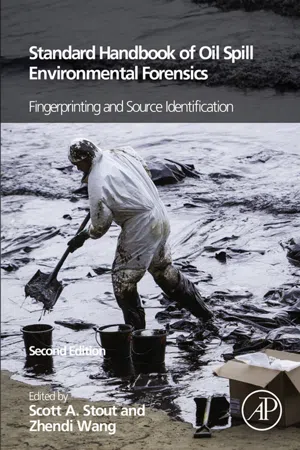
Standard Handbook Oil Spill Environmental Forensics
Fingerprinting and Source Identification
- 1,142 pages
- English
- ePUB (mobile friendly)
- Available on iOS & Android
eBook - ePub
Standard Handbook Oil Spill Environmental Forensics
Fingerprinting and Source Identification
About this book
Standard Handbook Oil Spill Environmental Forensics: Fingerprinting and Source Identification, Second Edition, provides users with the latest information on the tools and methods that have become popular over the past ten years.
The book presents practitioners with the latest environmental forensics techniques and best practices for quickly identifying the sources of spills, how to form an effective response, and how to determine liability. This second edition represents a complete overhaul of the existing chapters, and includes 13 new chapters on methods and applications, such as emerging application of PAHi isomers in oil spill forensics, development and application of computerized oil spill identification (COSI), and fingerprinting of oil in biological and passive sampling devices.
- Contains 13 new chapters on methods and applications, including emerging application of PAH isomers in oil drill forensics, the development and application of computerized oil spill identification (COSI), and the fingerprinting of oil in biological and passive sampling devices
- Presents the latest technology and methods in biodegradation of oil hydrocarbons and its implications for source identification, surface trajectory modeling of marine oil spills, and identification of hydrocarbons in biological samples for source determination
- Contains new case studies to illustrate key applications, methods, and techniques
Information
1
Spill site characterization in environmental forensic investigations
Ed H. Owens*
Elliott Taylor**
Heather A. Parker†
* President, Owens Coastal Consultants, Inc., Bainbridge Island, WA, USA
** Principal, Polaris Applied Sciences, Inc., Kirkland, WA, USA
† District Response Advisory Team, Thirteenth District, United States Coast Guard, Seattle, WA, USA
* President, Owens Coastal Consultants, Inc., Bainbridge Island, WA, USA
** Principal, Polaris Applied Sciences, Inc., Kirkland, WA, USA
† District Response Advisory Team, Thirteenth District, United States Coast Guard, Seattle, WA, USA
Abstract
Characterization of a spill site and the affected area is the necessary first step to determine the nature and scale of the problem and to identify environmental and acute safety issues before conducting a forensic investigation. A key immediate objective is to define the area affected by the spill, describe the oil distribution and character, forecast where the oil will be transported, and estimate the persistence in order to understand the potential safety and environmental risks associated with the spill. Delineation of the geographic extent and boundaries of a spill is usually straightforward for oil on the surface but can be problematic if the oil originates from a subsurface leak, penetrates into sediments, is mixed into river waters by turbulence, or sinks into a water body. Samples of the spilled oil are collected to identify the source in the case of a “mystery” spill and to determine the toxicity and potential impacts of the spill. Time is of the essence to initiate an investigation, as spills typically involve a dynamic and ever-changing situation, particularly for spills onto oceans, lakes, and rivers. The survey program design should include a sampling plan with QA/QC and a data management plan to ensure that a comprehensive, systematic investigation is conducted.
Keywords
delineation
environmental
monitoring
risk
safety
sampling
SCAT
1.1. Introduction
The first step in all forensic investigations surrounding surface oil spills is to characterize the spill site and the affected area to determine the nature and scale of the problem and to identify acute safety issues. Scaling the problem is critical to a forensic investigation and involves essentially defining the source, type, amount, and location of the spilled oil. These elements provide the necessary framework for an assessment of the environmental variables that control the transport and weathering of the oil, and for identification of amplifying evidence on the nature of the spill itself. The identification of safety issues, typically as part of a site safety plan, provides the backbone of all spill-related activities and sets limits on what actions operations personnel and site investigators can and cannot take at the spill site and in the affected area.
There is a fundamental difference between the behavior of oil spilled on land and on water that determines the speed at which spilled oil moves or spreads and the resulting size of the affected area. This difference has a significant influence on the scale and character of the site investigation. Oil spilled on land, except in rare circumstances, flows down slope and typically collects in depressions or against topographic or man-made barriers (Table 1.1). The rate of down-slope movement is a function of the oil viscosity, air/ground temperatures, slope steepness, and the surface condition (roughness, vegetation type, soil type, permeability, etc.). Land surfaces are rarely flat, so that the thickness of layers of oil varies considerably. Oil that reaches creeks, streams, or rivers and oil spilled directly on water is transported and spread by winds and/or surface currents, so that the extent of the affected area, weathering rates, and therefore the scale of the problem, typically increase dramatically.
Table 1.1
Characteristics of spills on land and water
| Oil on land | Oil on water |
| • Spilled oil is generally slow moving or static. • The oil collects in depressions or against natural and man-made barriers. • Usually the size of the affected area is small and it is easy to define the location and amount of surface oil. • Only light oils spread to form a thin layer; there is often considerable pooling of oil. • Weathering slows considerably after approximately 24 hours. | • Spilled oil is moved by winds and/or currents and often remains in motion for days and sometimes weeks. • The size of the affected area increases with time and it can be difficult to locate some or all of the oil; the oil may submerge or sink. • Oil on the water surface typically spreads to form a very thin layer. • Weathering and emulsification are dynamic processes that continually alter the physical and chemical properties of the oil. |

Adapted from Owens, 2002.
In this chapter we describe methods that are appropriate to characterize the spill site in terms of environmental and safety issues; the survey tools that have been developed to define and describe the spill site and the affected area; sampling considerations, both for spills where the source is known and for “mystery spills”; and data management techniques to capture, organize, and present the results of the investigation.
1.2. Environmental site characterization and reconnaissance
An early challenge for spill site investigation is the competing demand and need for emergency response. Initial response activities usually include spill and safety assessment studies, sampling programs, oil containment and treatment, and recovery activities. For any forensics investigation, it is essential to have a clear understanding of the natural site conditions; potential spill sources; factors that influence the area, as well as the fate of spilled oil; and safety risks associated with activities and the environment itself. Objectives for site characterization and reconnaissance surveys are to:
• Define site features that influence oil fate and persistence.
• Delineate areas affected by the spill.
• Identify background and incident-specific contributions of oil at the field site.
• Describe variations in oil’s physical character, concentration, and mode of occurrence in space and time.
• Evaluate the variability of oil concentrations and oil penetration depth.
• Provide data to help forecast residence time of surface and subsurface oil from knowledge of in situ weathering processes.
• Provide data to support understanding the short- and long-term effects of oiling on resource use.
A first step in site investigation is to establish a scope or scale of the problem, starting with a broad picture and working towards detail. The exact design, size, duration, and scope of the survey program will vary with each spill situation, the environmental conditions, and the operational response. The American Society for Testing Materials (ASTM) standards for site investigations of oil and hazardous chemical sites list a number of variables to be considered in a site investigation (ASTM, 2002, 2004a, 2004b). Additionally, protocols for the study of oiled shorelines are described in detail in the Petroleum Environmental Research Forum (PERF) guidelines (e.g., Owens, 1999) and elsewhere (IPIECA, 2014; RRT/NWAC, 2015a).
A spill site investigation and delineation must take into account steps typical of an ecological risk assessment: identify potential contaminant sources, identify potential receptors that may be affected by exposure to oil, and identify the transport processes that can place oil in contact with receptors (Table 1.2). ASTM (1999) Standard D 5745–95 indicates that site investigation entails assembling existing available information and development of a conceptual site model, including:
• Identification of contaminants (oils)
• Characterization of background conditions
• Contaminant (oil) source characterization
• Migration pathway characterization
• Contaminant (oil) mass estimate
Table 1.2
Examples of factors to be assessed as part of a site investigation
| Attribute | Examples – terrestrial | Examples – marine |
| Physical characteristics | Buildings, structures, landmarks, topography, soils (homogeneity, distribution), debris | Landmarks (points, islands, inlets), topography (nearshore and subtidal), sediments (homogeneity, distribution) |
| Ecological use | Vegetation, avifauna, burrows, wildlife, freshwater habitats (lentic, lotic) | Nearshore and intertidal biota (algae, vegetation), epi- and infauna, sessile and mobile organisms, wildlife |
| Human use | Industrial, residential, commercial use, public use (parks), transportation (railways, roads, etc.) | Industrial, coastal residential, commercial use, public use (parks), transportation (ports) |
| Spill sources | Tanks and pipelines (surface or buried), hoses, tankers (truck, rail), industrial histories, seeps | Vessel traffic, effluent discharges, submerged wrecks, industrial histories, seeps |
| Surface pathways | Drainages, surface water (runoff, streams, rivers – direction, speed) | Surface currents, wind, wave, and tidal action |
| Subsurface pathways | Infiltration (stratigraphy and permeability), groundwater (depth), hydraulic gradient (groundwater speed, direction) | Burial processes, heavier than water oils (initially or after weathering), currents, upwelling, infiltration (stratigraphy and permeability) |
The source(s) of spilled oi...
Table of contents
- Cover
- Title page
- Table of Contents
- Copyright
- List of contributors
- Author biographies
- 1: Spill site characterization in environmental forensic investigations
- 2: Sampling procedures for securing evidence for waterborne oil spill identifications
- 3: Chemical fingerprinting methods and factors affecting petroleum fingerprints in the environment
- 4: Petroleum biomarker fingerprinting for oil spill characterization and source identification
- 5: Polycyclic aromatic hydrocarbon homolog and isomer fingerprinting
- 6: Polycyclic aromatic sulfur heterocycles as source diagnostics of petroleum pollutants in the marine environment
- 7: Forensic studies of naphthenic acids fraction compounds in oil sands environmental samples and crude oil
- 8: Applications of comprehensive two-dimensional gas chromatography (GC × GC) in studying the source, transport, and fate of petroleum hydrocarbons in the environment
- 9: Oil fingerprinting analysis using gas chromatography-quadrupole time-of-flight (GC–QTOF)
- 10: Application of isotopic compositions in fugitive petroleum product identification and correlation
- 11: Chemical fingerprinting of gasoline and distillate fuels
- 12: Forensic fingerprinting of biodiesel and its blends with petroleum oil
- 13: Chemical character of marine heavy fuel oils and lubricants
- 14: CEN methodology for oil spill identification
- 15: Development and application of online computerized oil spill identification – COSIWeb
- 16: A multivariate approach to oil hydrocarbon fingerprinting and spill source identification
- 17: Advantages of quantitative chemical fingerprinting in oil spill identification and allocation of mixed hydrocarbon contaminants
- 18: Statistical analysis of oil spill chemical composition data
- 19: Biodegradation of oil hydrocarbons and its implications for source identification
- 20: Photochemical effects on oil spill fingerprinting
- 21: Oil spill remote sensing: a forensics approach
- 22: Water column sampling for forensics
- 23: Forensic trajectory modeling of marine oil spills
- 24: Identification of hydrocarbons in biological samples for source determination
- Index
Trusted by 375,005 students
Access to over 1.5 million titles for a fair monthly price.
Study more efficiently using our study tools.
Frequently asked questions
Yes, you can cancel anytime from the Subscription tab in your account settings on the Perlego website. Your subscription will stay active until the end of your current billing period. Learn how to cancel your subscription
No, books cannot be downloaded as external files, such as PDFs, for use outside of Perlego. However, you can download books within the Perlego app for offline reading on mobile or tablet. Learn how to download books offline
Perlego offers two plans: Essential and Complete
- Essential is ideal for learners and professionals who enjoy exploring a wide range of subjects. Access the Essential Library with 800,000+ trusted titles and best-sellers across business, personal growth, and the humanities. Includes unlimited reading time and Standard Read Aloud voice.
- Complete: Perfect for advanced learners and researchers needing full, unrestricted access. Unlock 1.5M+ books across hundreds of subjects, including academic and specialized titles. The Complete Plan also includes advanced features like Premium Read Aloud and Research Assistant.
We are an online textbook subscription service, where you can get access to an entire online library for less than the price of a single book per month. With over 1.5 million books across 990+ topics, we’ve got you covered! Learn about our mission
Look out for the read-aloud symbol on your next book to see if you can listen to it. The read-aloud tool reads text aloud for you, highlighting the text as it is being read. You can pause it, speed it up and slow it down. Learn more about Read Aloud
Yes! You can use the Perlego app on both iOS and Android devices to read anytime, anywhere — even offline. Perfect for commutes or when you’re on the go.
Please note we cannot support devices running on iOS 13 and Android 7 or earlier. Learn more about using the app
Please note we cannot support devices running on iOS 13 and Android 7 or earlier. Learn more about using the app
Yes, you can access Standard Handbook Oil Spill Environmental Forensics by Scott Stout,Zhendi Wang in PDF and/or ePUB format, as well as other popular books in Biological Sciences & Forensic Science. We have over 1.5 million books available in our catalogue for you to explore.