eBook - ePub
Implantable Biomedical Microsystems
Design Principles and Applications
- 336 pages
- English
- ePUB (mobile friendly)
- Available on iOS & Android
eBook - ePub
Implantable Biomedical Microsystems
Design Principles and Applications
About this book
Research and innovation in areas such as circuits, microsystems, packaging, biocompatibility, miniaturization, power supplies, remote control, reliability, and lifespan are leading to a rapid increase in the range of devices and corresponding applications in the field of wearable and implantable biomedical microsystems, which are used for monitoring, diagnosing, and controlling the health conditions of the human body.
This book provides comprehensive coverage of the fundamental design principles and validation for implantable microsystems, as well as several major application areas. Each component in an implantable device is described in details, and major case studies demonstrate how these systems can be optimized for specific design objectives.
The case studies include applications of implantable neural signal processors, brain-machine interface (BMI) systems intended for both data recording and treatment, neural prosthesis, bladder pressure monitoring for treating urinary incontinence, implantable imaging devices for early detection and diagnosis of diseases as well as electrical conduction block of peripheral nerve for chronic pain management.
Implantable Biomedical Microsystems is the first comprehensive coverage of bioimplantable system design providing an invaluable information source for researchers in Biomedical, Electrical, Computer, Systems, and Mechanical Engineering as well as engineers involved in design and development of wearable and implantable bioelectronic devices and, more generally, teams working on low-power microsystems and their corresponding wireless energy and data links.
- First time comprehensive coverage of system-level and component-level design and engineering aspects for implantable microsystems.
- Provides insight into a wide range of proven applications and application specific design trade-offs of bioimplantable systems, including several major case studies
- Enables Engineers involved in development of implantable electronic systems to optimize applications for specific design objectives.
Information
Part I
Design Principles for Bioimplantable Systems
Chapter 1
Introduction
Swarup Bhunia*; Steve J.A. Majerus*,†; Mohamad Sawan‡ * Department of Electrical Engineering and Computer Science, Case Western Reserve University, Cleveland, Ohio, USA
† Advanced Platform Technology Center of Excellence, Louis Stokes Cleveland Department of Veterans Affairs Medical Center; Cleveland, Ohio, USA
‡ Polystim Neurotechnologies Lab, Department of Electrical Engineering, Polytechnique, Montreal, Quebec, Canada
† Advanced Platform Technology Center of Excellence, Louis Stokes Cleveland Department of Veterans Affairs Medical Center; Cleveland, Ohio, USA
‡ Polystim Neurotechnologies Lab, Department of Electrical Engineering, Polytechnique, Montreal, Quebec, Canada
Abstract
With great advances in electronics and electrode technologies, it has become possible to realize implantable biomedical microsystems that interface with the internal body parts to monitor and manipulate their activities. One of the major success stories in the field of implantable systems is the cardiac pacemaker, in which over one million pacemakers were installed or replaced worldwide in 2009. Today, miniaturized wireless implantable systems are changing the face of biomedical research and clinical practices through the development of intelligent pacemakers, cochlear implants, neuroprostheses, brain–computer interfaces, deep organ pressure sensors, and precise drug delivery units. New and exciting applications of implantable systems enabled by the technology advances are emerging, such as implantable contraceptives, which can be implanted under a woman's skin to release a small dose of levonorgestrel, a hormone, every day over a period of 16 years and can be remotely controlled, or implantable miniaturized imaging devices that can help effective diagnosis and/or monitoring of a disease, including cancer.
Keywords
Neuroprostheses
Parkinson's disease
Bioimplantable system
Levonorgestrel
Microelectromechanical systems
Brain-computer interfaces
With great advances in electronics and electrode technologies, it has become possible to realize implantable biomedical microsystems that interface with the internal body parts to monitor and manipulate their activities. One of the major success stories in the field of implantable systems is the cardiac pacemaker, in which over one million pacemakers were installed or replaced worldwide in 2009 [1]. Today, miniaturized wireless implantable systems are changing the face of biomedical research and clinical practices through the development of intelligent pacemakers, cochlear implants, neuroprostheses, brain–computer interfaces, deep organ pressure sensors, and precise drug delivery units. New and exciting applications of implantable systems enabled by the technology advances are emerging, such as implantable contraceptives, which can be implanted under a woman's skin to release a small dose of levonorgestrel, a hormone, every day over a period of 16 years and can be remotely controlled [2], or implantable miniaturized imaging devices that can help effective diagnosis and/or monitoring of a disease, including cancer [3].
These systems are making broad scientific and translational impact and are saving or enhancing the lives of millions through clinical diagnosis and therapeutics for complex diseases. On the other hand, they are providing invaluable tools to increase our scientific understanding of different body parts including the brain and central nervous system. For example, implantable neural interfaces are being used for neural recording and stimulation as in functional electrical stimulation (FES) to assist patients in grasping, standing, or urination. Deep brain stimulation has been shown to be an effective treatment for Parkinson's disease, and its long-reaching benefits are being realized in treatment methods for epilepsy, psychological disorders, and even drug addiction, among other debilitating diseases. Concurrently to offering patient care, these systems are providing researchers with an enhanced toolbox to probe the underlying mechanics of complex physiological systems.
Although the field of implantable electronic medical devices is fairly old—simple radio transmitters were implanted with early commercial transistors in 1959 [4]—decades of microelectronic technology innovations have recently permitted the development of fully autonomous implants suitable for chronic application, as shown in Figure 1.1. The complexity of implanted devices has chronologically tracked the trend of ever-shrinking electronics. Early implants from 1960 to 1975 were mainly analogue telemeters [5] and simple pacemakers [6], while devices developed in the 1980s integrated precise, programmable digital logic to incorporate additional important functionalities. This permitted the development of semiautonomous stimulation devices, such as the cochlear implant [7] and peripheral FES systems [8]. However, a lack of miniature, onboard sensing on these implants limited their application to open-loop devices requiring external control to achieve different treatment modalities. With the advent of microelectromechanical systems and micromachining techniques in the 1990s [9], implantable microsystems could finally integrate wireless telemetry, low-power digital control, and analogue sensing of the biological environment, and this confluence of technologies has led to an explosion of research and development efforts in the field of bioimplantable systems.
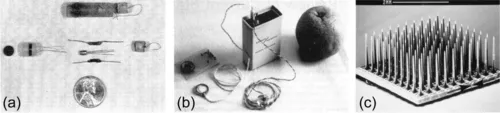
Figure 1.1 Implantable systems have increased in complexity with advances in electronics and electrode technologies, from (a) an implantable transmitter in 1959 [4], to (b) a cochlear implant in 1982 [7], to (c) a 100-channel microelectrode neural recording array in 1999 [11].
Today, researchers are designing diverse implantable devices for different bodily systems, as indicated in Figure 1.2. While some implantable devices fulfill a security role similar to biometric identification (e.g., PositiveID©, VeriMED, or Dangerous Things© xM1 implantable RFID tag) and use the host body mostly as a containment/transport vessel, the focus of this book is on implantable systems that can realize translational success in clinical disciplines. The functionality of these systems is rooted in the interaction between the human body parts and electrodes, sensors, and actuators such that a bridge between physiology and electronics is created. Currently, such systems are used in a broad range of clinical applications but most commonly for disease treatment and diagnosis. In the future, however, ...
Table of contents
- Cover image
- Title page
- Table of Contents
- Copyright
- Contributors
- Preface
- Part I: Design Principles for Bioimplantable Systems
- Part II: Applications of Bioimplantable Systems
- Summary and future work
- Index
Trusted by 375,005 students
Access to over 1.5 million titles for a fair monthly price.
Study more efficiently using our study tools.
Frequently asked questions
Yes, you can cancel anytime from the Subscription tab in your account settings on the Perlego website. Your subscription will stay active until the end of your current billing period. Learn how to cancel your subscription
No, books cannot be downloaded as external files, such as PDFs, for use outside of Perlego. However, you can download books within the Perlego app for offline reading on mobile or tablet. Learn how to download books offline
Perlego offers two plans: Essential and Complete
- Essential is ideal for learners and professionals who enjoy exploring a wide range of subjects. Access the Essential Library with 800,000+ trusted titles and best-sellers across business, personal growth, and the humanities. Includes unlimited reading time and Standard Read Aloud voice.
- Complete: Perfect for advanced learners and researchers needing full, unrestricted access. Unlock 1.5M+ books across hundreds of subjects, including academic and specialized titles. The Complete Plan also includes advanced features like Premium Read Aloud and Research Assistant.
We are an online textbook subscription service, where you can get access to an entire online library for less than the price of a single book per month. With over 1.5 million books across 990+ topics, we’ve got you covered! Learn about our mission
Look out for the read-aloud symbol on your next book to see if you can listen to it. The read-aloud tool reads text aloud for you, highlighting the text as it is being read. You can pause it, speed it up and slow it down. Learn more about Read Aloud
Yes! You can use the Perlego app on both iOS and Android devices to read anytime, anywhere — even offline. Perfect for commutes or when you’re on the go.
Please note we cannot support devices running on iOS 13 and Android 7 or earlier. Learn more about using the app
Please note we cannot support devices running on iOS 13 and Android 7 or earlier. Learn more about using the app
Yes, you can access Implantable Biomedical Microsystems by Swarup Bhunia,Steve Majerus,Mohamad Sawan in PDF and/or ePUB format, as well as other popular books in Technology & Engineering & Biomedical Science. We have over 1.5 million books available in our catalogue for you to explore.